The Charles Archive: Box Tree Cottage
- 2nd October 2018
This is the fourteenth in a series of blog posts celebrating the life and work of timber-frame building specialists F.W.B ‘Freddie’ and Mary Charles. Funded by Historic England, the ‘Charles Archive’ project aims to digitise and make more accessible the Charles Archive collection.
This blog explores the structure and form of Box Tree Cottage that once stood on Upper Street in Defford.
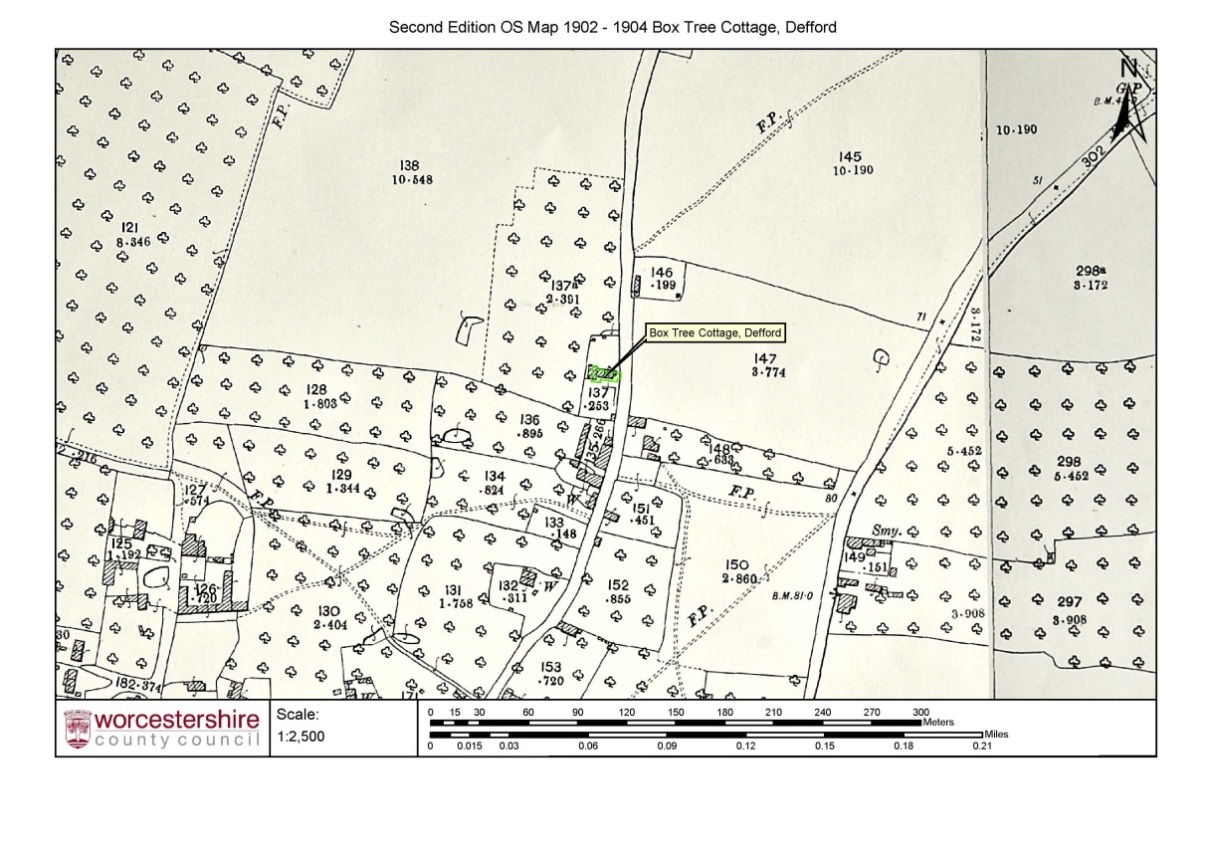
Second Edition Map showing possible location of Box Tree Cottage, Defford
The first thing to say about this building is that originally it was an open hall house potentially dating from the 13th or 14th century (Pevsner, 1968). An open hall house is a type of building that has a central hall that is open from floor to ceiling and wall to wall with further rooms either side, which are referred to as the upper and lower ends of the house. The central hall is a public space with the private space of the upper end of the house at one end and the kitchens and storage rooms of the lower end of house at the other (medarch.co.uk, 2018). Similarly to how a castle or stately home is laid out, you have the aesthetically pleasing bits of the house that you’d want guest to see at the front and all the domestic bits and servant quarters, at the back.
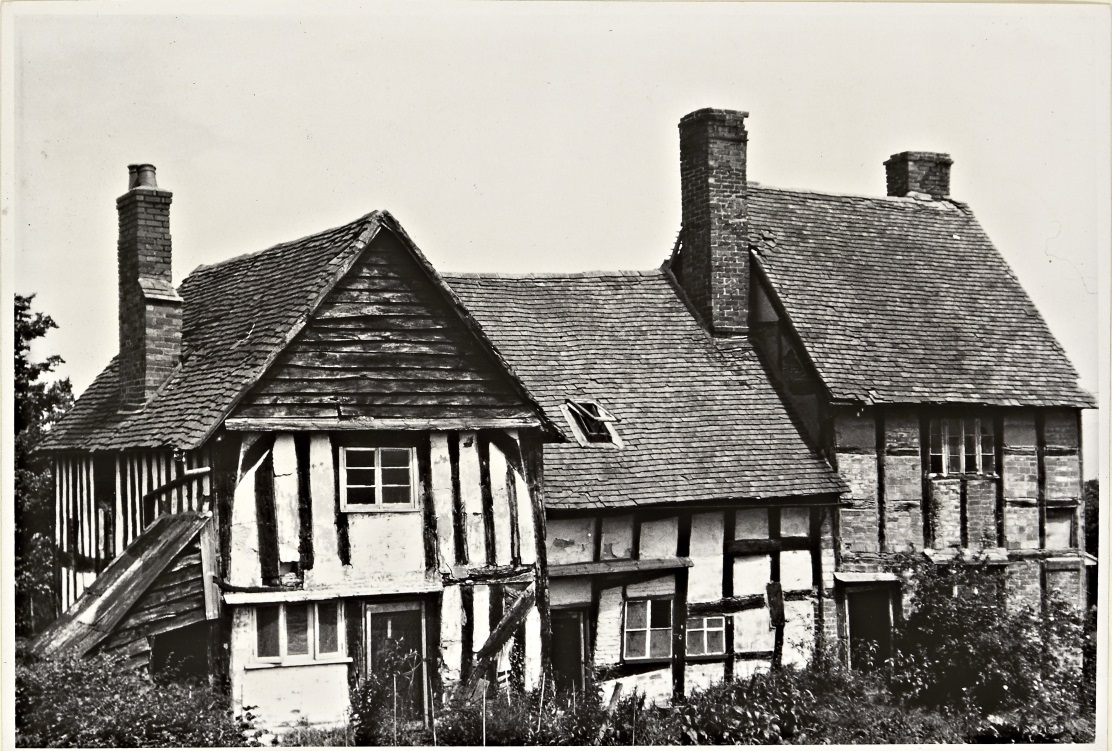
Digitised photograph of Box Cottage, Defford © Worcestershire Archive and Archaeology Service: Charles Archive Collection.
Box Tree Cottage had three distinct building phases, the earliest being the aforementioned cruck hall from, potentially, the 13th/14th century (Pevsner, 1968). The solar wing, the upper end, was added around 1500. This part of the house had close-studding on the outside walls, which means several pieces of upright timber are set close together to divide the wall into narrow panels, but these do not provide any structural support (Pevsner, 1968), (Charles, 1967). Basically, the more wooden uprights there are in a wall panel the more impressive and expensive the building appears on the outside, which tells people that this building is high status and owned by someone who can afford the extra materials.
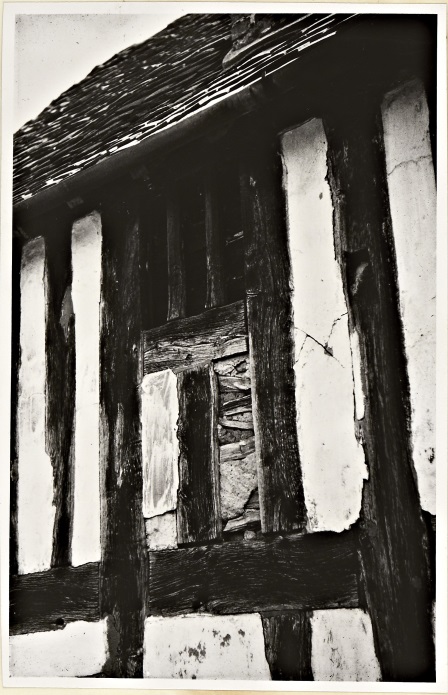
Digitised photograph of close – studding on the solar of Box Cottage, Defford © Worcestershire Archive and Archaeology Service: Charles Archive Collection.
In around 1650 a two storey extension with an attic was built at the lower end of the house to serve the upper parts. This latest addition was ‘brick nogged’, which means bricks were used to infill between the timber frame rather than wattle and daub, and the original 17th century fireplaces, doors and windows with ovolo mouldings were all intact (Pevsner, 1968).
One very distinct feature of medieval open hall houses is the open hearth that would have been at the centre of the hall. The roof would have been open above it to let the smoke out, but this area in the hall house would have been the main source of heat, prior to the later additions and fireplaces. Part of a wattle and daub smoke hood or flue, measuring some 7ft square, remained and within which the much later brick flue was built (Charles, 1967).
This building is mentioned in a research report as late as 1981 and was classified as a ‘True Cruck’. The definition of a true cruck describes the structural type in which paired cruck blades rise in a single sweep from floor or plinth to ridge (the internal roof space) (Alcock, 1981), (Charles and Horn, 1973).
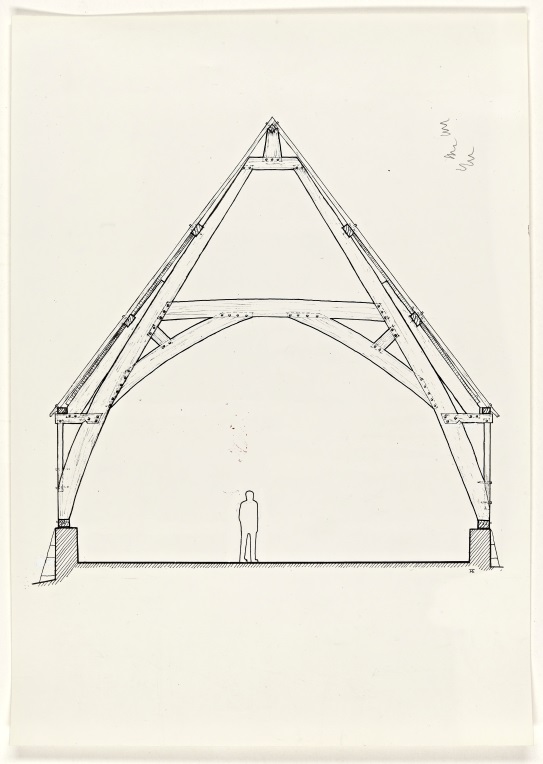
Digitised illustration of a ‘True Cruck’ from Leigh Court Tithe Barn © Worcestershire Archive and Archaeology Service: Charles Archive Collection.
In the mid 1980’s there were several residential developments on Upper Street and it is presumed this is when Box Tree Cottage was demolished to make way for modern housing.
Further Reading:
Alcock, N. (1981). Cruck Construction: An Introduction and Catalogue. Council for British Archaeology Research Report, 42, p. 122
Charles, F. W. B (1967). Medieval cruck buildings and its derivatives. London: Society for Medieval Archaeology.
Charles, F. W.B and W. Horn. (1973) The Cruck-Built Barn of Leigh Court, Worcestershire, England, Journal of the Society of Architectural Historians, 32 (1), pp. 5 – 29
Medarch.co.uk (2018). The Medieval Open Hall House. [online] Avaliable at: https://medarch.co.uk/open_hall.html#open [Access 26th September 2018]
Pevsner, N. (1968). The Buildings of England: Worcestershire. Harmondsworth: Penguin Books.


Post a Comment