Helena Bantock, a Woman in Her Own Right
- 6th April 2023
The pages of history are filled with the achievements of men and less so women. In no period is this more evident than the late 18th and early 19th centuries, where gender roles were sharply defined and the Victorian notion of seperate spheres for men and women prevailed.
Born in Pancras, London on 21st November 1868, Helena Franceska Maud Schweitzer was an artist and published poet; though she lived a life often overlooked in the shadow of her husband, acclaimed composer Sir Granville Ransome Bantock. The daughter of Carl Adolph Herman Schweitzer and Frances (Fanny) Jane Ellerby, Helena could well have been a household name alongside her spouse had she not lived in an age categorised by gender inequality. She was a promising painter, and Worcestershire Archive & Archaeology Service holds an impressive self-portrait in oils by her – a beautiful work still in its original frame. A sketchbook and musical notebook also in the Bantock Archive further evidence her artistic abilities.
Self-portrait (c.1893) was painted a few years before Helena married Bantock and hung for many years in their son Raymond’s home in Barnt Green, Worcestershire. Our archive is the appropriate place for the work where it sits alongside other oil paintings of Bantock relations, passed to us after the family home was sold in the 1980s.
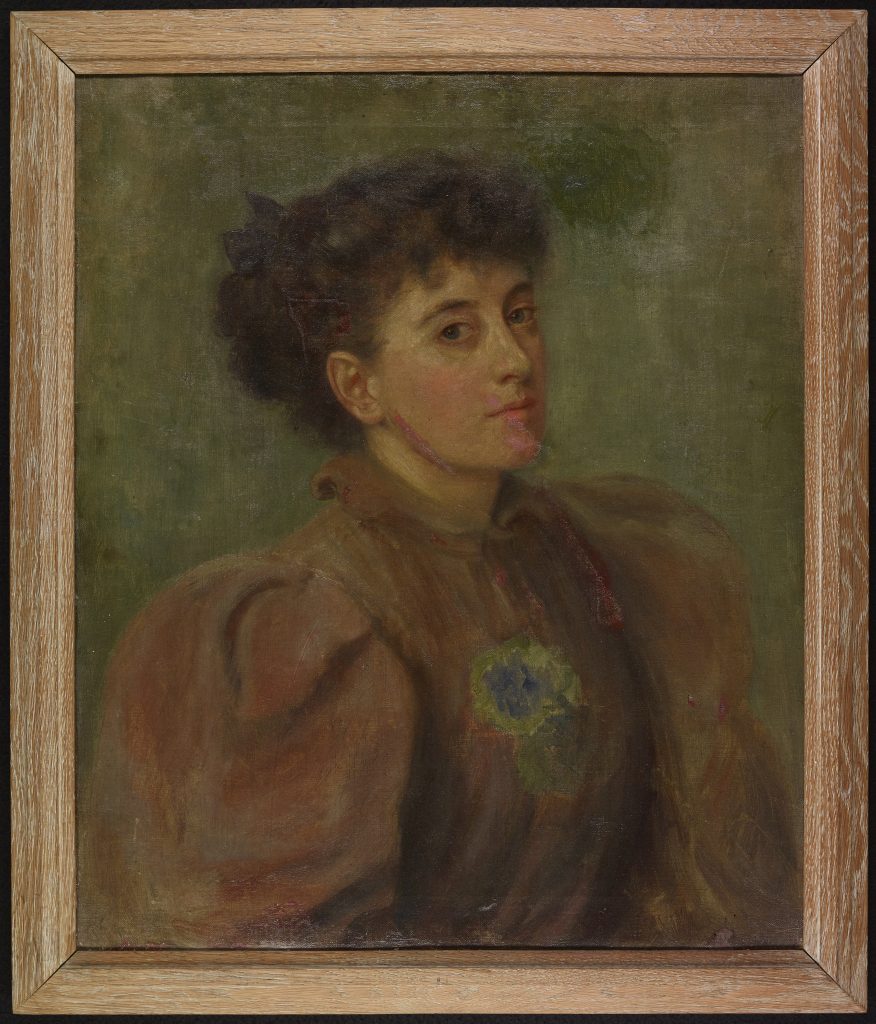
Self-portrait of Helena Bantock (nee: Schweitzer), c.1893: 705:462, BA15859
Helena, often called Helen, first met Bantock in 1886 at an afternoon tea-party given by a mutual friend of both the Schweitzer and Bantock families, though they would not meet again until 1896, or marry until 1898. Their relationship was one of combined artistic interest that resulted in many musical collaborations. Helena was actively involved in the creation and promotion of her husband’s music, and many of his successes were composed to poems written by her, sitting her alongside William Blake and Robert Browning when it came to his literary inspiration.
Bantock worked often on songs composed to verses by Helena. In 1897 he wrote almost exclusively to them. Also in 1897, The Love-Philtre and other poems by Helen F. Schweitzer was published. Until recently, the authorship of two of Bantock settings to the poems Love’s Sacrament and Sun and Shadow were unknown. We now know that these were in fact texts taken from Helena’s collection. The Helena Variations – an 1889 orchestral work dedicated by the composer to his then young wife – is another example of Bantock writing music to his wife’s texts.
Bantock’s diaries – also deposited with us – record numerous other examples including The Ship of Dreams and The Moon in 1923, and Norway National Song in 1940. Helena also arranged the music to Two Chinese Songs – a piece published in 1909 by Breitkopf & Härtel – the world’s oldest music publishing house. It is also well documented that the Bantock epic Songs of the East was a collaboration between husband and wife. It was widely felt within the Bantock family, however, that Helena had more talent as a painter than a poet, and it was a shame her husband encouraged her to stop this and focus on writing poetry for him to set music to. Her interest in painting is perhaps unsurprising given her grandfather was the English portrait artist Thomas Ellerby.
Helena died on 17th December 1961 at her Sherriff Cottage home in Barnt Green. Perhaps she was content – producing poetry as a by-product by her deep love of literature and marriage to a creative kindred spirit. Or perhaps she felt eclipsed – forced to give up a career as an artist to support her husbands. We can only assume; but we can certainly acknowledge her talent.
This is the first of a series of four blogs about the Bantock Archive at Worcestershire Archive and Archaeology Service, which we will be publishing throughout April.
Self-portrait by Helena Schweitzer, Sketchbook of Lady Bantock and Music notebook of Miss H. Schweitzer (Lady Bantock) are available to research. Please submit an enquiry at ArchiveEnquiry (worcestershire.gov.uk) or speak to someone on the desk if you would like to enquire about accessing these records.


Post a Comment