Powick Hospital: Worcestershire’s first County Pauper and Lunatic asylum
- 17th December 2025
Delve into the establishment and history of Powick Hospital, along with the types of records we hold for those patients admitted. As we come towards the end of a 2 year project to catalogue a range of public records as a result of New Burdens funding, we turn our attention to records held on behalf of Herefordshire and Worcestershire NHS Trust.
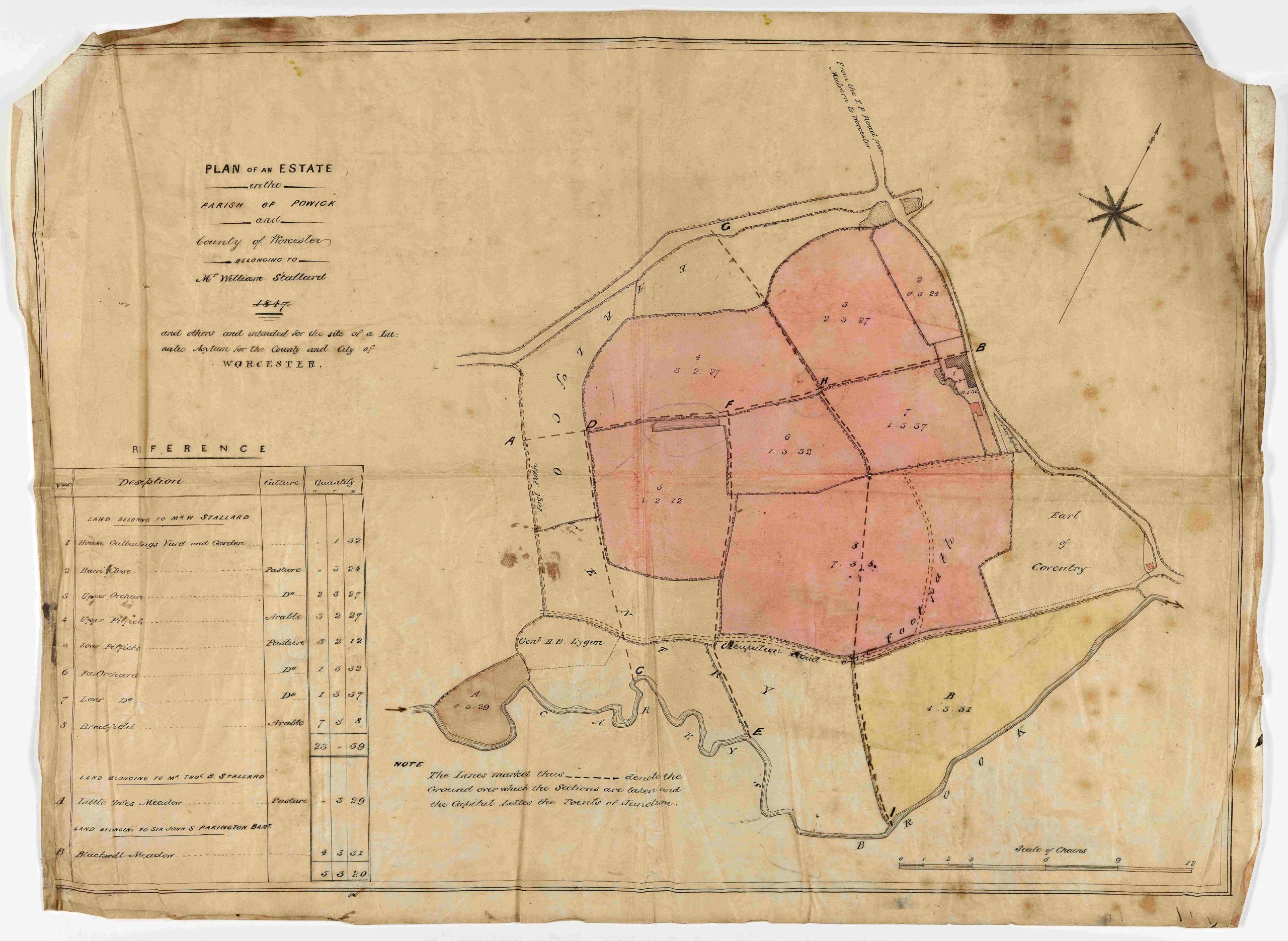
Plan of land once belonging to Mr William Stallard upon which Powick Asylum was to be built c1847 BA652/2
Under the Public Records Act, as an appointed place of deposit, we hold records of historical value for permanent preservation on behalf of Worcestershire County Council and specific local statutory bodies. This includes Herefordshire and Worcestershire NHS Trust and covers patient files for Powick Hospital, previously called Powick asylum. Cataloguing of patient files has recently got underway, which includes notes of patients covering the period 1890’s-1980’s. These are amongst the latest of records we have received, and they join a wealth of existing collections about the administrative and management of Powick, as well as admission and discharge registers and volumes containing patient case notes. An outline of existing Powick Hospital records can be found via our online catalogue at Powick Hospital which include summary descriptions.
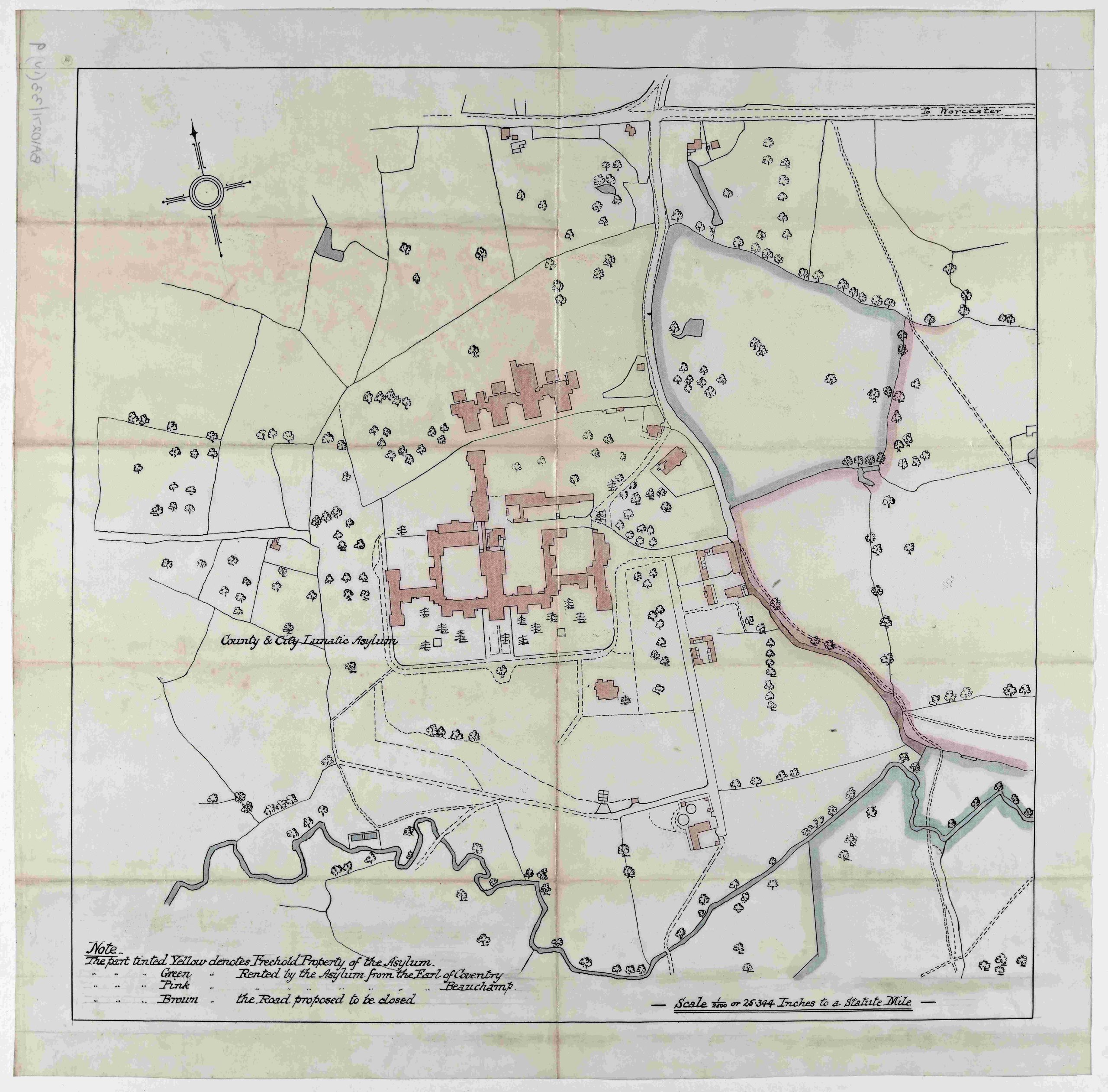
BA10271(iv) 33/9 Plan of Powick Asylum and Grounds © Herefordshire and Worcestershire NHS Trust
Creation of Powick Hospital
Powick asylum opened on the 12th August 1852, 7 years after the Lunacy Act made it compulsory for Public Lunatic asylums to be built in England and Wales. County asylums were created for “pauper lunatics” from primarily working class families who couldn’t cope. There were a wide variety of private institutions at the time, but as Michelle Higgs writes in ‘Tracing Your Ancestors in Lunatic Asylums’, when Worcester County Lunatic Asylum opened, both Dudley Union Workhouse and Droitwich Asylum almost immediately transferred their pauper lunatics. Higgs states “The inference is clear: it was cheaper to accommodate pauper lunatics in a county asylum rather than a private institution.”
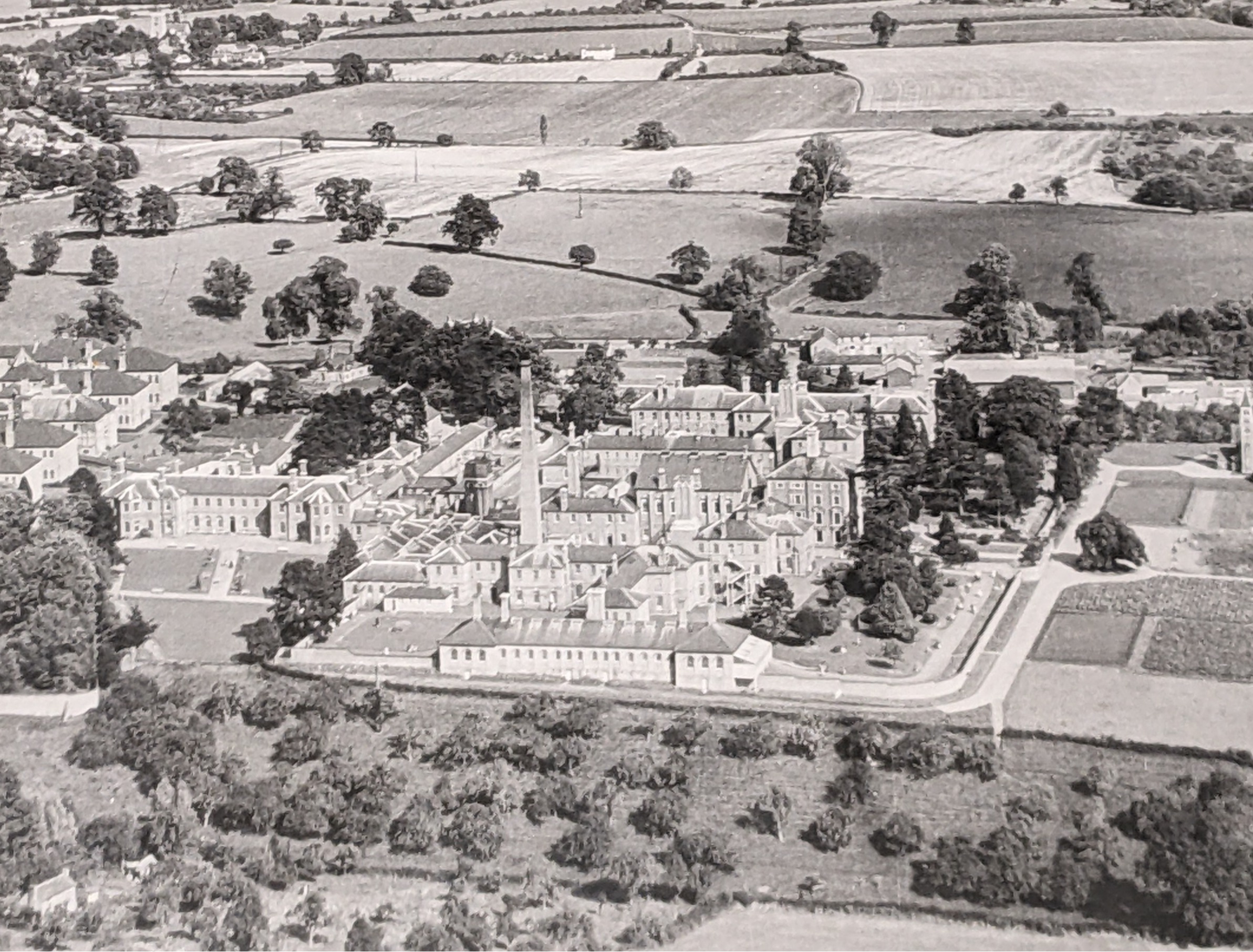
Powick Hospital, Former City and County Lunatic Asylum, from the air c.1949 copyright unknown WPS 951
Private asylums that chose not to take paupers on the other hand were marketed as being more comfortable than the county asylums. An advertisement for Ashwood House, Kingswinford, Staffordshire circa 1879 states that the rooms were “large, lofty and cheerful” and “entirely the air and character of a gentleman’s private residence”.
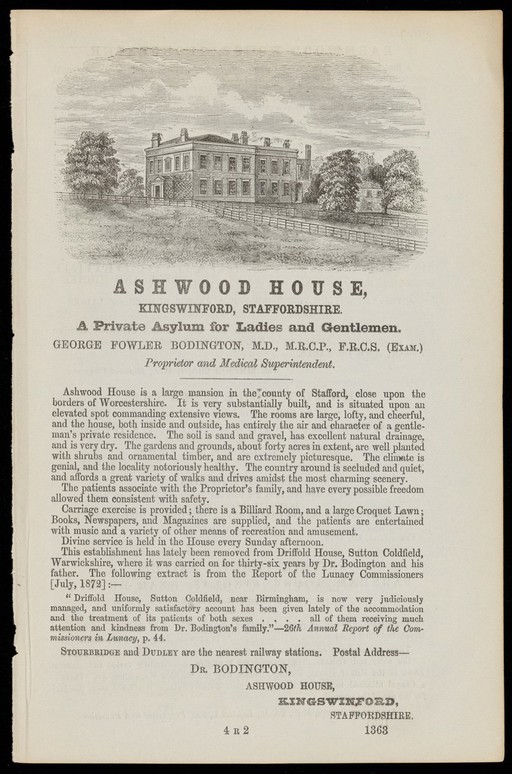
Advertising leaflet for Ashwood House, c. 1879. Wellcome Collection © CC BY 4.0 Available at Europeana.eu
Whilst cost may have been a factor, the construction of county asylums such as Powick were designed in the Victorian period as benevolent and compassionate facilities for vulnerable people. They were part of the Moral treatment approach to mental disorder, which was based upon the latest scientific and medical knowledge of the day. The county asylum was defined as an ‘institution for the shelter and support of afflicted or destitute persons, in particular, for the insane’ and were part of the Victorian fabric of society alongside workhouses, prisons, hospitals, boarding schools, public parks and cemeteries. It is important to note as well that each had its own community, with a large building, park and gardens and was intended to be therapeutic and to help cure patients.
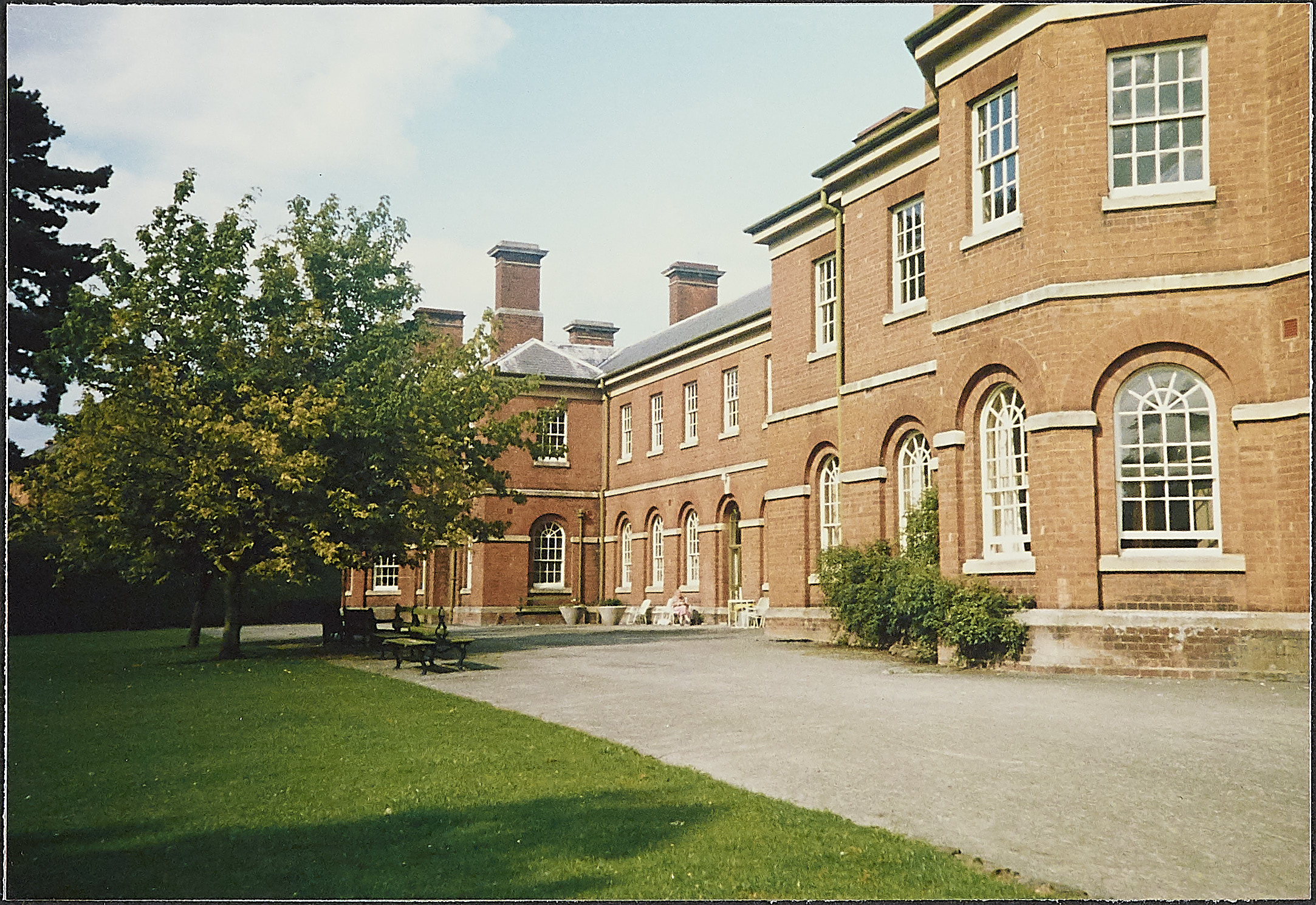
Powick Hospital, Former City and County Lunatic Asylum. Exterior. c.1989 Finding No: 899:156 BA1332 WPS 61632 © Dr. P. Hall, Herefordshire and Worcestershire NHS Trust
Early days
Dr Peter Hall writes in ‘The History of Powick Hospital’ that the nursing attendants were all artisans, e.g. tailors, shoemakers, bakers, butchers and carpenters. Male and female staff weren’t allowed to mix and were fined one penny for every three minutes they were late for work and worked 20 hours out of 24 for a wage of about £20.00 a year. A summary of the typical day observed with the ringing of the bell is shown below taken from Rules and regulations – Attendants and servants of Powick Asylum dated 1888.
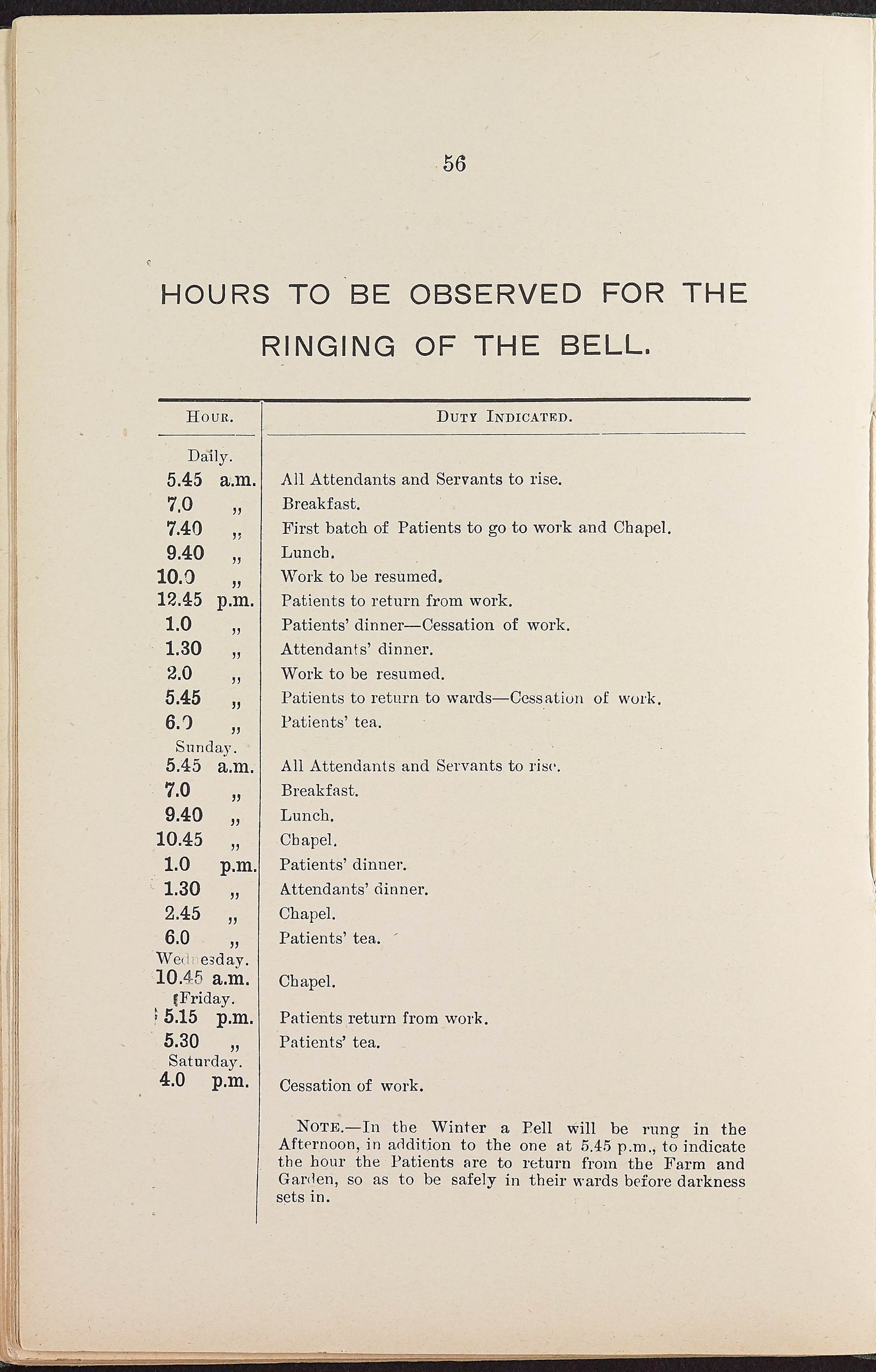
Rules and regulations – Attendants and servants, c.1888 p.56 Finding No: 499:9 BA10371/1(v) © Herefordshire and Worcestershire NHS Trust
Hospital rules were initially very strict, for instance, the on-site library originally consisted of books of a religious nature only. However, this changed – the library was later supplemented with more secular books and even weekly publications, and patients and staff were also allowed on excursions. In 1862 on the occasion of the wedding of the head male attendant, a ball was held in the laundry, where upwards of 150 patients were regaled with plum cake and gin punch and dancing took place from 7 o’clock until 11.30pm! Powick also had its own ballroom where events regularly took place.
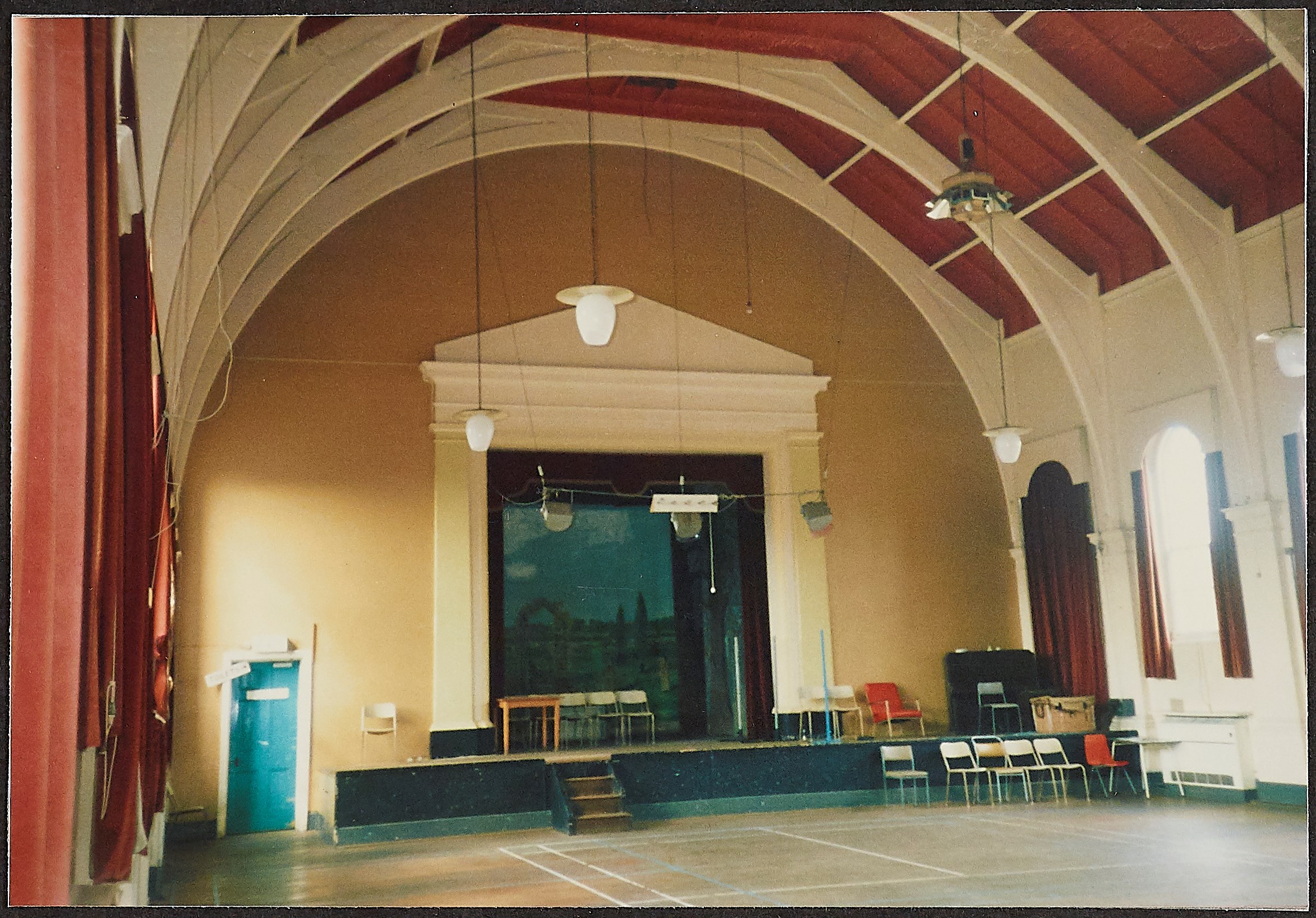
Powick Hospital, Former City and County Lunatic Asylum. ballroom. c.1989 Finding No: 899:156 BA1332 WPS 61624 © Dr. P. Hall, Herefordshire and Worcestershire NHS Trust
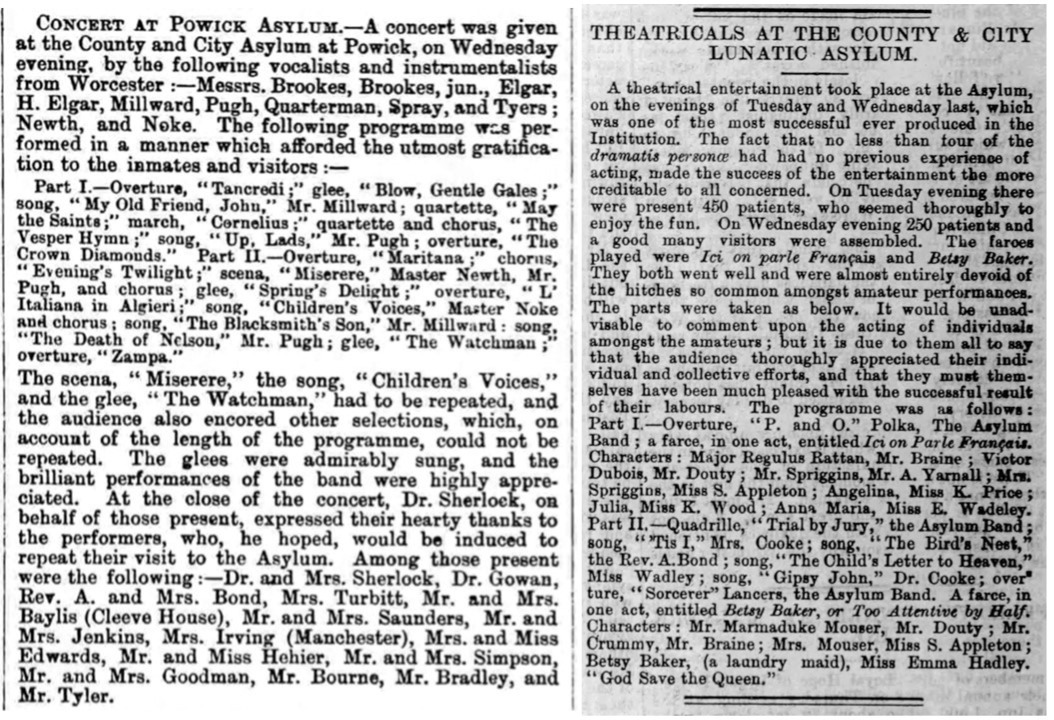
Concert at Powick Asylum which included mention of the Elgar family in the Berrow’s Worcester Journal 19th April 1873 and mention of the Asylum Band in The Worcester Herald dated 11th August 1884 © Newsquest
Powick had its own very own Asylum Band, with regular performances. In fact, Sir Edward Elgar’s first job was that of Band Master at the asylum, with a salary of £36 per annum. A newspaper article from the Berrow’s Worcester Journal in 1873 mentions a concert given at Powick Asylum. Two members of the Elgar family are listed, although these aren’t the official band. They are described as a group of ‘vocalists (singers) and instrumentalists’ and it is most likely referring to Henry Elgar, Elgar’s father and his uncle or brother. Elgar began by playing violin with the asylum band, before taking over as Band Master in 1879.
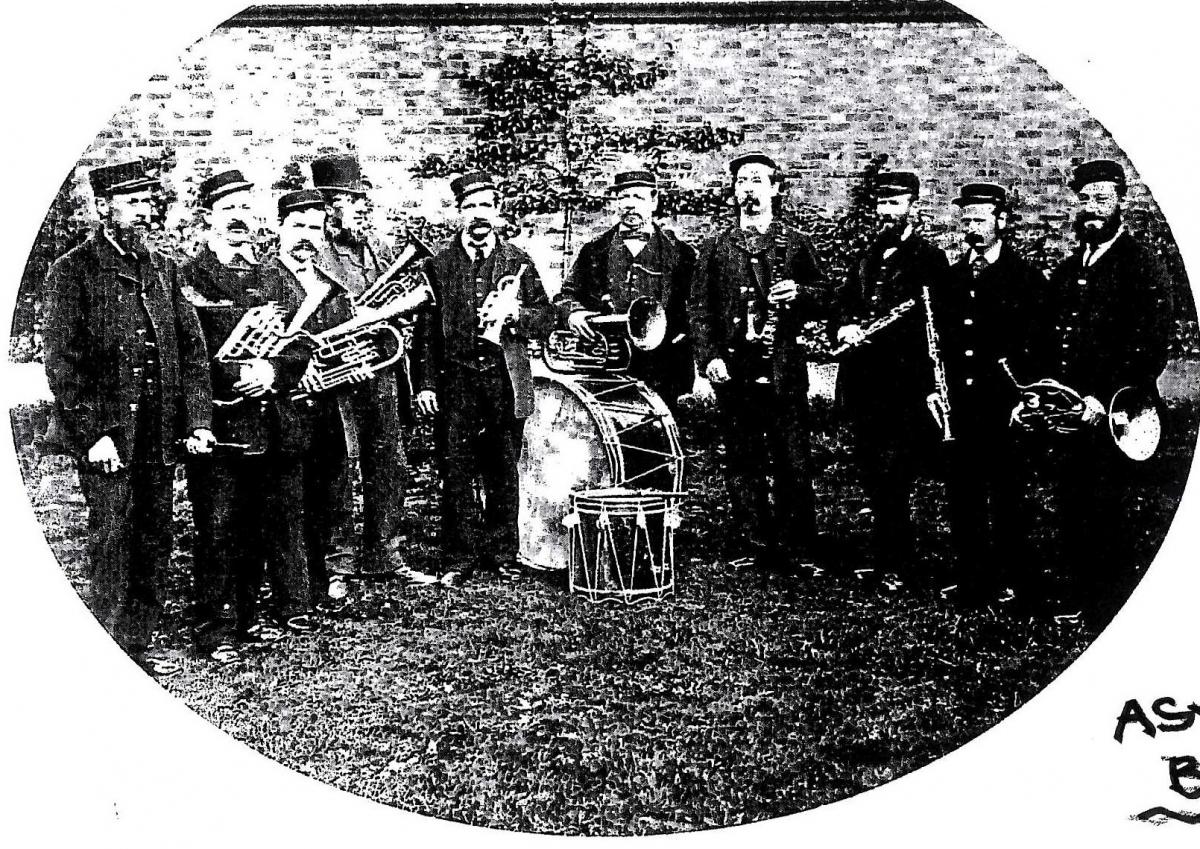
Asylum Band, early 20th century © Newsquest
Growth of mental health hospitals
Across England, there were 5247 Pauper patients housed in 21 publicly funded asylums in 1847, but by 1914 this had risen to 108,837 patients in 102 asylums, with 1000 patients per institution on average. Powick Hospital, as it was renamed in 1890, was no exception. It had to be enlarged and become more institutional, in the view of Dr Peter Hall, with the extensions being very different to the original Georgian building. As Malcolm Penny describes ‘In The Cuckoo’s Nest?’, by 1898 Powick held over 1000 inmates in wards designed to house 200. The Commissioners decided another asylum was needed, which became Barnsley Hall Hospital.
Image: 226.02 BA181/5 Proposed Plan of Powick Asylum c.1907 © WAAS
Barnsley Hall Hospital
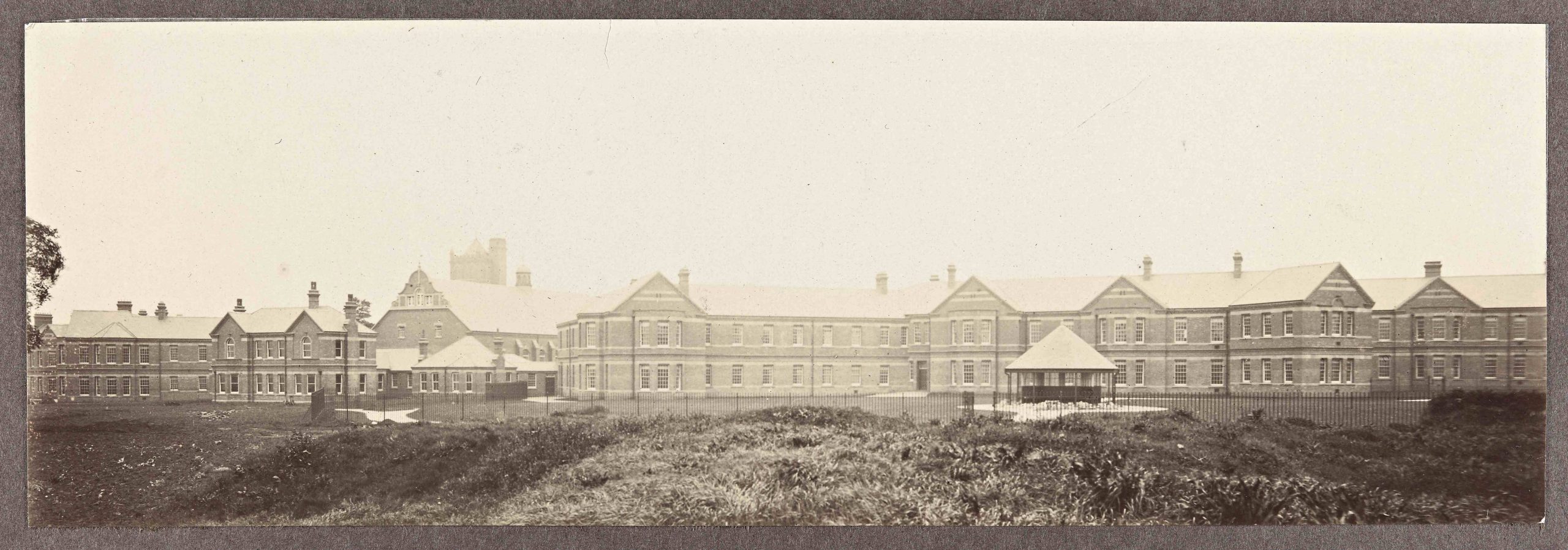
Barnsley Hall taken on the opening of Barnsley Hall c.1907 Finding No: 899:1170 BA11923/3ii/2 © WAAS
It was decided that the Barnsley Hall Estate near Bromsgrove, with its324 Acres and sale price of £17000, was suitable for a new hospital and the site was purchased by the County Council. The hospital was formerly opened on June 27th 1907 by the Earl of Coventry and one of the publicity images taken prior to its opening is shown above. According to Alfred Holden ‘In the Cuckoo’s Nest?’, the technology of the buildings was state of the art for its time and to ensure a reliable water supply, two boreholes were dug, with steam pumps to lift water into tanks high in the tower, with a capacity of 58,000 gallons. This was enough to supply up to 7000 gallons an hour to all the buildings. The heating and hot-water supply incorporated an electricity generated system which remained fully functional to the end of its life.
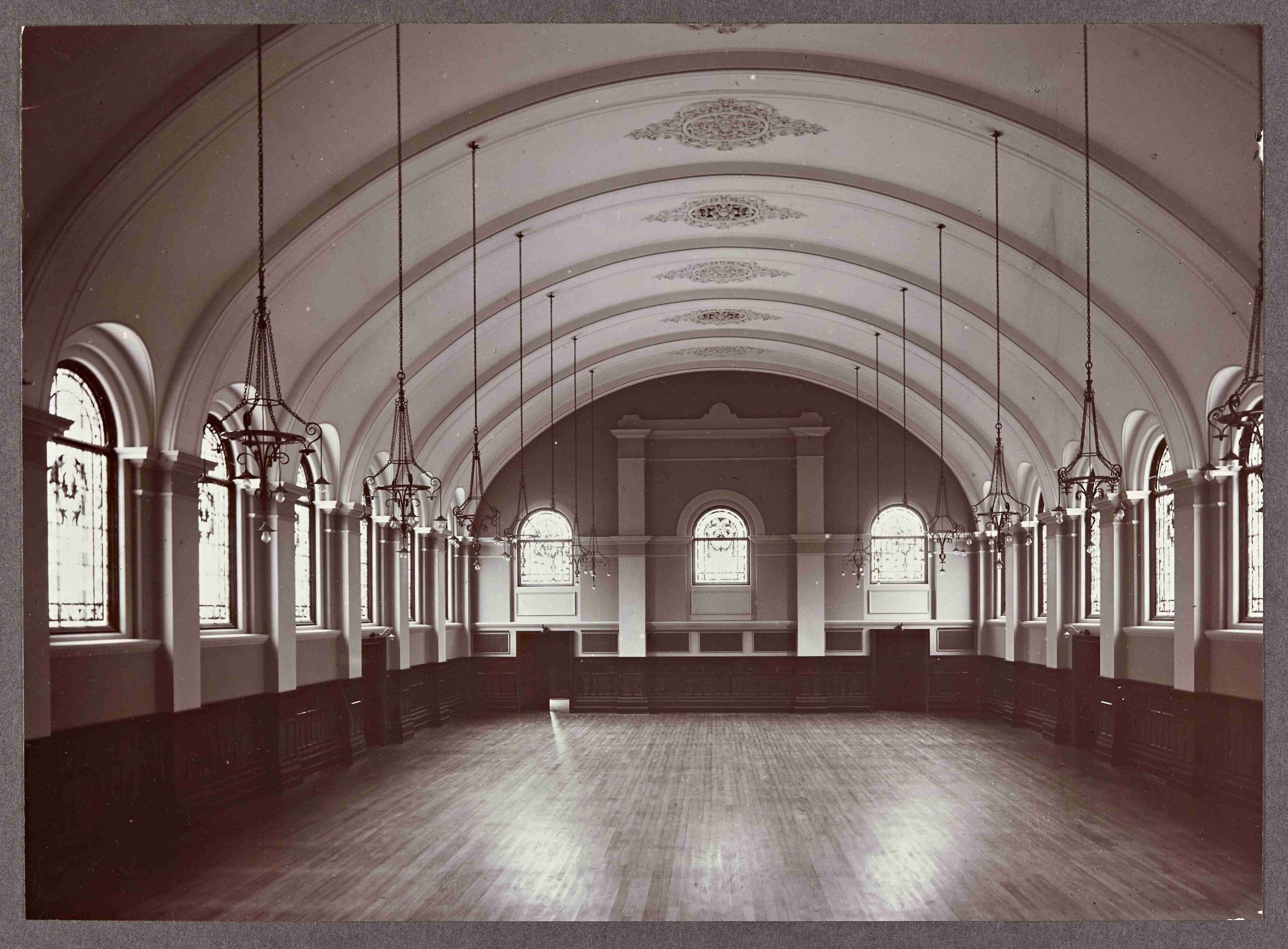
Barnsley Hall ballroom or Recreation Hall on the opening of Barnsley Hall c.1907 Finding No: 899:1170 BA11923/3ii/7 © WAAS
Barnsley Hall, like Powick, had a Recreation Hall or ballroom for events and it was even grander than that of Powick Asylum. As Alfred Holden explains, it provided entertainment for both patients and staff and was used for cinema films, dances, concerts and whist-drives. Holden states it was one of the finest ball room and concert halls in the Midlands with a pitch pine dance floor, a stage with many scenes and drops from a woodland scene to a farmhouse kitchen. Many well known concert parties and pantomimes gave their performances for free. Every week, patients had a cinema show, dance and often a variety show or pantomime.
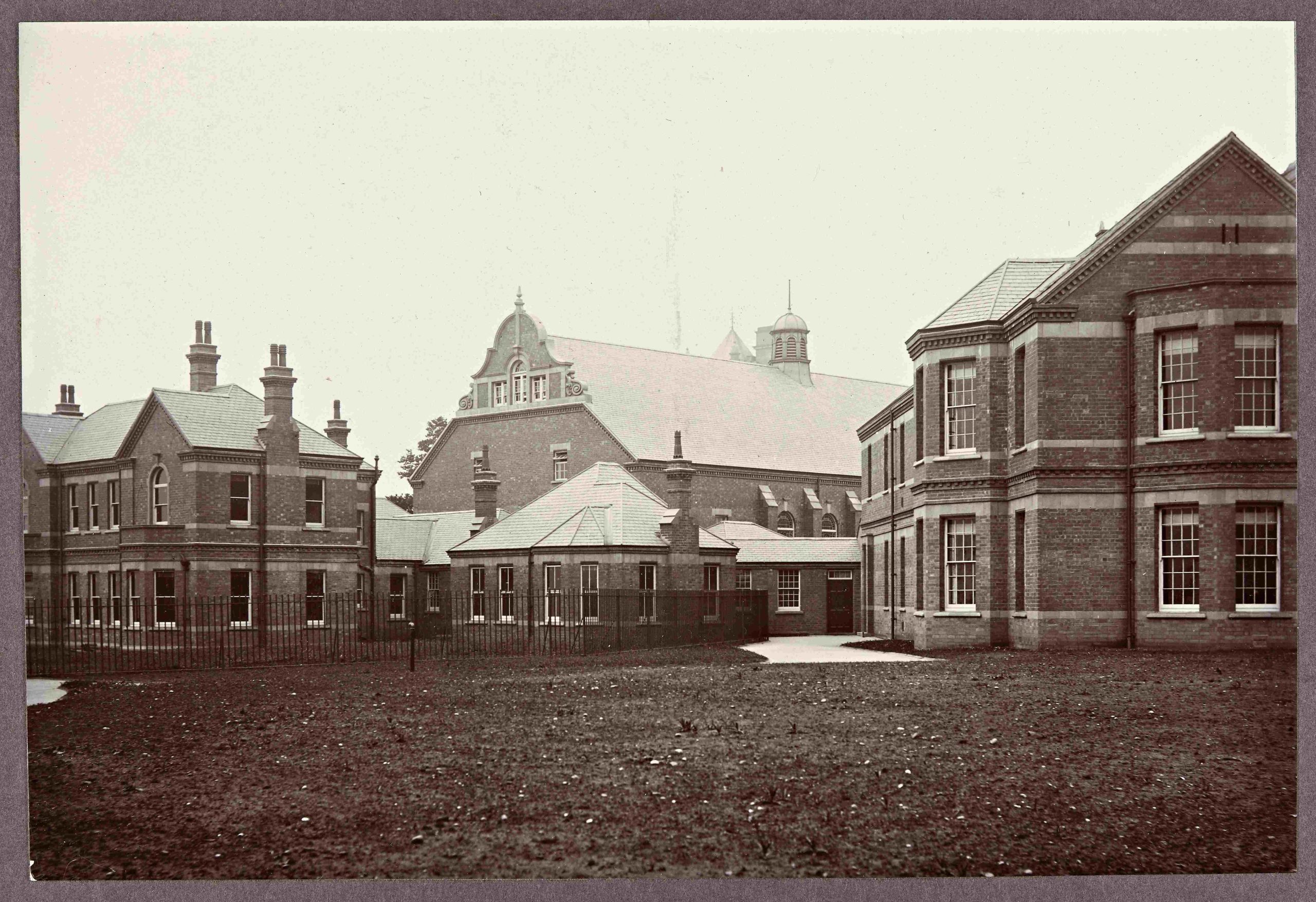
Barnsley Hall, Bromsgrove c.1907 Finding No: 899:156 BA1332 WPS 72449 © WAAS
Impact of the World Wars
Both Powick and Barnsley Hall hospitals were impacted by the First and Second World Wars, with 1327 patients at Powick by 1916 and many members of Powick staff serving at the front line. There were challenges in recruiting enough nurses for Powick in 1917 alongside the appointment of the first female Medical officer.
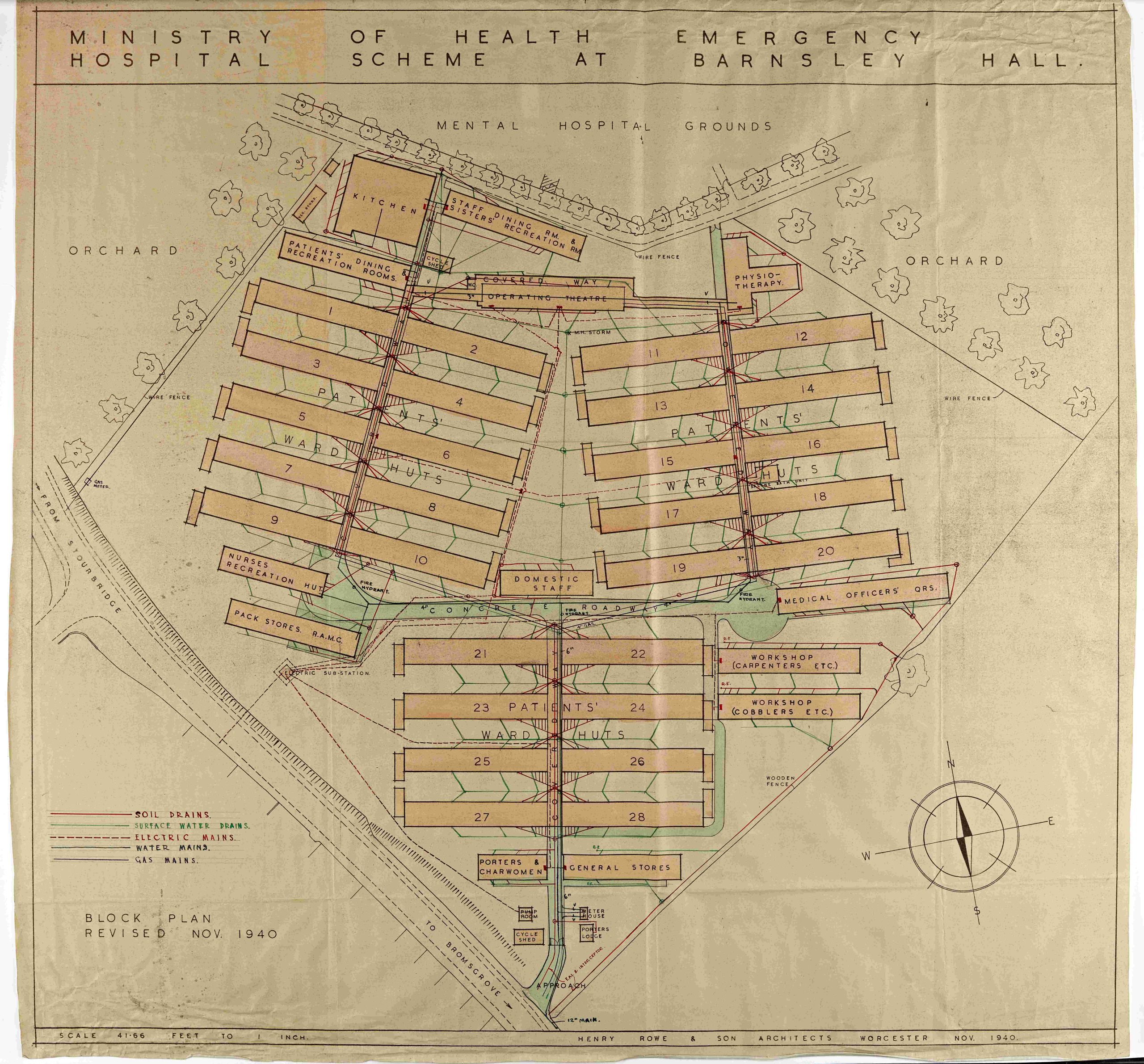
Ministry of Health Emergency Hospital Scheme at Barnsley Hall, Bromsgrove c.1940 Finding No: 226.02 BA793/1 © WAAS
At Barnsley Hall during the Second World War, an Emergency Medical Services (EMS) Hospital was built on the grounds. This followed a memorandum by the Ministry of Health to all selected hospital authorities and voluntary hospitals that “Room is to be made for the reception of casualties in one wing or block of most of the mental hospitals in the country, and a few selected mental hospitals are to be completely cleared of their ordinary patients”. According to WJ Holden, the EMS Hospital that was built at Barnsley Hall had a capacity of 1,000 not the 800 anticipated at the start of the war, with 400 more patients cared for within the old hospital buildings.
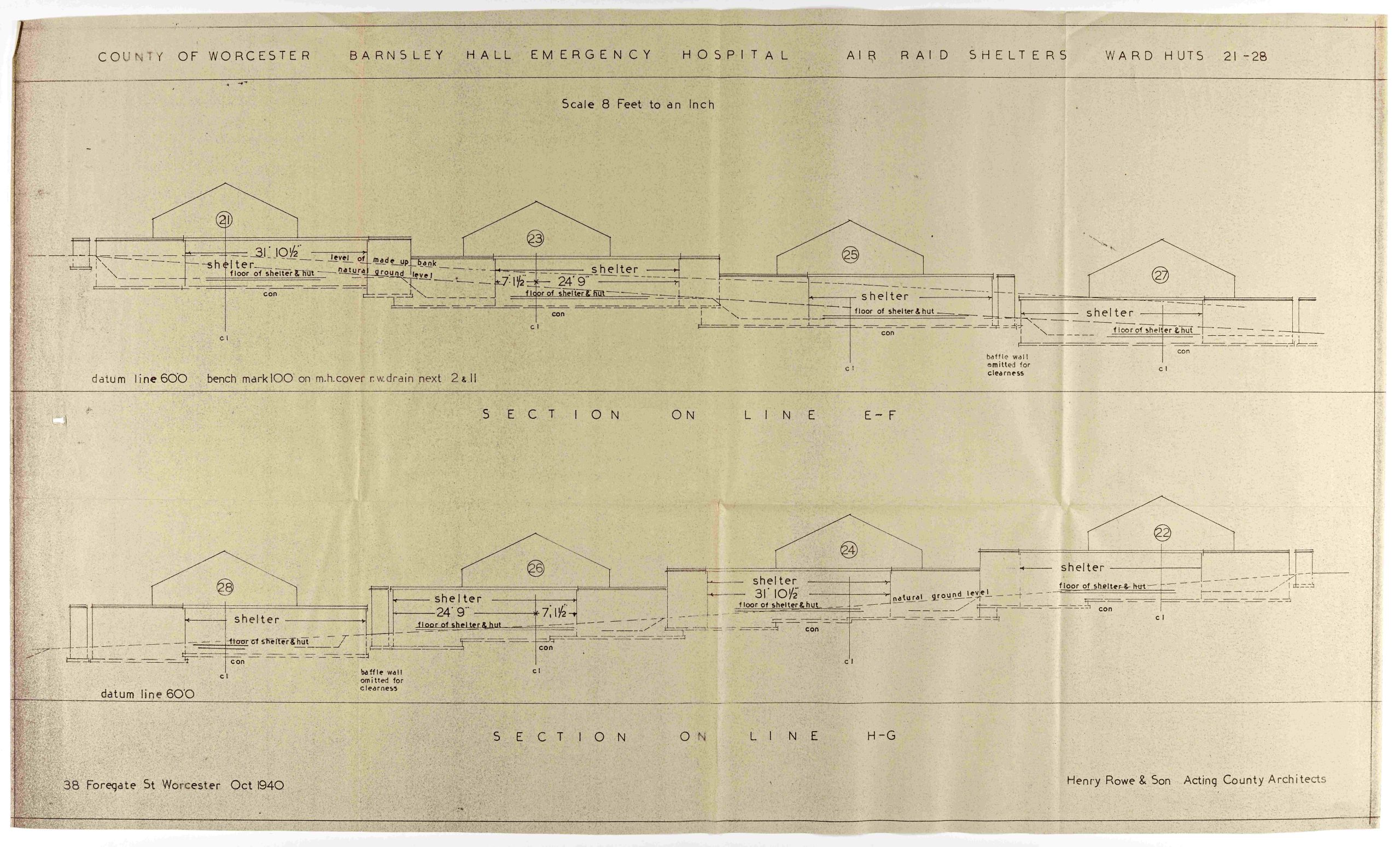
Emergency Hospital Scheme at Barnsley Hall. Plan of air raid Shelters c.1940 Finding No: 226.02 BA7941/9 © WAAS
Powick Hospital post-war
As reported by Dr Peter Hall, Powick Hospital underwent various changes in clinical practices through the years, such as the use of LSD treatments, alongside pioneering treatments for schizophrenia proposed by Dr Arthur Spencer, Medical Superintendent appointed in 1950. The Nursing School was revived the same year. Hall writes that his appointment to Powick in 1963 by the University of Birmingham and health authority led to stronger links between them. Powick ceased admitting patients on the 5th December 1978 and closed on 7th March 1989.
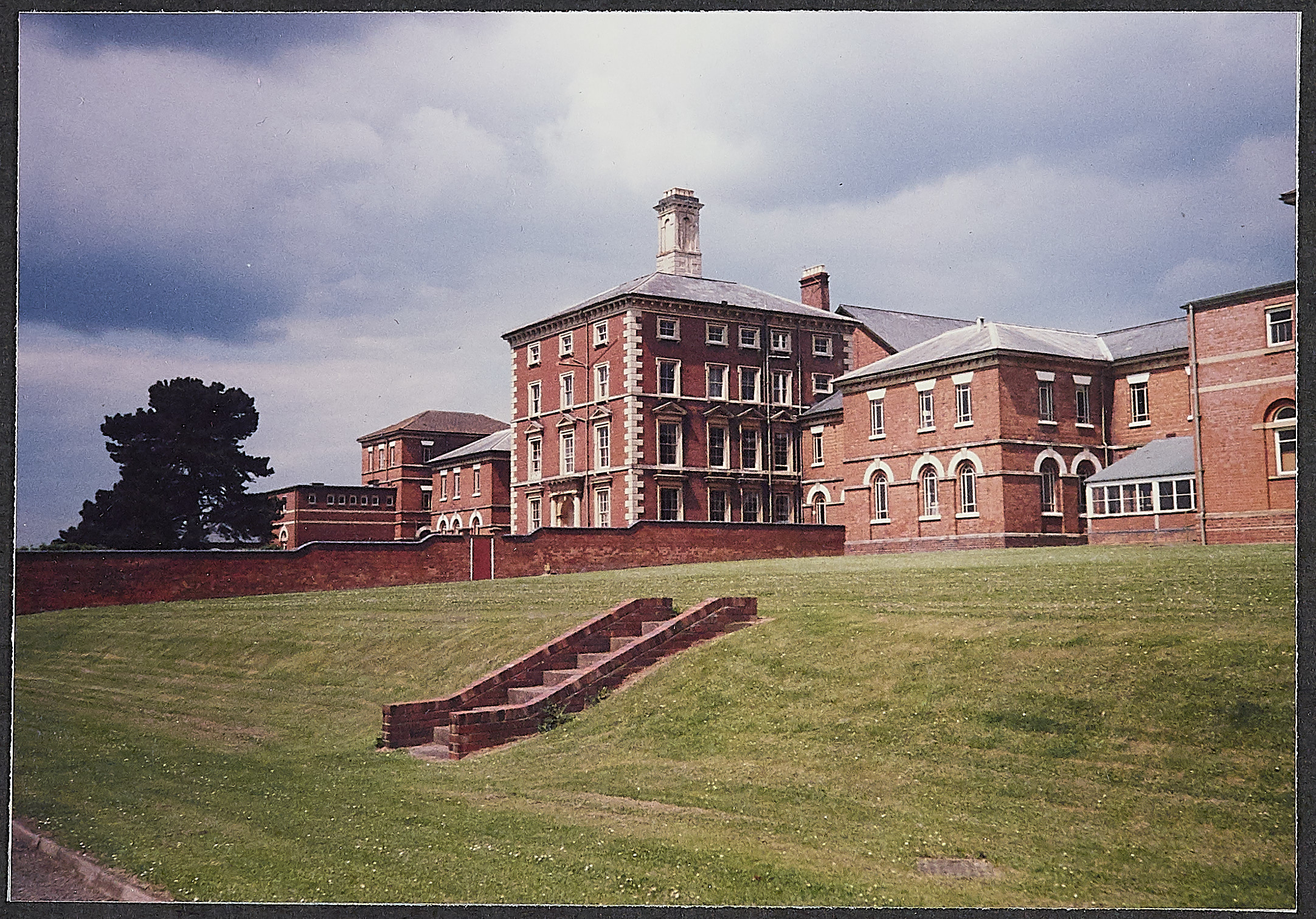
Powick Hospital, Former City and County Lunatic Asylum. Exterior. c.1989 Finding No: 899:156 BA1332 WPS 61611 © Dr. P. Hall, Herefordshire and Worcestershire NHS Trust
Keep an eye out for future blogs, where we will look into the individuals admitted to Powick over 100 years ago. For those curious or concerned about more recent patient records, please be aware that these are closed to public access under the Data Protection Act to protect living individuals.
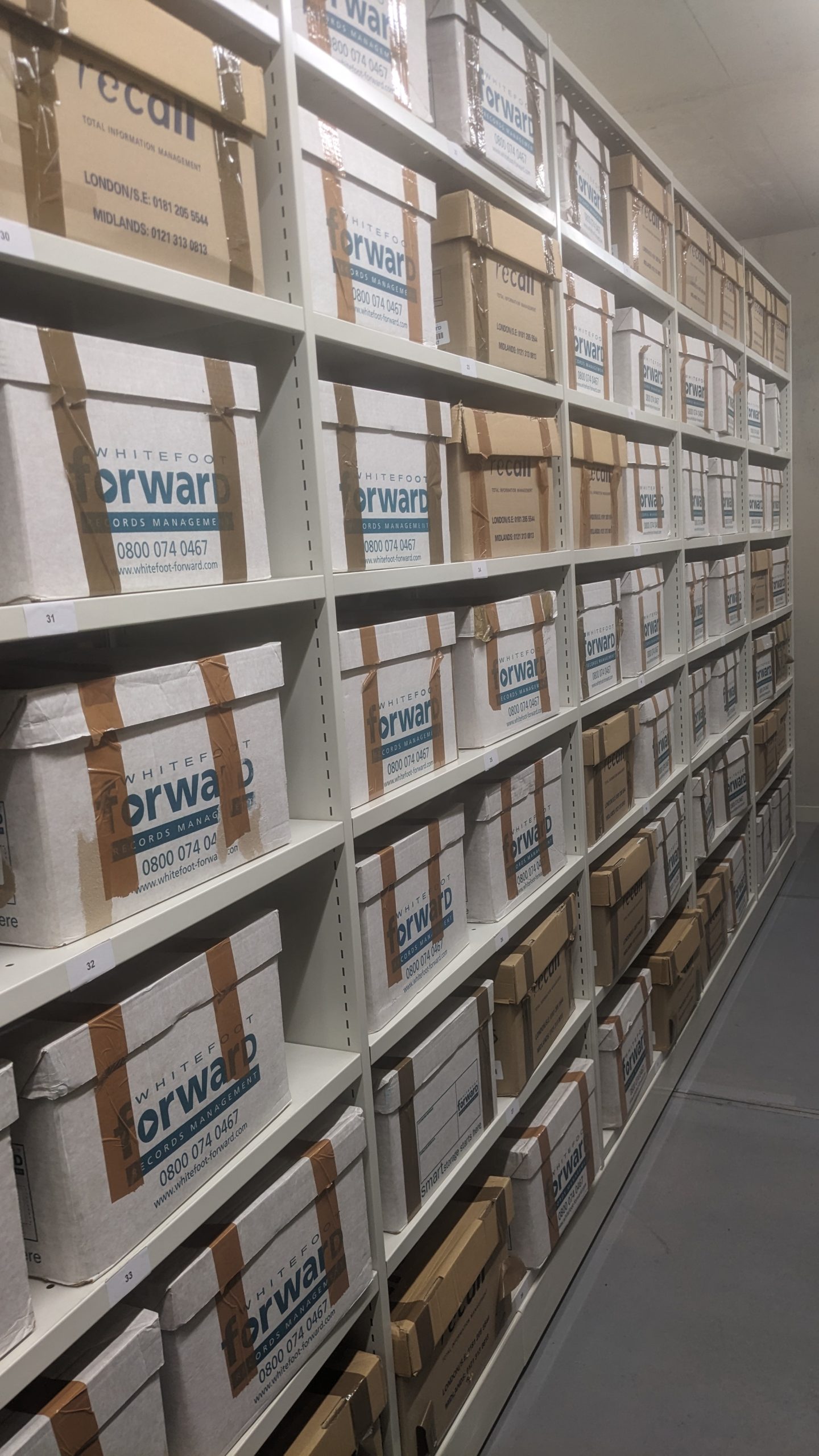
Powick patient files awaiting cataloguing in one of the strongrooms © WAAS
Acknowledgements
The New Burdens funding received from The National Archives has made the cataloguing of Powick patient records possible, alongside other public records, as a change in legislation has temporarily created a higher volume of records to process.
We acknowledge the kind permission and support of Herefordshire and Worcestershire NHS Trust along with Sarah Dentith for her research concerning Sir Edward Elgar at Powick Asylum and its wider history.
Sources used:
- Rutherford, Sarah The Victorian Asylum. Available at L362.2109, Local Studies Collection
- Higgs, Michelle Tracing Your Ancestors in Lunatic Asylums. Available at L362.2109, Local Studies Collection
- Compton, Frank and Leach, Katie Pauper Lunatics at Powick Asylum, Worcester 1852-1918: An Exploratory Monograph. Available at L362.21094244, Local Studies Collection
- Hall, Dr. Peter The History of Powick Hospital. Available at L362.210942447, Local Studies Collection
- Holden, A.J., Holden W.J. In the cuckoo’s nest?: Barnsley Hall, Bromsgrove: from lunatic asylum to Mental Health Care Unit 1907 to 1999. Available at L362.210942442, Local Studies Collection


You write of Elgar’s Bandmastership at the Powick Asylum, ‘few. if any, biographies of Elgar mention this about his early musical career – an air of stigma perhaps, or they simply weren’t aware of this.’ This is completely inaccurate. Elgar’s connection with the asylum is mentioned in the first major article about him, in the Musical Times of October, 1900, together with an example of music he wrote for the band. It is mentioned in the first Biography of Elgar published in 1905 (p. 21), and in ‘Elgar, his Life and Works, ‘ by Basil Maine, (1972 edition, pp35-36,) ‘Elgar, O.M.’ by Percy Young, (Collins 1955, pp. 46-47), ‘Elgar, his Life and Music’ by Diana McVeagh (Dent, 1955, p 10), ‘Elgar’, by WH Reed, (Dent 1939, p 13), ‘Portrait of Elgar,’ by Michael Kennedy (OUP, 1968, p.10), ‘Elgar,’ by Robert Anderson (Dent, 1993, p. 11) and ‘Elgar: A Creative Life,’ by JN Moore, (OUP, 1984, p.82)
There was no stigma about the Asylum, either on Elgar’s part or that of his biographers. The importance of the Asylum post for Elgar’s creative development, which all these biographies acknowledge, was that it taught him how to compose music for a disparate and often eccentric combination of instruments. The d dances he composed for the Asylum Band have been recorded on ‘Edward Elgar: Music for Powick Asylum’ Somm CD 252.
Thanks for sharing this detailed information and demonstrating that Elgar’s time at the Asylum was mentioned in more than one of his Biographies. We strive for accuracy as much as we can and clearly this was not investigated fully enough at the time. This has now been removed and updated appropriately.
My grandfather was at Powick 1973/4 time. I would love to find his records. How do I go about this?
Hi Helen, patient records under 100 years old are closed to the public under the Data Protection Act. If your relative is deceased these records would still be closed as the registers may contain details of individuals who are still alive. To gain access to information you would need to get permission from the NHS Trust whcnhs.caldicott@nhs.net
Once you have this permission you can contact us via our website and the NHS Trust will then send redacted copies to you. Hope that helps, but you can always get in touch with the Archive team via our ‘Contact us’ page if you want to discuss this process further.
Thank you!
I appreciate that your focus was on the Asylum itself.
Some of the biographies tell of how Elgar liked to deflate sycophants by beginning a conversation ‘When I was at the Asylum . . . ‘