A Remarkable Discovery in Broadway featuring on Digging for Britain
- 7th January 2026
Over the past year, we’ve been sharing lots about the archaeological discoveries from our work at Milestone Ground, Broadway. But one find, until now, has been kept very quiet.
Our archaeologists uncovered a truly extraordinary artefact during the excavation – and we can finally talk about it. A unique late Roman bone box discovered on the site will soon feature on the BBC Two’s Digging for Britain.
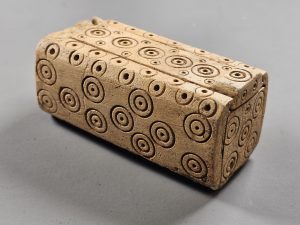
Late Roman bone box after cleaning by a conservator
Working ahead of planned development in Broadway, Worcestershire, our team uncovered evidence of around 8,000 years of human activity, from the Mesolithic period right through to Saxon times. While the site revealed many fascinating remains, one discovery stood out straight away: a beautifully carved bone box dating to the late Roman period.
A One-of-a-Kind Roman Find
The intact box with sliding lid was found carefully placed in the grave of a young woman and is remarkably well preserved. What makes it even more exciting is that it currently has no known parallels- nothing quite like it has been recorded before.
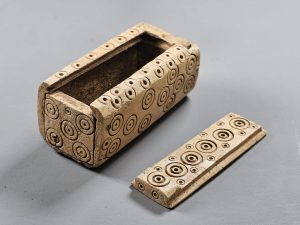
Carved bone box with sliding lid removed
The decoration is called ring and dot suggested a late Roman date, and radiocarbon dating of the burial has since confirmed this. The box measures at 68mm long, 33mm wide and 30mm deep. Specialist analysis has also revealed that the box was made from the bone of a roe deer and may originally have held an ointment or similar substance. Its careful placement in the grave tells us it was likely a valued or meaningful object, to the woman it was buried with and/or to those who laid her to rest.
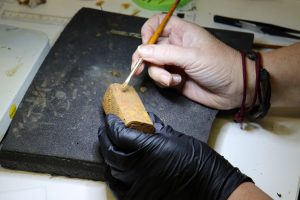
The box being cleaned by the conservator.
Jamie Wilkins, who led the excavation, described the discovery as, “extraordinary, not only because of the box’s craftsmanship and condition, but because of the story it tells about the community that lived here. I had never seen anything like this object before, and it immediately became clear that we had uncovered something truly special.”
Thousands of Years Beneath Our Feet
The bone box may be the highlight, but it’s only part of the story. Across the site, our archaeologists uncovered evidence of prehistoric, Roman and Saxon activity, showing that Broadway has been an important place for people for thousands of years. Its position along a major routeway across the Cotswolds escarpment helps explain why so many different communities chose to settle here over time.
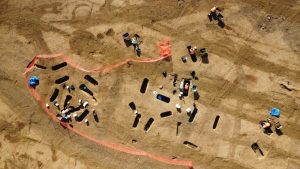
Aerial view of the Roman cemetery during excavation
The excavation at Milestone Ground was commissioned and funded by Wychavon District Council, with our team carrying out the fieldwork and ongoing analysis as part of the planning process. A detailed programme of specialist research is now underway, and once complete, finds and records will be carefully deposited with the county museum, in line with best archaeological practice.
See the Discovery on Digging for Britain
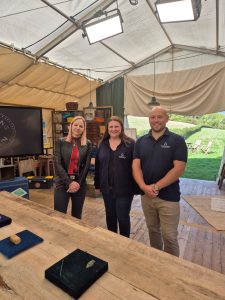
Digging for Britain presenter, Professor Alice Roberts (left), with Worcestershire Archaeology staff Laura Griffin (Senior Finds Archaeologist) and Jamie Wilkins (Project Officer).
The Broadway excavation will appear in episode 3 of the upcoming series of Digging for Britain, presented by Professor Alice Roberts. The new series will air on BBC Two and BBC iPlayer from 7 January 2026. The Broadway site will feature on Wednesday 21st of January giving viewers the chance to see this remarkable find and the story behind it.


I lived in a house on the opposite side of Station Road which overlooked the site and used to see flint bits in the garden and we had a spring that trickled down the side of the boundary into a sort of land drain. Would this have significance regarding the earlier use of the site, whether for water or religious reasons?
A shame that there wasn’t anything in the box to give us a clue like sewing items.
Hello, thanks for such a good question. While we cannot know if the spring in your garden relates to our site, we know throughout history, people have chosen to live and work near water sources. What we do know is the site is likely positioned where it is due to the Bunches Brook to the south of the site across Childswickham Road, this mirrors what we saw at our work between 2016-2017 at the flood alleviation scheme site further up the brook.