What’s in a name?
- 23rd January 2026
Why Archaeologists No Longer Use the Term “Deviant Burial”- Evidence from Milestone Ground, Broadway
In archaeology, terminology matters. The words we use shape how we interpret the past and how it is understood by the public. One term that is increasingly falling out of use is “deviant burial” – a description once commonly applied to Romano-British graves that did not fit a perceived norm.
Excavations at Milestone Ground, Broadway provide a clear example of why this change in language is necessary. The late Roman cemetery discovered there also offers fascinating research potential into the lives and varied beliefs of the communities buried there.
The Broadway Cemetery in Context
Across the site, we identified 126 burials, including three Beaker and three Iron Age graves. The remaining burials are currently interpreted as Roman in date, with 79 located within a defined cemetery, surrounding a D-shaped enclosure.
The cemetery layout is complex and organised, with distinct zoning, clusters of graves, and a notable line of burials extending from the northern corner and continuing south past the enclosure. Although there is variation in orientation, the majority of burials are aligned north-west to south-east. Several graves intercut others, suggesting either a long-lived cemetery or that grave markers were not always present.
Multiple strands of evidence indicate that the cemetery dates to the 4th century AD. Graves were cut into the backfilled early Roman enclosure, 12 coffins (not generally seen in pre-Roman burials) were identified, and the typology of grave goods supports a later Roman date. Two radiocarbon dates now place burial activity broadly between the late 3rd and early 5th centuries AD.
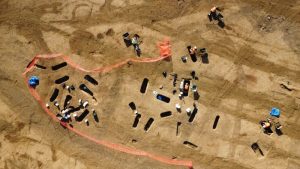
Roman cemetery and D-shaped enclosure at Milestone Ground Broadway
Where Did the Term “Deviant Burial” Come From?
The term “deviant burial” entered archaeological use in the 20th century, particularly within Romano-British studies. It was influenced by contemporary thinking in criminology, sociology, and anthropology, where “deviance” was used to describe behaviour that fell outside societal norms.
At the time, archaeologists often worked with relatively small datasets and limited comparative material. When graves differed from what was thought to be the standard Roman burial, typically an extended, supine inhumation (where the body was laid out straight, lying on their back) within a formal cemetery, they were grouped together as anomalies. The term “deviant” was used as a convenient shorthand for burial practices that did not conform to this model.
However, the word carried implicit assumptions. “Deviance” suggested deliberate wrongdoing, punishment, or social exclusion, and these ideas quickly shaped interpretation. Prone burials (placed face down), decapitations, burials in pits or ditches, and graves outside cemeteries were often explained as the result of execution, enslavement, or fear of the dead.
Crucially, these interpretations reflected modern moral ideas, not necessarily Roman or Iron Age beliefs. The term became embedded in the literature and continued to be used, even as evidence began to challenge its underlying assumptions.
Why “Deviant” No Longer Fits the Evidence
Large-scale cemetery studies across Roman Britain have shown that prone and decapitated burials are widespread and regionally patterned, particularly in southern Britain. They occur in both rural and urban cemeteries and are not confined to marginal populations or locations.
Decapitation is now often interpreted as a ritual practice, potentially connected to beliefs about the soul, transformation after death, ancestral rites, or protection from the dead. Some decapitations appear to have taken place after death, suggesting symbolic intent rather than punishment.
Prone burials where the person is lying face down may reflect local custom, specific ritual roles, accidents, or beliefs that are no longer archaeologically visible. Importantly, an atypical burial does not imply an atypical person.
As evidence accumulated, it became clear that the term “deviant” was both inaccurate and unhelpful.
A Change in Language
Modern archaeologists now favour neutral terms such as atypical burial or alternative burial practice.
These descriptions allow difference to be recognised without imposing modern moral judgement. They reflect a growing understanding that Roman and native British funerary traditions were diverse, flexible, and locally meaningful. Clearly there would been criminals and socially excluded people in the Roman period, and the change of terminology isn’t denying that these people existed in society. However we have to be aware that we can’t make blanket assumptions or impose modern associations on the past.
Burial Diversity at Broadway
The cemetery at Milestone Ground demonstrates that late Roman burial practice was far from uniform. Some individuals were buried with objects that offer insight into belief and identity, including copper alloy bangles, a burial with 86 beads arranged around the pelvis, and carved bone combs; a practice associated with later Roman burial traditions and rarely seen before the 360s AD.
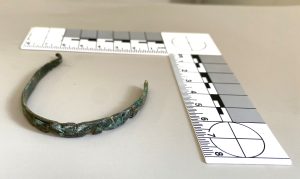
One of the copper alloy bangles found buried with an individual.
Hobnail footwear was also common, with 31 examples identified across the site, 21 of which came from the cemetery. One burial included three late Roman copper alloy coins placed in the mouth, reflecting Roman beliefs about the journey to the afterlife.
These burials show care, intention, and engagement with contemporary funerary traditions.
Alternative burials are still considered to be a minority practice, with a recent study of burial sites suggesting a figure of around 10%. At Broadway, alternative practices account for around 25% of the Roman burials. This is potentially higher than commonly seen in other cemeteries, but could be due to the site’s excellent preservation.
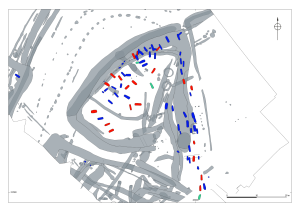
Map showing the burials in the cemetery. (Blue for standard burials, red for alternative burials and green for empty graves.
Within the cemetery, archaeologists identified 20 burials that differ from the most common burial form:
- 10 decapitated burials
- 8 prone burials
- 2 burials that were both prone and decapitated
In many decapitation burials, the head had been carefully placed by the feet or on the legs. In at least two cases, the skull was not deposited in the grave. One burial had a bone comb placed where the head would normally be, strongly suggesting a deliberate and symbolic act.
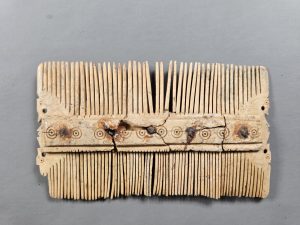
Bone comb with horse head decoration, found in place of a skull.
The Bone Box
The discovery of the carved bone box in association with a prone burial at Broadway clearly highlights the problem of using the term “deviant”. The box is exceptionally rare, with no close parallels currently known from Roman Britain. It was found in the grave of a young woman aged 25-30, which has been radiocarbon dated to AD318-415. Its careful manufacture and deliberate placement by the head indicate that it was a significant and meaningful object. Its association with a prone burial directly challenges the idea that such individuals were treated with disrespect or exclusion.
Such evidence is difficult to reconcile with the term “deviant”. Instead, it demonstrates that alternative burial practices could coexist with care, symbolism, and complex belief.
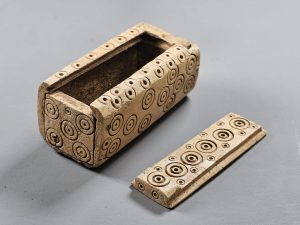
Carved bone box with sliding lid removed
Why This Matters
The late Roman cemetery at Milestone Ground is the largest Roman cemetery discovered to date in Worcestershire. Over the next few years, it will form part of a wider research programme incorporating DNA and isotopic analysis, offering new insights into family relationships, mobility, and lived experience.
Equally importantly, the site highlights why terminology matters. Moving away from the term “deviant burial” is not about avoiding interpretation, it is about ensuring that interpretation is guided by evidence rather than assumption.
Learn more the burials at Broadway on Digging For Britain, series 13 episode 3, available on BBC iPlayer now!


So interesting…