Uncovering the Art of Ombersley Court, Part Two
- 5th February 2026
From English country houses to dramatic naval battles and foreign lands, we continue our look at the Sandys family’s extraordinary art collection.
Many of the pictures at Ombersley came to the Court through Letitia Baroness Sandys, while others were bought directly from artists or collected abroad. From views of Chatsworth House to Spanish bullfighting scenes and Chinese wall panels, the Sandys art collection reflected taste and travel as much as it did wealth and power.
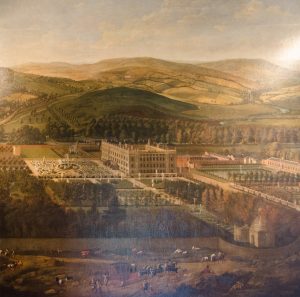
A View of Chatsworth from the East by Jan Siberechts, c1703 © Martin Davis
Landscape and Seascape
A View of Chatsworth from the East by Jan Siberechts is a spectacular large-scale landscape painting that hung at Ombersley opposite John James Baker’s The Whig Junto. Seen from a bird’s eye view, the detailed picture captures Chatsworth House as it was around 1703. Likely commissioned by the 1st Duke of Devonshire, it belonged to Letitia’s great uncle Admiral Edward Russell. Russell, a friend and political ally of the Duke, was also connected to the Devonshires through marriage.
The power of Siberechts’ painting was vividly recalled by Deborah, Duchess of Devonshire, during a visit to Ombersley Court in 1994. ‘They came on a mild Sunday morning’, writes the 7th Lord Richard Sandys, ‘when the light was fair but not perfect to see our Chatsworth picture. Standing in front of it, the first comment Debo Devonshire made was, ‘You cannot have any idea what this means to me—it is like finding a lost child, or a child I never had.’ The work has since returned to Chatsworth.
Another jewel in the Court’s collection was a group of seascapes by Willem van de Velde the Younger. Van de Velde was a prominent Dutch marine painter of the late 17th and 18th centuries, whose work typically focused on ships and historic naval events.
Painted during the 1690s, this group of seven naval scenes was commissioned (you guessed it) by Russell for his home at Chippenham Park in Cambridgeshire. They depict military actions in which he was likely involved. Most notably, The Burning of the Soleil Royal is an epic canvas showing the Battle of La Hogue, where he famously defeated the French in 1692. The Van de Veldes hung for many years in the ground floor dining room at Ombersley Court.
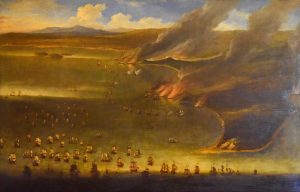
The Burning of the Soleil Royal during the Battle of La Hogue, 22 May 1692 by Willem van de Velde the Younger, oil on canvas © Rory Rae
Art from Abroad
The paintings at Ombersley bought back from abroad included those by Lord Marcus Sandys. A bullfighting enthusiast, he collected works that promoted these events. His most notable souvenirs were two large landscape paintings of Madrid by the Venetian artist Antonio Joli. Dating from 1756, one shows the Plaza de Toros with a bullfight in progress and another the Plaza Mayor. Marcus also bought a third large bullfighting scene by an unknown artist.
A fellow traveller, Marcus’s son ‘Mikey’ 5th Baron Sandys installed nine hand painted Chinese wall panels in one of the Court’s bedrooms during his time. Painted on Xuan paper, together, they tell part of the story of tea. Details show tea being grown and picked, a merchant and his servant in discussions with a wholesaler and a tea shop. According to Mark Sandiford (a conservator of historic wall papers who was commissioned to restore the panels in 2015) they were painted between 1780 and 1810.
Mikey was the last of the Sandys to add work to the family’s collection. Mainly that of the British artist Thomas Rowlandson – a printmaker known for his popular political satire. Mikey’s friend, the art collector Joseph Grego, was an expert on Rowlandson and advised him on his purchases. One of Mikey’s favourites was the painting The Exeter Fly at Honiton. A watercolour from 1818, it was hanging in his bedroom when he died.
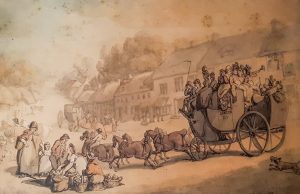
The Exeter Fly at Honiton by Thomas Rowlandson, 1818, watercolour © Martin Davis
From House to Museum
Mikey was not only a passionate collector but also an active lender. In 1934, he lent ten paintings from the Sandys collection to British Art Treasures – an exhibition at Birmingham Art Gallery that brought together pictures from private collections across the Midlands. Amongst them was the civil war portrait by William Dobson, a Van de Velde seascape and a copy of an original painting by Sir Anthony van Dyke. This latter portrait of Lady Lucy Percy, Countess of Carlise was listed in the exhibition’s catalogue as being by van Dyke, but it is in fact a copy of the original held at Petworth House.
Of all the pictures at Ombersley, the Dobson was the most frequently exhibited. In 1938, it was loaned to the Royal Academy for its 17th Century Art in Europe exhibition. In the Sandys Archive, is a letter from the artist Gwen John to Bruce Chaloner urging him to see it:
‘I do want you if you should stay in London to see 3 pictures at Burlington House…the second a Dobson, not the best picture he has there, but the most interesting—of Prince Rupert…[and] Colonel John Russell, who has thrown up his commission for conscientious scruples. Russell is holding away his own cockaded hat and also the wine bottle and his face is almost speaking.’
Much like Mikey, Richard Sandys cherished his Ombersley collections – in particular, the paintings. The Archive is full of his letters including enquires and requests regarding pictures at the Court. In 1967, the portrait of Edwin Sandys by Sir Joshua Reynolds featured in the exhibition Mr Boswell at the National Portrait Gallery. In an inventory of Ombersley Court from 1963, Reynolds’ painting is valued at £350. After its exhibition at the Portrait Gallery, and having been revalued by Christie’s in 1995, it was listed at £6000.
Following the deaths of Richard and his wife Patricia, Ombersley Court was sold and its collection dispersed. Family treasures passed down through generations, much of the work went on sale at Christie’s, with some items sold at Sotheby’s and Chorleys. Others returned to their ancestral homes or were given to museums.
We can view Ombersley as a micro-history of British art collecting. A collection dispersed but no longer invisible, it continues to be seen, discussed and admired.
We are currently cataloguing the archive of the Sandys family as part of a two year project funded by Ombersley Conservation Trust. To see what we’ve discovered, visit our project page where you can keep up to date with our progress.


Post a Comment