Uncovering the Art of Ombersley Court, Part One
- 4th February 2026
From Old Master paintings to prints, ceramics and furniture, the Sandys family’s art collection tells a story of politics, personal taste and ancestry.
For centuries, the Sandys family collected art, turning Ombersley Court into something as much like a gallery as a home. Whilst a number were commissioned or purchased directly from artists, others were inherited. Most notably, those that came through Letitia Tipping, wife of Samuel 1st Baron Sandys, who inherited many of the finest Old Master paintings in the Court’s collection. But more on that later!
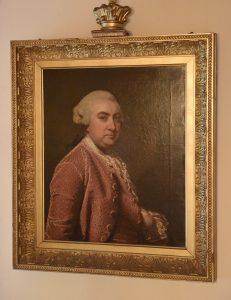
Portrait of Edwin 2nd Baron Sandys by Sir Joshua Reynolds, 1773, oil on canvas © Rory Rae
Portraits and Patronage
Portraits form the backbone of the Sandys’ collection, and include examples by some of the most celebrated English artists of the 18th and 19th centuries. Dated 1773, Sir Joshua Reynolds’ painting of Edwin 2nd Baron Sandys is a notable highlight. It forms part of Reynolds’ Streatham Worthies series – a set of portraits commemorating members of the celebrated circle of writers and thinkers known by the same name. Edwin was himself a figure of cultural importance. A noted scholar, he was a founding trustee of the British Museum as well as one of the Worthies.
The Reynolds was purchased at auction forty three years after it was painted, by Edwin’s niece, Mary (later Marchioness of Downshire and Baroness Sandys). Yet its most dramatic chapter came in 2015, following the death of Patricia Lady Sandys. When her executors asked Sotheby’s to prepare a probate valuation of the contents of the Court, the Reynolds was noticeably absent from the inventory. A search party returned to the house, and the missing work was eventually found beneath the main staircase stored in a shopping trolley.
Reynolds’ portrait is not the only picture painted of Edwin. An earlier depiction by Benjamin West shows him wearing the same coat and was considered by some to be a more accurate likeness. ‘In his attempts to give character where it did not exist’ wrote James Northcote, ‘he [Reynolds] has sometimes lost likeness’. There is also a miniature of Edwin in old age painted by the artist R Fortin which was exhibited at the Royal Academy in 1793.
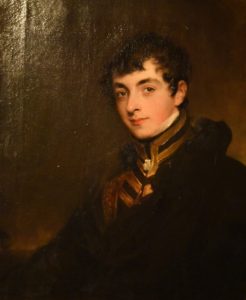
Lord Marcus Hill by Sir Thomas Lawrence, 1816 © Rory Rae
Another noteworthy portrait is that of Lord Marcus Hill, by the English artist Thomas Lawrence. Painted around 1816, it shows Marcus (later 3rd Baron Sandys of the second creation) in the uniform of an Ensign in the Blues. At the time, Lawrence was one of the most sought after portrait artists. He would later paint Marcus’s cousin the Duke of Wellington.
Marcus’s portrait was commissioned by his mother (the same Mary as above) after a visit to Lawrence’s studio with her daughters, who were stuck by the ‘beautiful and striking likenesses’ of the artist’s work. However, Lawrence was not her first choice. According to the diary kept by Marcus’s sisters, she initially visited the studio of George Hayter, but he was unavailable. The painting now sits at Hillsborough Castle, where artworks associated with the Sandys and subsequent Hill families are displayed in the Ante Room.
These include the so-called Ombersley miniatures, inherited by Mary through her marriage to Arthur Hill and later gifted to Historic Palaces England. Painted at different times by various artists they include two in the style of the Renaissance artist Raphael, as well as family portraits by Richard Cosway and two of Jane Austen’s nieces.
Like her grandfather Samuel 1st Baron before her, Mary was a patron of Worcester Porcelain Factory. In 1807, she visited the factory with her friend the Prince of Wales, who is said to have strongly influenced her passion for collecting. Many of the best porcelain pieces later sold at auction were probably hers, since they appear in inventories compiled after her time but not before.
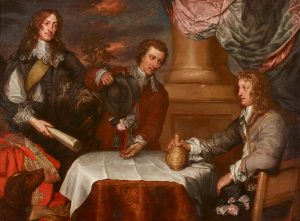
Portrait of Prince Rupert, Colonel William Legge (probably) and Colonel John Russell by William Dobson, 1645 – 1646, oil on canvas, WA2017.38 © Ashmolean Museum, University of Oxford
Painting and Politics
Long considered the jewel of the Ombersley Court collection is the powerful group portrait by William Dobson. Painted during the English Civil War, it shows a meeting between Prince Rupert, nephew of King Charles I, Colonel William Legge and Colonel John Russell. Dobson’s painting, commissioned by Russell, commemorates the loyalty and honour of these three Royalist commanders who, following defeat at Bristol in September 1645, were accused of treachery. Legge, the central figure, dips his cockade into a glass of wine – a metaphor for the stain cast upon the sitter’s honour. Further evidence of the Sandys Royalist connections is a portrait of Charles I after Edward Bowyer. Seated in a red velvet chair, the soon to be martyred King is shown at his trial in 1649.
Now at the Ashmolean Museum in Oxford, the Dobson hung at Ombersley for almost 300 years. Edward Russell was the brother of Letitia Cheek, grandmother of Letitia Tipping through whom several important paintings came to the Sandys. As Edward’s joint heir, she inherited perhaps the most politically significant painting in the Court’s collection – John James Baker’s The Whig Junto (1710).
Commissioned by Edward who stands on the right, it is a portrait of a group called the Whig Junto and a Black servant. The Junto were a group of political peers formed by leaders of the British Whig party. Shown together on a grand terrace, the Black servant draws a heavy velvet curtain. The setting is imagined and designed to project power and status. Did Russell actually have a Black servant? Or were they added to symbolise wealth and social prestige?
In 2018, The Junto was given to Tate and is now on display at Tate Britain. It is both a key work in the visual history of British politics, and a reminder of the Sandys’ deep engagement with political life and their role as custodians of artworks that documented it.
Opposite The Junto at Ombersley hung painting of Chatsworth House by another Flemish artist Jan Siberechts. These two pictures dominated the great staircase at Ombersley Court for two and a half centuries. But more on Chatsworth in part two!
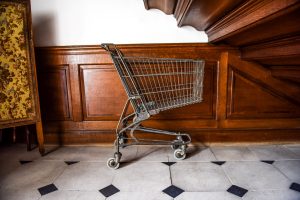
Shopping trolley in which Joshua Reynolds’ portrait of Edwin Sandys was discovered © Rory Rae


Post a Comment