If only artefacts could talk…
- 27th June 2023
Our Roots in Time project, based around 2022’s community excavation at Evesham’s New Farm Nature Reserve, has got us thinking about human nature. Prehistory is often thought of as being primitive – a time when life was just about survival and people were perhaps less intelligent than today. But archaeology shows us that this idea is far from true.
Human nature
Since 800 BC, the start of the Iron Age and earliest activity we found on the site, so much has changed – people’s beliefs, way of life, culture and society. Yet, people in the past were still humans just like you and I: they had loved ones, enjoyed having fun, had their own taste in clothes and food, got grumpy sometimes and had happy days. They were just as intelligent as us, with the same range of human emotions, hopes, fears and personal quirks.
Here are some particularly special archaeological finds from our Roots in Time excavation that reach across time and allow us to touch the lives of an individual. We may not know their names, but they also had a connection to the landscape around Evesham and their own stories to tell.
Artefacts with tales to tell
1. Fingerprints wiped across a Roman roof tile – decoration, a maker’s mark or something else?
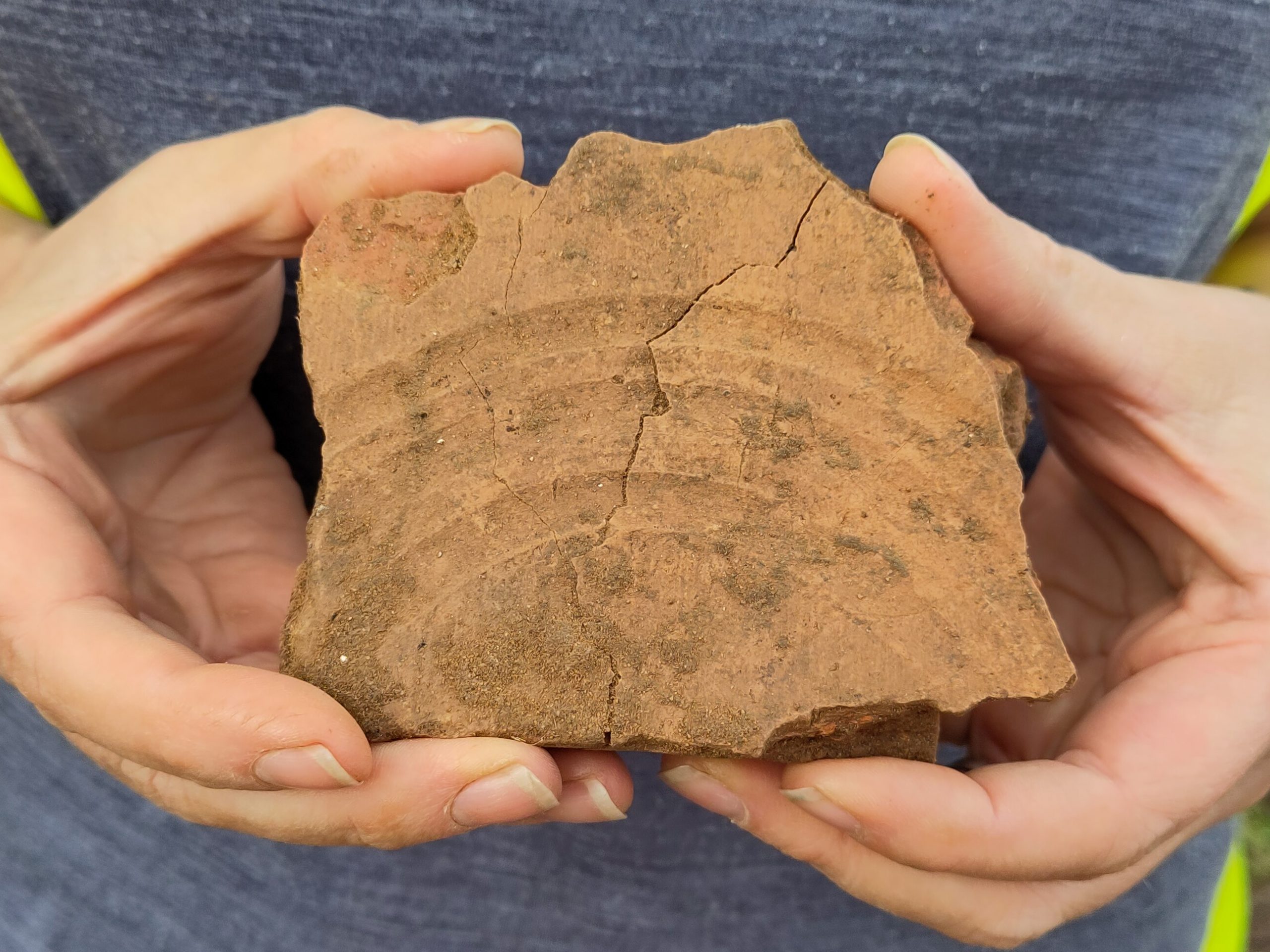
Fragment of Roman roof tile with three curving lines made by fingertips being drawn across damp clay
2. Boot, shoe or sandal: what did these Roman hobnails come from and who wore it?
Most of our hobnails are more corroded and grotty looking than the example below (from another nearby community project), but excavations at Vindolanda by Hadrian’s wall give us a glimpse of the sandals, shoes and boots worn during the Roman era.
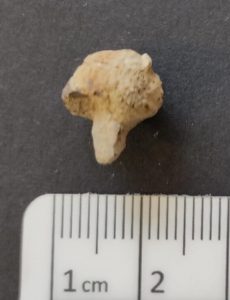 Example of a Roman hobnail from Badsey, near Evesham |
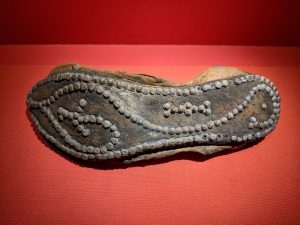 Decorative pattern of hobnails on a Roman shoe sole from Vindolanda |
3. Does an Elizabethan love story lie behind this silver coin? Given as love tokens, silver coins bent into an S shape were common during the late 16th and 17th centuries. It’s intriguing to wonder how it ended up in fields alongside the River Avon.
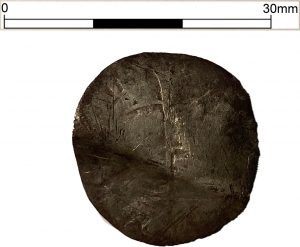 Front of the coin reused as a love token |
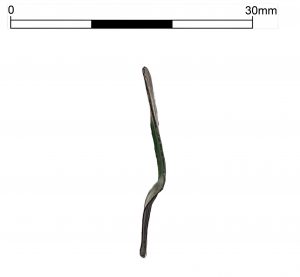 Side view of the coin, showing how it was bent |
4. Hints of the beliefs, traditions or superstitions of people who once lived here can be seen in a cow skull buried at end of a ditch and horse forelimb buried in a pit. These practices were common during the Iron Age, so it is interesting that the cow skull was placed on top of Roman pot sherds – a sign of someone keeping long held traditions?
5. An illiterate potter? This Roman pot base has tried to copy the maker’s stamps used on Samian ware pottery imported from Gaul (France). Instead of their name, just a row of triangles is used, suggesting that the potter couldn’t read or write.
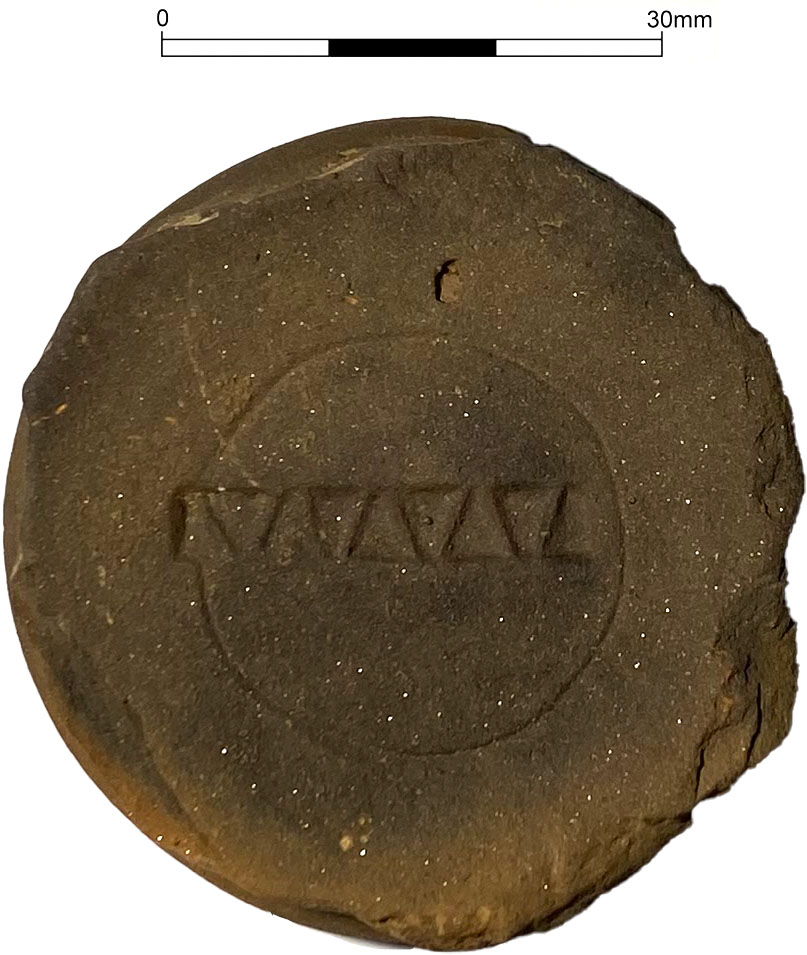
Pot base with a row of triangles inside a circle stamped on to the inner surface, in imitation of the Latin writing stamped on Samian ware pots.
Curious to know more?
You can:
- Find out more about Roots in Time on our project page.
- Feeling creative? Come along to one of our creative writing workshops where you’ll have a chance to handle the finds and imagine what stories lie buried with them. Sessions are free, open to all and running from the 28th June to 14th July 2023 – find details on our events page.
- Dig diaries – the excavation is over, but you can find dig diary updates on social media by searching for #RootsInTime. Find us on Facebook, Twitter and Instagram.


Thanks for this interesting post. Of course I can relate to the pottery having worked on some during my time working with you many years ago.