Victoria Woodhull Martin and Worcestershire
- 4th May 2026
One collection that we’ve come across as part of our retroconversion project is this box of documents relating to Victoria Woodhull Martin, the first woman to run for US President in 1872, and Lady of the Manor of Bredon’s Norton, 1901-1927.
Who was Woodhull Martin?
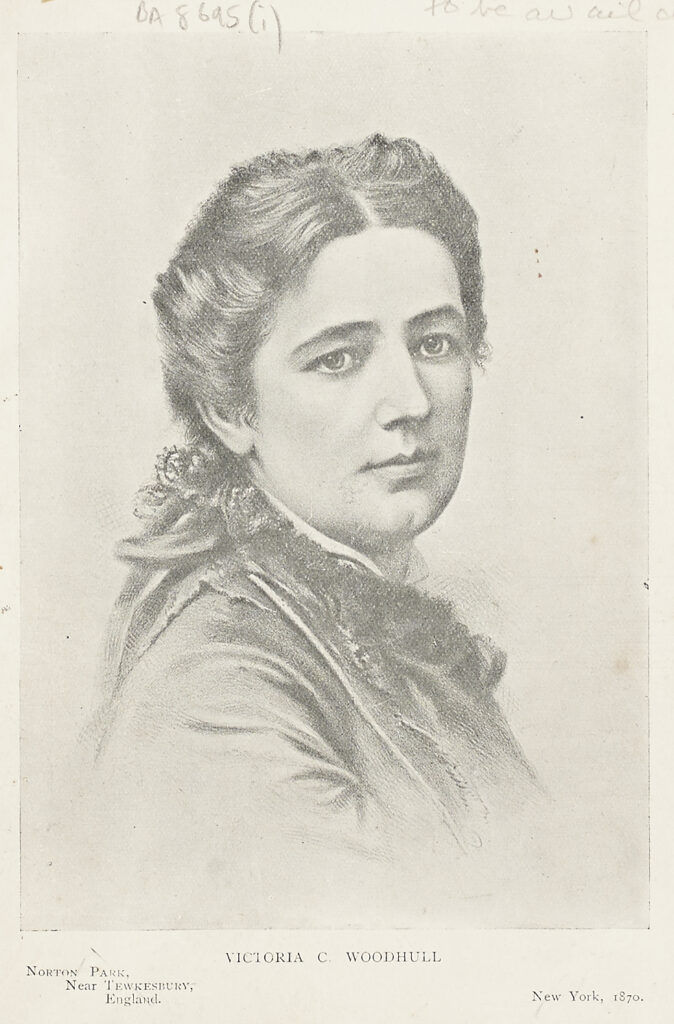
Woodhull Martin in 1870. [c1920]. BA8695 (i)
Described as “vastly avant garde”, Victoria Woodhull Martin was an advocate for causes as varied as women’s rights, free love, spiritualism, eugenics, and Anglo-American friendship. Over the span of about a decade in turbulent post-Civil War America, Woodhull Martin went from an obscure spiritualist healer to a wealthy stockbroker, sought-after lecturer and prominent women’s rights advocate, running for president as candidate of the Equal Rights Party in 1872.
Her radical views made her a controversial figure in America. The press nicknamed her first “the Woodhull”, then “Wicked Woodhull” and finally “Mrs Satan”. She was a gifted orator, but a poor politician, and eventually alienated even her supporters.
In 1877 she left America for the United Kingdom, which became her home for the rest of her life. She met and married James Biddulph Martin, of the Martin banking family. After her husband’s death, she inherited and moved to Norton Park, Bredon’s Norton, Worcestershire.
This collection
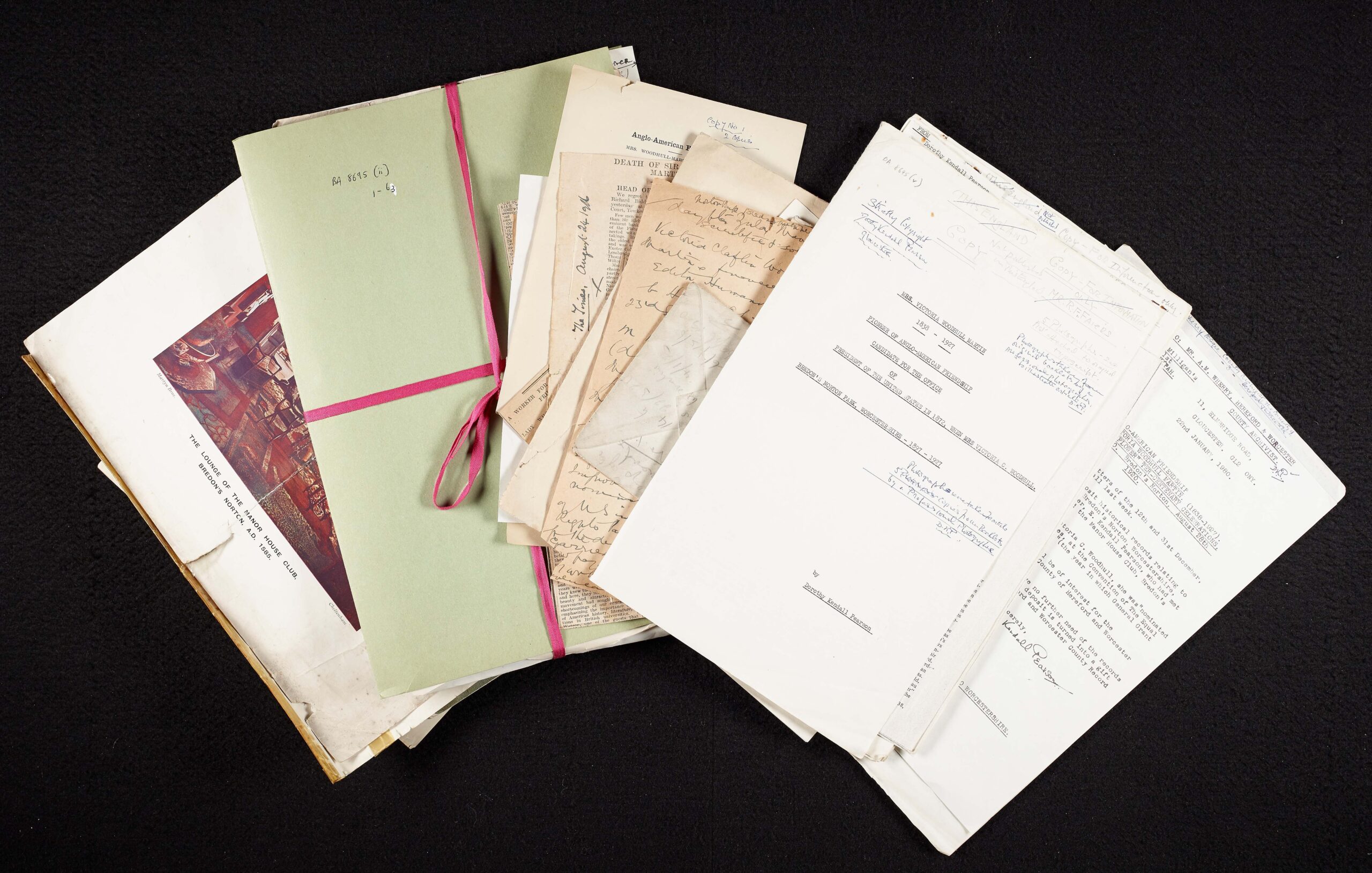
The collection as a whole. BA 8695.
It’s this period that our collection focuses on. It was donated by a local historian, Dorothy Kendall Pearson, who wrote an article about Woodhull Martin for Cotswold Life magazine. It includes copies of her article, and pamphlets, newspaper cuttings, letters and photographs she used as part of her research.
A lot of this material comes from Kendall Pearson’s father, Edward Kendall Pearson. He was the editor of a local newspaper called the Gloucester Citizen. He consistently tried to have material about Woodhull Martin placed into the local, national and international press.
One frequent object of his was to get birthday wishes for Woodhull Martin published. In 1925, he mailed 153 newspapers in all! One notable success that year was his getting published in the Daily Telegraph.
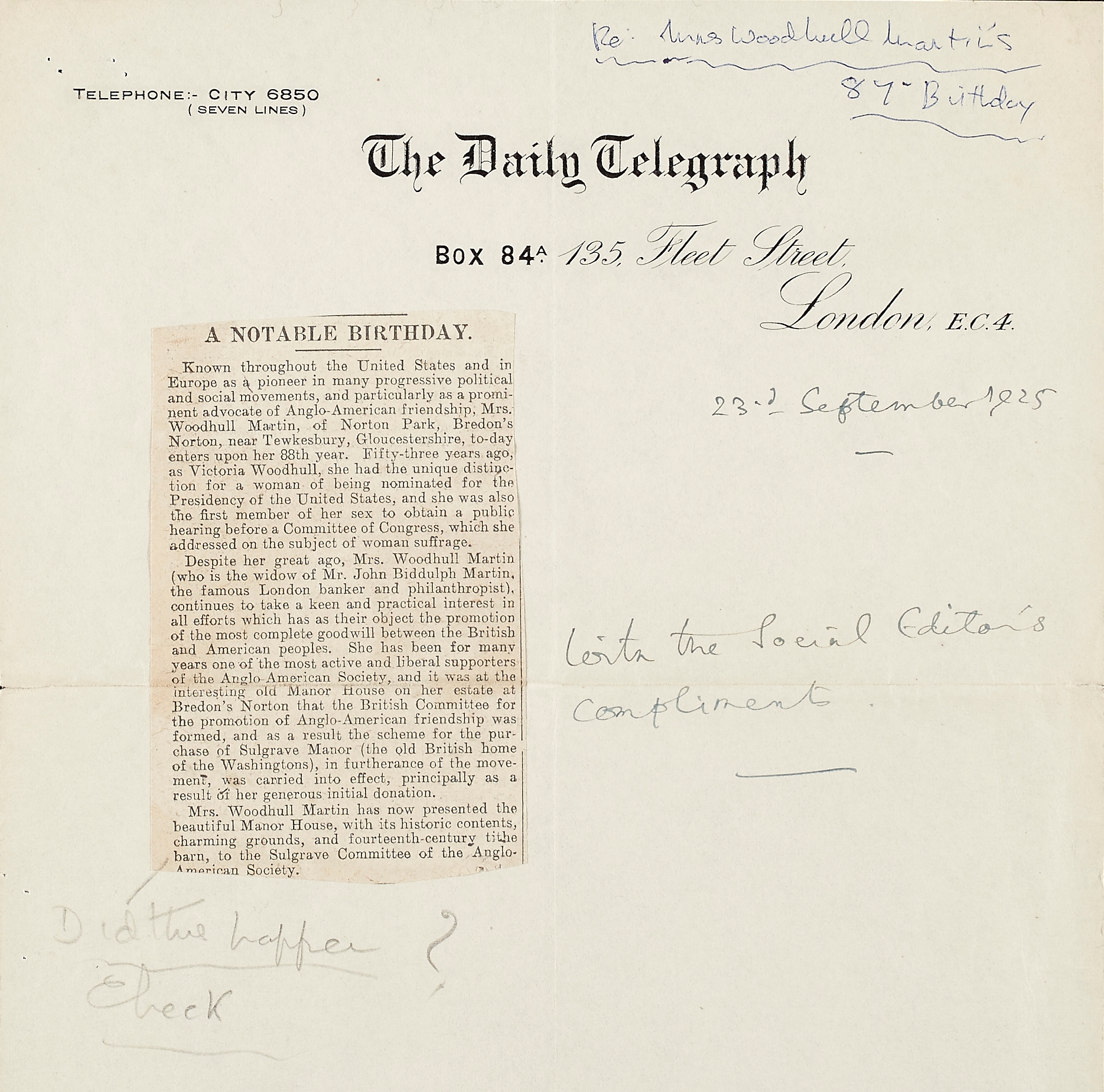
Newspaper cutting from the Daily Telegraph announcing Woodhull Martin’s 87th birthday. 23/09/1925. BA8695 (ii) 33
We also have a copy of his own wishes to Woodhull Martin on her 87th birthday: “cordial felicitations and best of good wishes upon this auspicious day”.
Anglo-American friendship
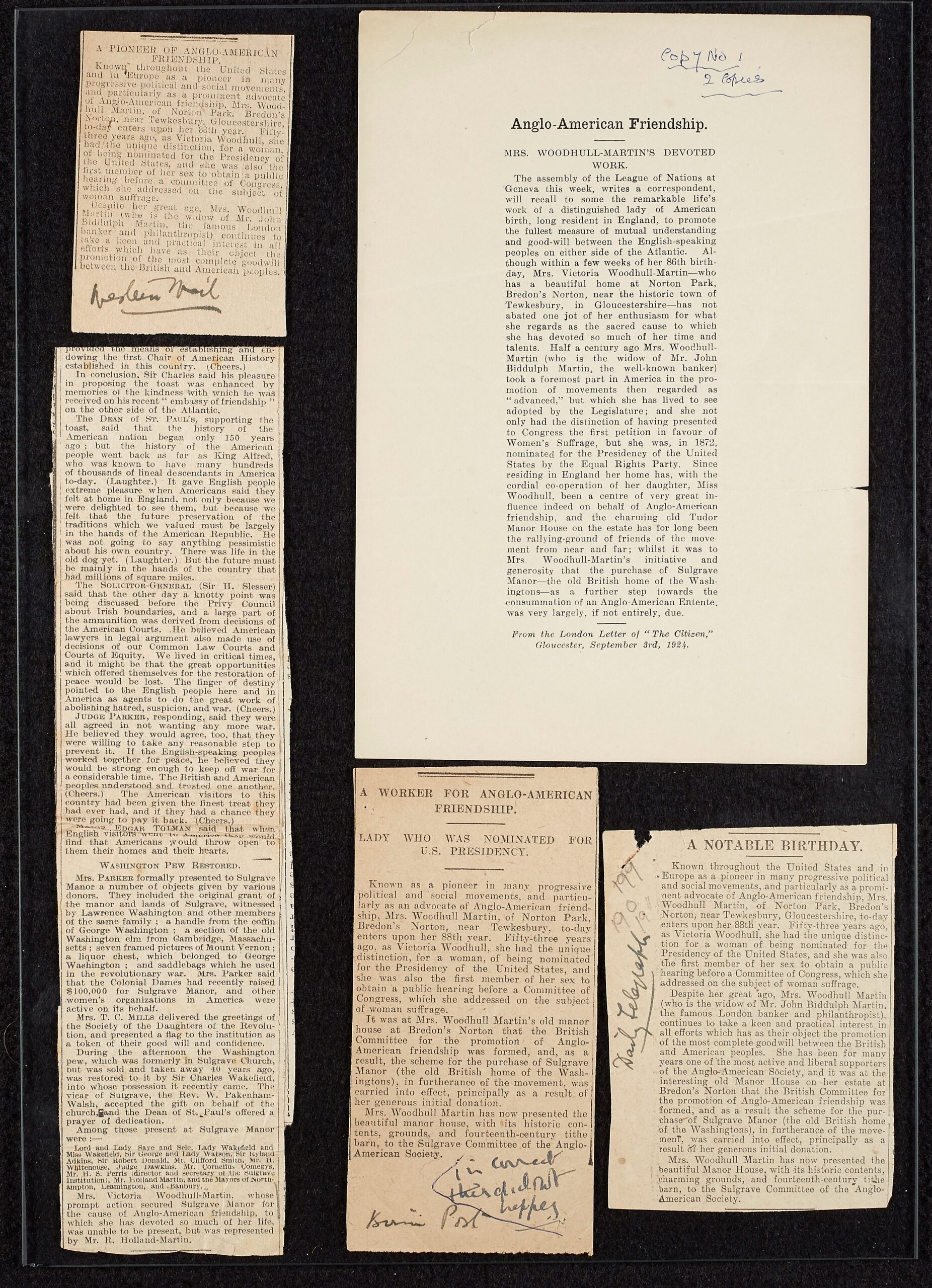
Newspaper cuttings celebrating Woodhull Martin’s Anglo-American friendship work. BA 8695 (iii) 1, 3, 5, 6 & 10
Edward Kendall Pearson also promoted Woodhull Martin’s support of Anglo-American friendship – she flew entwined American and British flags at Bredon’s Norton and called July 4th “Interdependence Day”.
She also made a substantial contribution towards the preservation of Sulgrave Manor in Northamptonshire, the ancestral home of the Washington family. She had even intended to gift Norton Park to an Anglo-American friendship organisation, and items in our collection say she had already made this gift. For reasons unclear, the gift was never made, and someone has gone through our collection and annotated documents with “did this happen? Check”, “This did not happen”, and “INCORRECT. This never happened”.
In 1920, the 300th anniversary of the voyage of the Mayflower for Virginia, Woodhull Martin held a pageant to celebrate at Norton Park. This was a dramatic re-enactment of Elizabethan England and the voyage of the Mayflower, with “Old English” dances in the interlude and a “most hospitable tea” at the end. We have a program of the pageant, an article by E Kendall Pearson and a letter to him from Woodhull Martin’s daughter, Zula, expressing her mother’s gratitude for the article.
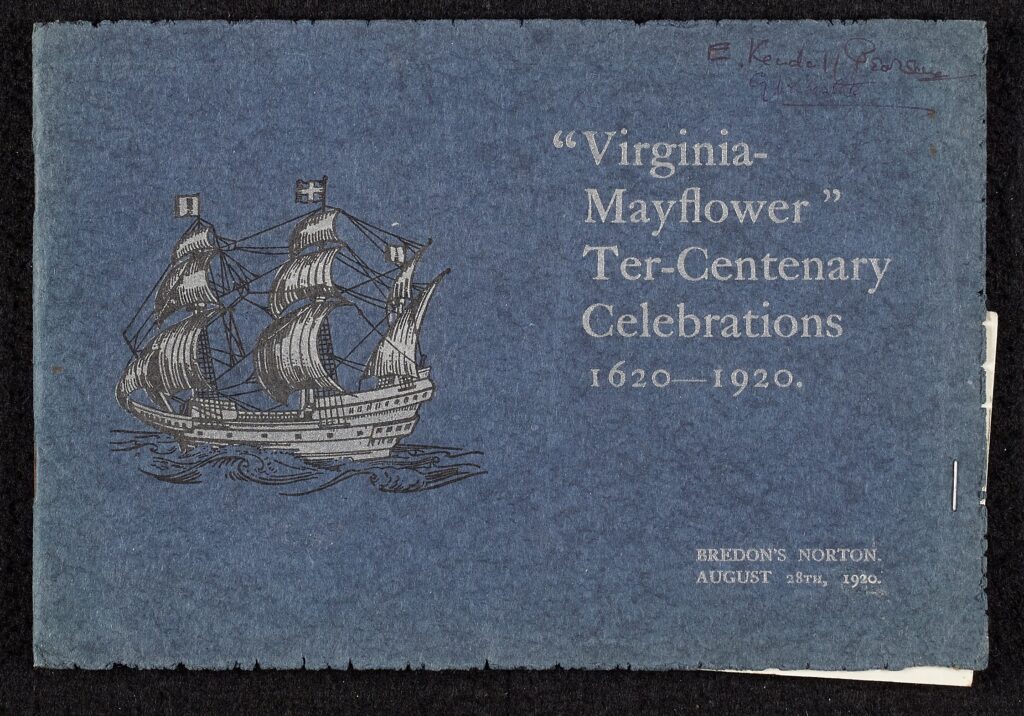
Mayflower pageant program. 28/08/1920. BA 8695 (i)
Lady of the Manor
Our collection also tells us that Woodhull Martin was a devoted Lady of the Manor. Apparently, she was a benevolent “lady bountiful…keenly solicitous of the welfare of the people of her estate”; a “fairy godmother”; someone who had channelled her “great gifts” to the benefit of Bredon’s Norton, “nobler work even than being President of the United States”. In fact, “To visit Norton Park is an entertainment and refreshment, to converse with its chatelaine a feast for the soul”. Gosh.
![4 pamphlets, one green bound, the others yellowing paper, on a black background. Titles "Manor House Club Causeries"; "The Story of Bredon Norton with Notes on Bredon's Hill"; "Some Reminiscences of a Happy Three Years' Residence at Bredon Norton", and [Two American Shrines: Sulgrave Manor and Bredon's Norton]. All [c1920].](https://www.explorethepast.co.uk/wp-content/uploads/2026/04/BA8695_08v1-scaled.jpg)
Some pamphlets celebrating Woodhull Martin and Norton Park. BA 8695 (i).
Norton Park servants
For instance, one of Woodhull Martin’s first actions at Norton Park was to fire all the servants. Woodhull Martin was told that they were lazy and idle, had stolen from the previous tenant, and enjoyed taking the chauffeur-driven car Woodhull Martin kept at Norton Park for joyrides.
The villagers saw this as very much “not the done thing”. A particular critic of hers, J Arthur Trenfield commented “her kindly act…it is easy to imagine the unrest and uncertainty caused in the village”. This would be a significant portion of the village population suddenly unemployed, and it’s easy to see how this could cause outrage.
American Lady of the Manor’s conclusion is that Woodhull Martin tried to do good in Bredon’s Norton, but she tried to change too much, too fast, and failed to understand how popular the “old regime” was with the villagers. She became quite unpopular – in 1904, eight streetlights she had installed were all thoroughly wrecked in a single night. In response, she became less active within the village and more reclusive, and cultivated friendly journalists, who promoted her in the local press and carried on letter wars with her critics.
American Lady of The Manor tells us that E Kendall Pearson was the last of these publicists. By the time she made use of his services, Woodhull Martin was slowing down. By this point, she had been a fixture in Bredon’s Norton for decades, and her generosity towards the church and villagers meant she had been accepted as Lady of the Manor, even if they were never as fond of her as they were of the older regime.
Obituary
![Obituary of Victoria (Clafeen) Woodhull Martin of Norton Park, Bredon's Norton, Worcester, bequeathing an estate of £181,722 to her daughter, Zula Maud. [1927], BA 8695 (iii) 8](https://www.explorethepast.co.uk/wp-content/uploads/2026/04/BA8695_02-Copy.jpg)
Woodhull Martin’s (very poorly spelt!) obituary
Conclusion
Taking a step back, this is an interesting and varied little collection. It offers a window into the life of a interesting and famous person, who you might not have known lived in Worcestershire. Woodhull Martin’s time in Bredon’s Norton is a period her biographers have often overlooked. Now, that might be partly because she had very little engagement with feminist causes in this period, and partly because for someone so controversial she was nicknamed “Mrs Satan”, settling into respectable semi-obscurity is rather disappointing!
There’s much more that could be said about Woodhull Martin, like her friendship with Cornelius Vanderbilt or when she sued the British Museum for libel. There’s also more we could have said about this collection, like the sample of her pro-eugenics writing. So if you’re interested in Woodhull Martin, why not come to the Hive and have a look at this collection?


Post a Comment