Uncovering the Bickmarsh Hoard
- 6th April 2026
A quiet field in south east Worcestershire. No visible traces of the past. No reason to expect what lay beneath.
And then, a signal.
Within hours, silver coins began to emerge from the soil, one after another, until it became clear that this was no isolated find, but part of a much larger story. By the end of the investigation, more than sixty coins dating to the ninth century had been recovered, forming what is now known as the Bickmarsh Hoard.
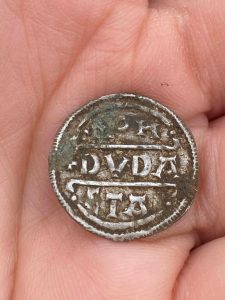
One of the silver coins in the hands of their finder, moments after being found
The Discovery
In the summer of 2022, members of Go Detecting (Midlands) Ltd were carrying out a routine metal-detecting survey in the parish of Bickmarsh when they began to recover early medieval coins. Over the course of a weekend in July, twenty-five silver coins were found within an area measuring approximately 30 by 30 metres. All were recovered from the topsoil, with no obvious container or associated features.
The coins date to the ninth century AD, within the Early Medieval (Anglo-Saxon) period. Finds from this period are relatively scarce, especially in Worcestershire, and the discovery of a hoard of this size is significant.
The field itself was not previously known to contain any archaeological remains. However, the wider landscape has clear evidence of past activity. The site lies close to the line of Ryknild Street, a Roman road constructed in the late first century AD, and within walking distance of Bidford-on-Avon, an important settlement during the early medieval period.
The find was reported to the Portable Antiquities Scheme (PAS), administered by the British Museum, and to the coroner in accordance with the Treasure Act.
Digging Deeper
Following this, a programme of further investigation was developed in partnership with the PAS and Historic England (funded by Historic England and the UK Government). Worcestershire Archaeology was commissioned to undertake the fieldwork, working alongside the original finders.
The work was carried out in two phases.
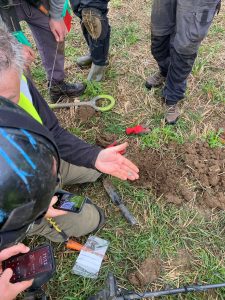
The metal detectorists and archaeologists worked together to uncover further coins
Phase 1 comprised a detailed metal-detector survey of most of the field, undertaken by Go Detecting Midlands, with the aim of recovering any additional coins. This was followed by a geophysical survey in November 2022 to assess the wider archaeological potential of the site.
The results informed Phase 2 which was a targeted excavation led by Worcestershire Archaeology. This involved the controlled stripping of selected areas, with systematic metal-detecting carried out as the excavation progressed. Further survey work was also undertaken across the surrounding area.
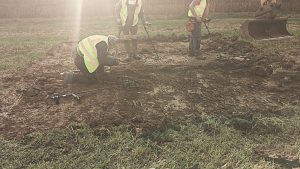
Metal detectorists detecting the surface as each spit is removed by the machine
During the excavation, two additional concentrations of coins were identified. This led to an expansion of the excavation area beyond that originally planned. In total, sixty-three coins were recovered from the hoard.
Beyond the Coins
Over one hundred additional finds were also recorded, ranging in date from the Roman period through to the modern day. Most of these appear unrelated to the hoard.
One group of finds is of particular interest: thirty-five small fragments of lead sheet. In some cases, coin hoards have been buried wrapped in lead, as seen at sites such as the Sizewell C hoard (Suffolk) and the Lenborough Hoard (Buckinghamshire). The fragments at Bickmarsh were found within the same general area as the coins, but they are undiagnostic, and it is not currently possible to confirm whether they are associated with the hoard.
All material classed as Treasure is assessed by specialists at the British Museum prior to valuation, and the Bickmarsh coins have undergone this process. No archaeological features or structures directly associated with the hoard were identified during the excavation. However, evidence of medieval and modern ploughing across the site likely explains the dispersed distribution of the coins within the topsoil. It is therefore likely that the hoard was originally buried at a shallow depth and has since been disturbed by agricultural activity.
The question of why the hoard was buried here remains open…
Can a more detailed, specialist assessment of the coins shed further light on how they came to be buried in an isolated location in southeast Worcestershire? Gareth Williams, former Early Medieval coin specialist at the British Museum, discusses this in our next article.

Read Part Two- The Coins
Read Part Three- Life in 9th century Bickmarsh


Post a Comment