Bickmarsh Hoard -The Coins
- 8th April 2026
This is the second post in a three-part series exploring the remarkable ninth-century Bickmarsh Hoard discovered in Worcestershire. Catch up on part one.
The discovery of the Bickmarsh Hoard in 2022 revealed a small but remarkable collection of ninth-century coins buried in the Worcestershire countryside over 1,100 years ago. In this second blog in our mini-series, we take a closer look at the coins themselves: where they were made, what they were worth, and what they might reveal about life in Mercia at a time of political instability and potential Viking activity.
This research forms part of a project funded by the UK Government and Historic England.
A Rare discovery for Worcestershire
Early medieval coins (dating from the 5th to early 11th centuries) are extremely rare finds in Worcestershire. Fewer than 100 have previously been recorded in the county. Eighteen of those came from the only other ninth-century hoard in the county known as the Severn Stoke Hoard.
Against this background, the discovery of the Bickmarsh Hoard is particularly significant.
The hoard contains 63 coins dating to the ninth century. One of these is a gold solidus, two are Frankish deniers from continental Europe, and the remainder are Anglo-Saxon silver pennies of varying purity.
How valuable was the hoard?
How much wealth did these coins represent to the person who buried them over 1,100 years ago?
A natural question is how valuable the hoard would have been at the time it was buried.
This is not easy to answer. Documentary sources from the period rarely record prices, and the relative value of goods in the early medieval world does not translate easily into modern terms.
Depending on the method used, a Saxon penny has been estimated to have a modern equivalent value anywhere between £10 and £200, although most calculations suggest a figure between £20 and £50.
On that basis, the Bickmarsh Hoard might represent the equivalent of around £2,000–£3,000 today. It was certainly not a trivial sum but neither was it an enormous fortune.
Coins of King Burgred
Most of the coins in the hoard were issued in the name of Burgred, King of Mercia (AD 852–874).
They belong to the so-called “Lunettes” type, a design also struck by Burgred’s brothers-in-law, Æthelred I of Wessex (AD 865–871) and Alfred of Wessex (AD 871–899). Alfred appears to have stopped producing this type following Burgred’s death in AD 874.
The coins struck for Burgred fall into several sub-types, while stylistic differences suggest that both earlier and later issues from within his reign are represented. The presence of later coins of Burgred together with a coin of Alfred suggests the hoard was probably buried between about AD 871 and 874.
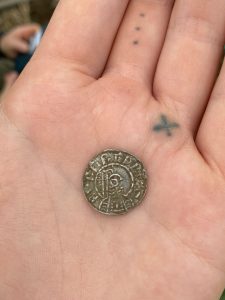
One of the Silver coins
Another hoard nearby
The Severn Stoke Hoard, discovered around 22 km to the west, was buried slightly earlier, around AD 868.
Twelve of the coins in that hoard were also struck for King Burgred. The others were issued by three kings of Wessex – Æthelwulf, Æthelberht and Æthelred I.
The burial of the Severn Stoke Hoard has sometimes been interpreted as evidence for Viking incursions along the River Severn at this time. However, surviving documentary sources only record Viking forces reaching Gloucester in AD 877/8, several years after the hoard was buried.
Clues pointing to Vikings?
According to Gareth Williams, former Early Medieval coin specialist at the British Museum, the Bickmarsh Hoard may add weight to the idea that Vikings were active in the region.
The key piece of evidence is the presence of Frankish coins. Coins from northern Europe are relatively unusual in Anglo-Saxon hoards but appear more frequently in hoards associated with Viking activity.
Two comparable Frankish deniers were found in the Watlington Hoard (Oxfordshire, c. AD 878–879) and at least one in the Herefordshire Hoard (AD 877–879). Others are known from the Croydon Hoard (AD 871–872).
Unlike Bickmarsh, these hoards contain bullion as well as coins, giving them a clearer Viking character. Even so, they establish a wider pattern of Frankish coins appearing in Viking-period hoards, reflecting the documented movement of Viking forces from Francia to England.
A particularly intriguing coin
Perhaps the most striking object in the hoard is the imitative gold solidus.
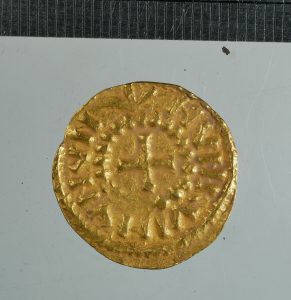
The gold solidus of Louis the Pious
Gold coins appearing alongside silver are also known from the Watlington and Herefordshire hoards. Evidence for a mixed gold-and-silver economy can also be seen at Viking army sites such as Torksey (Lincolnshire, AD 872–873) and Aldwark (North Yorkshire, c. AD 874–876).
Excavations at Torksey have even produced evidence that imitative gold coins were being produced at the Viking camp itself, as well as circulating as currency.
Does the burial of the Bickmarsh and Severn Stoke Hoards in the late 860s and early 870s indicate that Worcestershire was subject to Viking incursions not recorded in the surviving documentary sources, or could they be indicative of unrest closer to home?
In the final article in this series, we explore the wider historical context and consider whether the burial of the Bickmarsh Hoard might be linked to unrest within Mercia, or even to the movements of Viking armies.

Information in this article is taken from The report for HM Coroner on possible Treasure from Bickmarsh, Worcestershire by Gareth Williams, Early Medieval coin specialist at the British Museum at the time of the report.


Post a Comment