Bickmarsh Hoard – Life in 9th century Bickmarsh
- 10th April 2026
Imagine walking along a quiet country lane in rural Worcestershire. Fields stretch away on either side, and the landscape feels peaceful and timeless. Yet over 1,100 years ago this same landscape may have been a place of uncertainty, where someone buried a small collection of coins in the ground and never returned to reclaim them.
The Bickmarsh Hoard, a rare ninth-century coin hoard, offers us a glimpse into that moment in time. In this third and final blog in our series, we explore what the hoard might tell us about life in Worcestershire during the ninth century. (Read Part One and Part Two)
A Landscape with Deep Roots
Today Bickmarsh is a small hamlet of scattered houses and farms arranged along the former Roman road of Ryknild Street, where it meets Sixteen Acres Lane. Sitting on the border between Worcestershire and Warwickshire, it lies within a low-lying landscape that has seen people living and farming here for centuries. Archaeological evidence suggests settlement in this area dates back to at least the late Iron Age.
The location would have made it an attractive place to live. Bickmarsh lies just over a mile south of the River Avon, close to the ancient settlement of Bidford-on-Avon, and directly beside a major Roman road. Access to water, fertile farmland and important routeways created ideal conditions for small rural communities to thrive.
Even so, Bickmarsh seems always to have remained a rural settlement, a place of farms and fields rather than a large town.
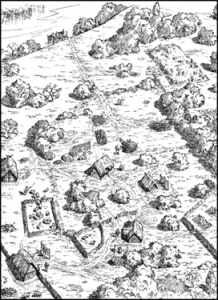
Artist Steve Smith’s reconstruction of the Early Medieval/ Early to Mid Anglo-Saxon settlement at Saxon Lodes Farm, Ryall Quarry, Ripple. Bickmarsh may have looked similar to this at the time the hoard was buried. Image © Worcestershire Archaeology Society and Cotswold Archaeology
Why Was the Hoard Buried?
The Bickmarsh Hoard was buried sometime around AD 871–874, not long after another ninth-century hoard from the county was deposited at Severn Stoke around AD 868.
But why bury coins at all?
Hoard deposits are often linked to periods of uncertainty or instability. Someone might hide their wealth in the ground intending to return once the danger had passed. In many cases, however, the owner never came back.
The shallow burial of the Bickmarsh Hoard suggests exactly this kind of hurried decision.
Worcestershire in the Kingdom of Mercia
In the ninth century Worcestershire lay in the heart of the Kingdom of Mercia, one of the most powerful Anglo-Saxon kingdoms in England. From the late seventh to the mid-eleventh century Mercia and Wessex dominated much of the political landscape of Anglo-Saxon England. At its height Mercia was the largest and most influential of the Anglo-Saxon kingdoms.
When the Bickmarsh Hoard was buried, Mercia was ruled by King Burgred, who reigned for 22 years and is often considered the last truly independent Mercian king.
In AD 874, however, Burgred was driven into exile in Rome, a date that coincides closely with the estimated burial date of the Bickmarsh Hoard.
The Viking Advance
The Anglo-Saxon Chronicle records the movements of Viking armies across England during the ninth century. From the 860s onwards they pushed south and east from Northumbria and East Anglia, gradually expanding their control.
In AD 867 they captured Nottingham, deep within Mercian territory. Burgred attempted to buy peace, but the threat continued to grow. By AD 874, Viking forces had marched into Repton, forcing Burgred into exile. After his departure, the Vikings installed Ceolwulf as a client king loyal to them.
Just a few years later, in AD 877, a treaty between King Alfred of Wessex and the Viking leader Guthrum established the Danelaw, a region of England under Viking rule stretching roughly north and east of a line from London to Chester. Worcestershire lay just outside this boundary, remaining under Anglo-Saxon control, though the wider political situation would still have felt increasingly uncertain.
A Rural Community Near Important Centres
In the ninth century Worcester was an important ecclesiastical and administrative centre. Its cathedral still preserves a remarkable archive of Anglo-Saxon charters, many relating to land ownership and church affairs.
These documents provide valuable insights into the political landscape of the time and show connections between Mercian rulers, the church and the rising power of the West Saxon royal dynasty.
Bickmarsh itself appears to have remained a small rural settlement, located around 25 km from the trade routes along the River Severn and the important centre at Worcester. However, it was much closer to Bidford-on-Avon, only around half an hour’s walk away. Bidford was an important Mercian settlement and would likely have played a key role in the local economy.
Coins from Across Europe
One of the most intriguing features of the hoard is the wide range of coins it contains.
Alongside Mercian coins are Frankish deniers, a gold solidus, and even a coin from East Anglia. These objects hint at connections that extended far beyond the local landscape. Some researchers, including Gareth Williams, have suggested that this mixture of coins might indicate Viking activity in the region.
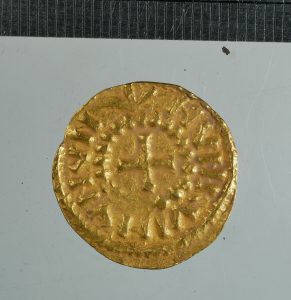
The gold solidus of Louis the Pious
However, documentary sources preserved in the Worcester Cathedral archives do not record Viking incursions into Worcestershire itself.
The Roman Road Connection
Another possible explanation may lie in Bickmarsh’s location beside Ryknild Street, one of the major Roman roads that once crossed Britain.
Long after the Roman period these roads remained important routes for trade, travel and the movement of armies.
It is therefore possible that coins from many regions circulated more widely than we currently realise, particularly along major routeways and in settlements such as Bidford. At present, we simply do not yet have enough archaeological evidence to know how unusual the Bickmarsh Hoard truly is.
A Story Still Waiting to Be Fully Told
The shallow burial of the hoard suggests someone hid it quickly, perhaps expecting to return later.
Did the political turmoil surrounding the Viking advance and the fall of King Burgred play a role in that decision? Or was it simply a precaution taken during uncertain times?
For now, the Bickmarsh Hoard leaves us with more questions than answers. Yet it offers a rare glimpse into a moment when even the quiet rural landscapes of Worcestershire may have felt the ripple effects of events reshaping Anglo-Saxon England.
You can find out more about Anglo-Saxon Worcestershire in our Early Medieval Research Framework.



Post a Comment