Lavinia Talbot’s diary : Reflections on the War and the weather, summer 1917
- 7th August 2017
Lavinia Talbot kept a diary from her teens to old age. She regularly recorded her thoughts and feelings about her life and events unfolding around her. Her three sons served in the forces during World War I, as did the children of her wider circle of family and friends, so her wartime diaries include many observations on the conduct of the war.
Anniversary of the death of her son Gilbert
Lavinia’s diary for July 1917 was initially full of social activities and ecclesiastical duties associated with her husband’s role as Bishop of Winchester. As the month wore on her thoughts were very much focused on her youngest son Gilbert who had been killed two years earlier at Hooge. His death clearly still affected her deeply as she noted on the 26th ‘the shadow of ’15 over these days’ and on the 29th ‘thinking of Gilbert all day’. The anniversary itself, 30th July, was marked in the diary with a cross and the entry showed that her thoughts for that day were very much of Gilbert.
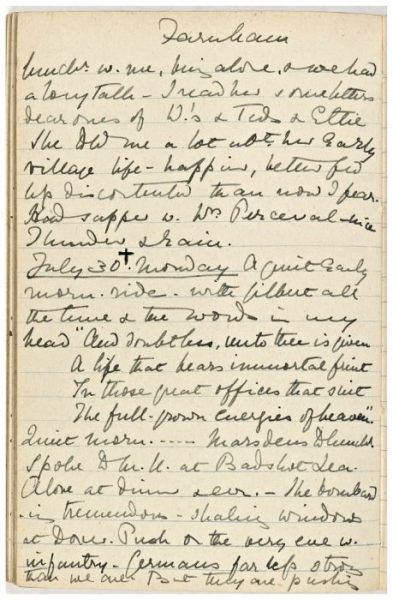
Lavinia’s diary entry for 30 July
Passchendaele
But Lavinia’s mind was also very much on the coming British offensive. Her diary entry for 18th July noted ‘immense bombarding going on in Flanders’, calling it ‘a preparation for one of the Great pushes’. On 23th July she recorded ‘the pulsing feel & noise of the awful guns in Flanders’. On 30th July she noted ‘the bombarding tremendous – shaking windows at Dover’. There were many stories of people living in the south of England during World War I hearing the sounds of heavy artillery barrages or exploding mines from the Western Front, so Lavinia was evidently one of them.
Much of her entry for 31st July was given over to the launch of the ‘3rd Ypres battle’ as she called it, later known as ‘Passchendaele’. The infantry attack was to begin on 31 July and Lavinia seemed herself to be aware of this as she recorded that ‘the “Push” has begun – at 4am’. She was very well connected and had been at the House of Lords earlier that day so that may be how she obtained her information. She noted that the British had taken ‘the first line of the Germans’ and had also taken prisoners and that the French seemed to have been successful too. She also recorded ‘DD’s’ anxiety for her son Oliver who would be in the thick of the battle. This is likely to be referring to her nephew Oliver Lyttelton, son of Alfred and Edith Lyttelton, who served in the Grenadier Guards in World War 1.
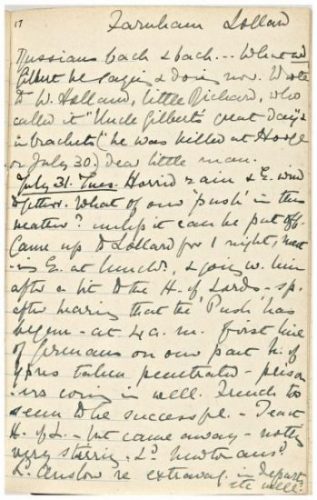 |
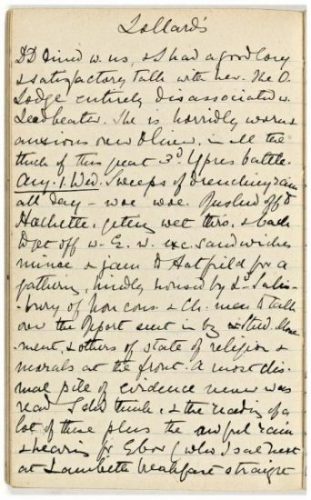 |
| Lavinia’s diary entry for 31 July commenting on the first day of Passchendaele and her nephew Oliver | |
The weather
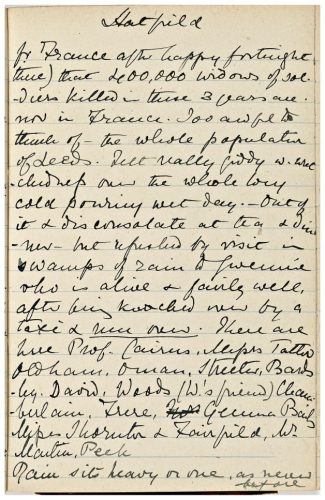
Lavinia’s diary entries for the period also commented on the bad weather in England at the time and in particular the affect it might have on the ‘push’. As July turned to August her descriptions of bad weather continued. On 1st August she complained ‘Rain sits heavy on me as never before’. She described ‘sweeps of drenching rain all day’ and ‘swamps of rain’ when out visiting. Certainly many accounts of the Third Battle of Ypres comment on the appalling weather conditions participants of the battle had to endure.
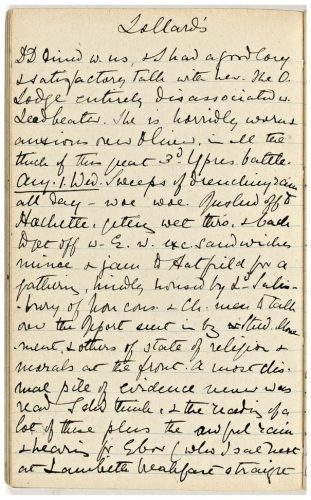 |
 |
| Lavinia’s diary entry for 1 August commenting on the weather | |
Lavinia Talbot’s diaries are part of the Lyttelton collection held at The Hive. For information about using our original archive collections please see our Visitor Guide.
Further reading
For more information about the Third Battle of Ypres, see:
The Battle of Passchendaele on Wikipedia
BBC History’s account of Passchendaele
For information about Oliver Lyttelton, see:
The Wikipedia entry for Oliver Lyttelton, 1st Viscount Chandos
By Maggie Tohill


Hi there. Love your blog!.