W.P. Harper, famous football referee of Stourbridge
- 14th May 2026
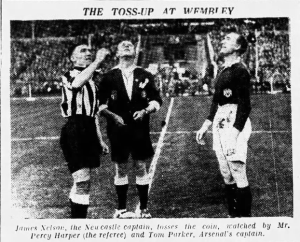
Coin toss, F.A. Cup final 1932, Sunday Mercury, 24th April 1932 © Newspapers.com
On 23rd April 1932, during the F.A. Cup final between Newcastle United and Arsenal, a refereeing decision would create controversy and change the result of the game.
The referee, one W. P. Harper of Stourbridge, allowed an equalising goal for Newcastle that appeared to go out of play before ending in the net. Newcastle would go on to win the game against Arsenal 2 – 1, much to the consternation of the fans from North London.
Despite this controversy, the referee from Worcestershire had a glittering career as an official, spanning some 27 years and we at Worcestershire Archives are fortunate to care for his collection of papers and records covering his career in football.
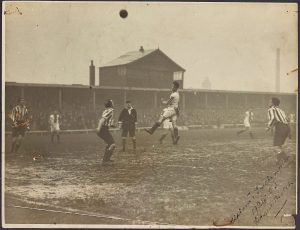
Oldham v. Southampton, Division 2, 1924/25 season. BA1786/1a
Born in Stourbridge in 1892, William Percival ‘Percy’ Harper was by profession a law clerk and civil servant at the County Courts as well as a part-time fireman and special constable during the Second World War.
W.P. Harper began his footballing career as an official in various Worcestershire leagues before being called upon to officiate the 8th January 1921 fixture between Division 2 Leicester City and that years Division 1 champions, Burnley, in the F.A. Cup.
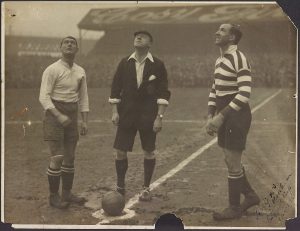
BA1786/1b
By the mid-1920s, Harper was an established Football Association official and acted as assistant referee in the 1926 and 1931 F.A. Cup finals. In 1932, he was given the honour of refereeing the F.A. Cup final between Newcastle United and Arsenal. The controversy of a Jack Allen equalising goal is referenced above.
Despite this, it was not just domestic fixtures but also international ties that were officiated by the man from Stourbridge, refereeing fixtures between the ‘Home Nations’ and even Netherlands v. Belgium.
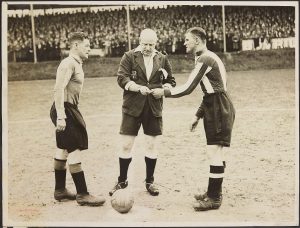
BA1786/1a
At his retirement in 1939, Harper had officiated at every single First Division, Second Division and most of the third tiers teams grounds.
W.P. Harper was not to be found just on the pitch. After the Second World War, Harper acted as Secretary of the Worcestershire Football Association, was a member of the England International Selection Committee and was chairman of the Aston Villa Shareholders committee.
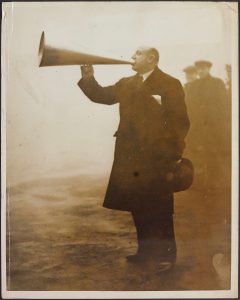
Game at Stamford Bridge cancelled due to fog. BA1786/1a
In September 1927, he led a team of Worcestershire footballers on a tour of the United States, culminating in games against teams from Worcester, Massachusetts. Results were two wins, two draws and one defeat. This followed on from a 1926 tour of England by an American team.
He appears to have lived in Stourbridge all his life, passing away at the age of 62 in 1954.
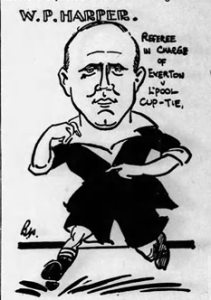
Caricature from The Evening Express, 2nd January 1932 © Newspapers.com
If you are interested in the footballing career of W.P. Harper, you can view his collection at Worcestershire Archives under the reference 899:195 BA1786/1 and 2.


Post a Comment