Off the illustrator’s desk – a Bronze Age pot falling apart for unexpected reasons
- 4th September 2017
What’s so unusual about an old pot falling apart? Isn’t that just what old things do?
This particular pot is decorated and comes from a Bronze Age cremation cemetery in Staffordshire, so it is at least 3500 years old. The pot was found fairly whole, standing up in a small pit, filled with a small amount of cremated remains and fragments of another pot.
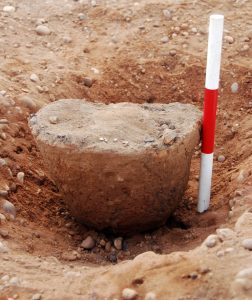
Photo of the urn on site prior to being lifted – the shallow depression around it is the burial pit (30cm scale).
Back in the office our archaeological illustrator, Laura, has just finished carefully drawing and photographing the pot, which has been slowly crumbling to pieces. Whilst studying the pot in detail, Laura realised that the pot has been made in an unusual way – the base and sides were made as separate pieces and simply placed together, with no attempt to mould or join them, as was typically the case. Instead, the pot’s maker chose to cover the base and sides with a thin layer of clay, which was later decorated. Although this held the pot together, it’s not how you’d make a pot intended for everyday use.
So, it seems that we have a pot made specifically for one particular use. A cremation burial. This funerary urn was buried with a little cremated bone and several fragments of a different pot inside – perhaps this second pot was placed on the pyre, where it broke?
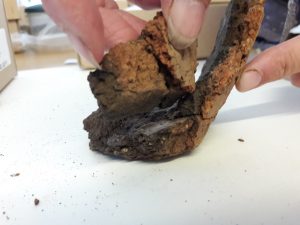
The orangey outer layer of clay is flaking away from the sides and base.
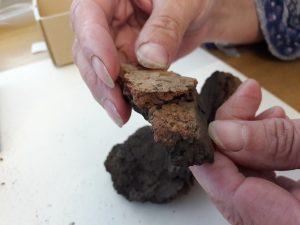
Laura holding a side fragment by the pot’s base. See how the fragment has broken off, revealing smooth surfaces where the side and base meet.
As mentioned earlier, this pot was decorated once made. Small depressions, roughly circular or oval in shape, have been pushed into the damp clay in no obvious pattern. Most of the marks occur in pairs, suggesting that the impressions were made with the end of a small bone.
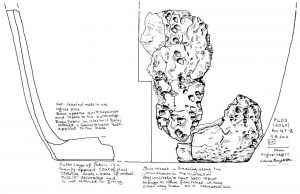
Laura’s annotated drawing of fragments from the Bronze Age funerary urn
Laura’s annotated drawing of fragments from the Bronze Age funerary urn.
What exactly are we looking at here? A potter churning out urns that can be individualised through decoration – an early example of a customisable mass produced item? Or a one-off urn made specifically with an individual in mind?
It is tempting to see the easy assembly and weak construction of the pot as a sign of speed and a lack of care on behalf of the maker (whether they were a full time potter or casual pot maker). However, we have to remember that our 21st century European mindset is not universal across time and space. What we assume may not be what others would assume. It is equally plausible that the way the pot was formed, and even the act of making it, may have held great meaning and importance to those Bronze Age people who lived and died 3500 years ago in the region we now call Staffordshire.


It’s certainly poorly made, but possibly more importantly very poorly fired. The division of the base from the wall may simply be the result of the potter having pressed out the disk for the base with rather greasy hands. Something that I’ve demonstrated in several experiments. Finishing the outer surface with a thick slip or slurry layer wouldn’t be unusual, and the division between the black and the orange fabric, would appear to be simply a result of the pot having been fired upside-down. This results in the outside becoming re-oxidised at the end of the firing while the interior, sealed by the rim sitting ti ashes, remains heavily reduced. I have often debated whether such pots could have been fired in the funeral pyre, such a fast firing may well cause additional trauma to the outer layer of the pot, particularly if it has been recently made and possibly a little damp in the core. Would love to have a closer look at this.
Thanks for your comments