Retroconversion Project Update
- 21st November 2026
We’ve been working hard on our ongoing retroconversion project to digitise paper catalogues, and we’ve made considerable progress. In this blog, we’re going to give you a general update on what we’ve done, what we’re doing now, and what’s coming next!
What have we done?
We’ve finished scanning our paper catalogues and finding aids. We now have digital versions of all of those. This means we have backups of everything, and we’ve been able to provide digital images of catalogues in response to enquiries.
When we started this project, we had 15% of our catalogues available digitally via CALMview, and our goal is 70%. We’re now up to 49%, which is great progress! A big chunk of that increase comes from our official collections – the records of the County Council, District Councils, Hereford and Worcester NHS Trust and other government bodies. We’d been working on retroconverting these for some time before this particular project. We’ve been able to finish and check that work, and make those catalogues live and publicly available.
We’ve scanned more than 13,500 catalogues and made around 3500 accessions entries and over 6000 catalogue entries since this project began!
What are we doing?
Currently, we’re focusing on three broad class ranges: class 705, class 850 and class 899. These are personal collections, parochial archives and artificial and stray collections respectively. When we’ve done retroconversion previously, we never made these catalogues a priority, as we wanted to focus on official collections.
We’re processing these records through two main workflows.
Accessions entry
This involves making entries in the accessions database of CALM. These are basic outlines of a collection, which we can then use as the skeleton to hang a more complete catalogue off of. We’re inputting basic information from the first covering page of the catalogue – the title and a short description of the collection, covering dates, a summary of physical condition, and information regarding the history of the collection. This is also where we connect collections to their depositors.
Catalogue entry
After we’ve made an accessions entry for a collection, we can then link this record to the CALM catalogue database. This contains more detailed information about a collection – all the information from the paper catalogue. Our CALMview online catalogue is taken from this database.
We’re doing this in two ways.
First, for smaller collections we’re manually importing them into the catalogue database. Many of our catalogues are single page, and so the information we take from the first page at the accessions step is already a complete catalogue. Moreover, another sizeable body of catalogues are only a handful of pages long, so it really isn’t much work to add those in manually.
For larger catalogues, we’re running the catalogue pages we scanned earlier through ABBYY FineReader OCR software. We can then take the text this produces, and put it into a spreadsheet that CALM can ingest. To speed this up, we’re making use of the Council’s CoPilot AI license. This can perform simple but time-consuming formatting tasks for us. Because it’s a special institutional license, our data remains on UK servers and isn’t used for training AI.
This process still takes time – we’re striving to retain accuracy and quality – and only works with printed and typed catalogues. However, it gives us a chance to digitise some very large catalogues that would otherwise be impossible within the constraints of the project and staff time. For instance, we’re currently working on BA4000, a collection of over 66,000 solicitor’s papers, the catalogue for which runs to 140 pages!
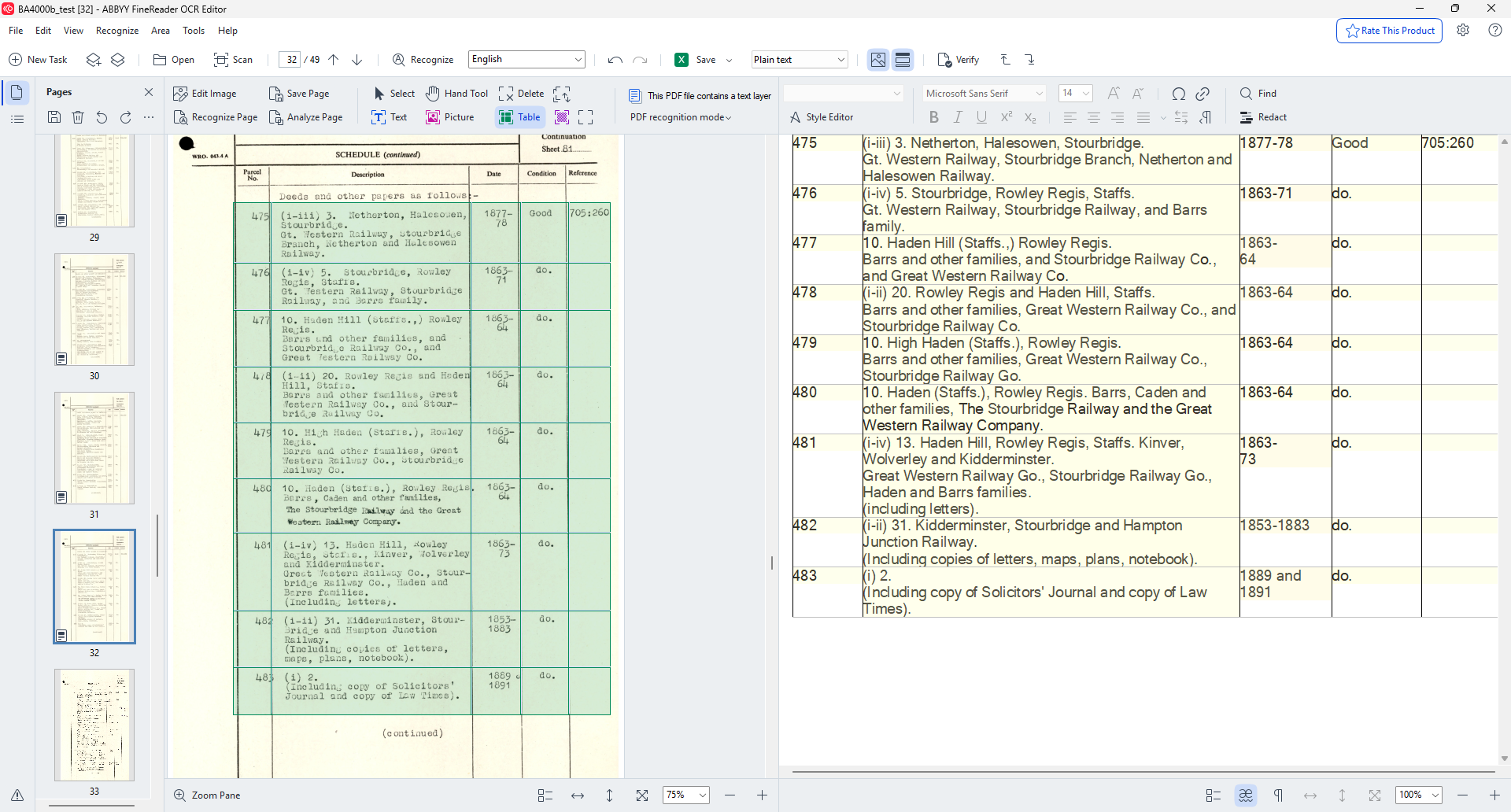
One of the pages of BA4000, one of our largest catalogues, being processed in ABBYY FineReader!
We’ve been trialling this OCR process for about a month now. We have over 130 catalogues in the pipeline, and we’re now ready to start adding those to CALMview.
After we’ve gotten catalogues onto CALM, we’re going through one last check, which is key to retaining accuracy. We know that in future, we might not have the chance to go back over our catalogues in as much detail as we are now, and we don’t want to propagate errors that will now be online for everyone to see. After this final check, we’re making catalogues live in CALM, which means they’re linked to CALMview and available to the public.
Blogs
Finally, as you’ve probably noticed, we’ve been sharing some of the interesting collections that we’re rediscovering. We’ve got more to come, so make sure to keep an eye on our project page! We’re also adding shorter posts to show some things off on our Facebook and Instagram, so keep an eye on those, too.
What’s next?
Over the near future, we’ll be continuing with our current workflows. We’re continuing to make accessions entries and then export those to the catalogue database. In particular, we’ll be focusing on our new OCR workflow. We’ve got a better idea of some of the issues we might face with that, and so we should be able to work more quickly now that we’ve got used to it.
We’ll also be continuing with the 705, 850 and 899 classes. After that, we’ll be focusing on diocesan catalogues. These relate to the central administration and management of the diocese, as opposed to parish affairs.


Post a Comment