Outside Powick Asylum: The Governess of Brockencote Hall
- 21st August 2026
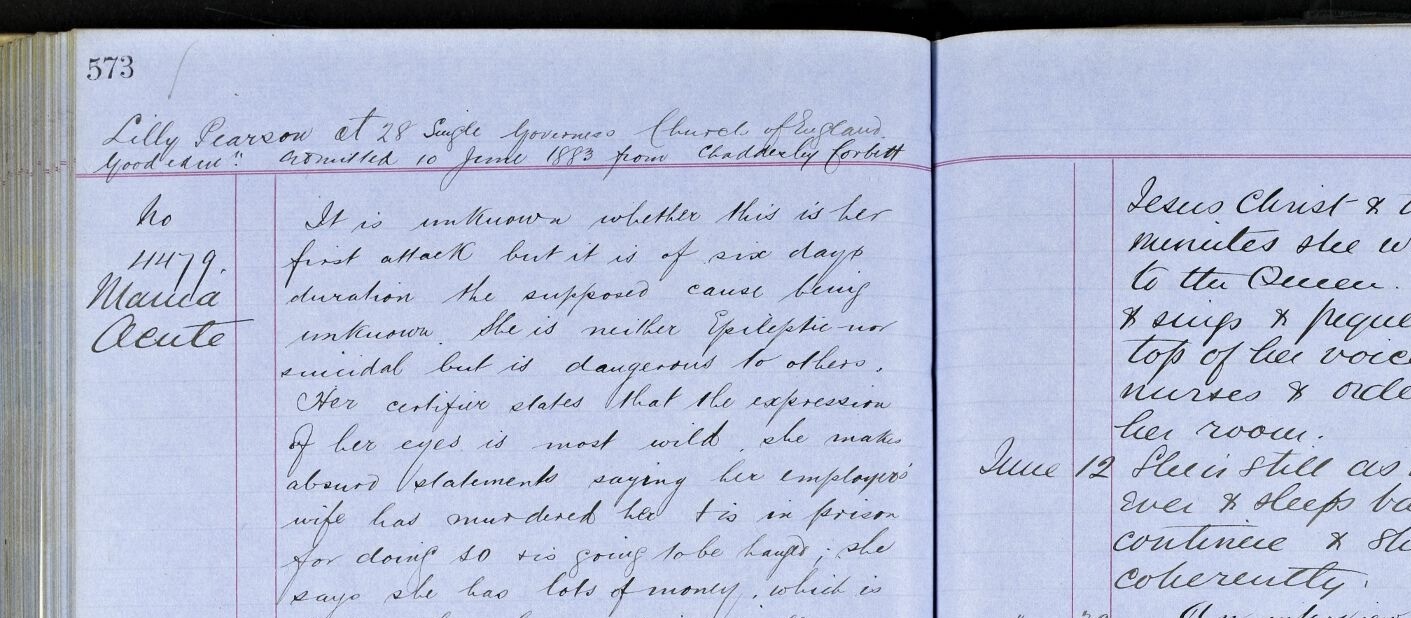
Lilly Pearson recorded in Powick Asylum Powick Case Book Vol.25 Females. No. 4510-4790 p573 at Finding No: 499:9 BA10127/22 © Herefordshire and Worcestershire NHS Trust
In today’s blog, we tell the story of Lilly Pearson, a young woman admitted to Powick asylum whose time is recorded in records we hold over 100 years ago. Alongside patient files which are catalogued covering the period 1890’s-1980’s, we hold admission and discharge registers and volumes containing patient case notes from the late 19th and early 20th century. An outline of existing Powick Asylum (later Powick Hospital) records can be found via our online catalogue at Powick Hospital and the George Marshall Medical Museum’s (GMMM) Outside the Asylum Project which aims to give a voice and tell the story of patients admitted to Powick.
Some of the original patient case notes are included where appropriate to provide further context of their lived experiences alongside other sources*. For those curious or concerned about access to recent patient records, please be aware these are closed to public access under the Data Protection Act to protect living individuals. You can learn about the story of up to 60 patients through GMMM’s Outside the Asylum Patients portal and we would like to thank the Curator and team at the GMMM for their kind support and assistance with this research.
*Please note, users may encounter outdated, offensive, or harmful language used in original records reproduced and/or described in this blog. Words whose meaning we are familiar with today may describe something very different in the past. As such historical records reflect the terminology of their creators. This includes derogatory naming conventions regarding race, ethnicity, gender, identity, and disability. We retain any original descriptions used to preserve historical context, evidence, and research integrity.
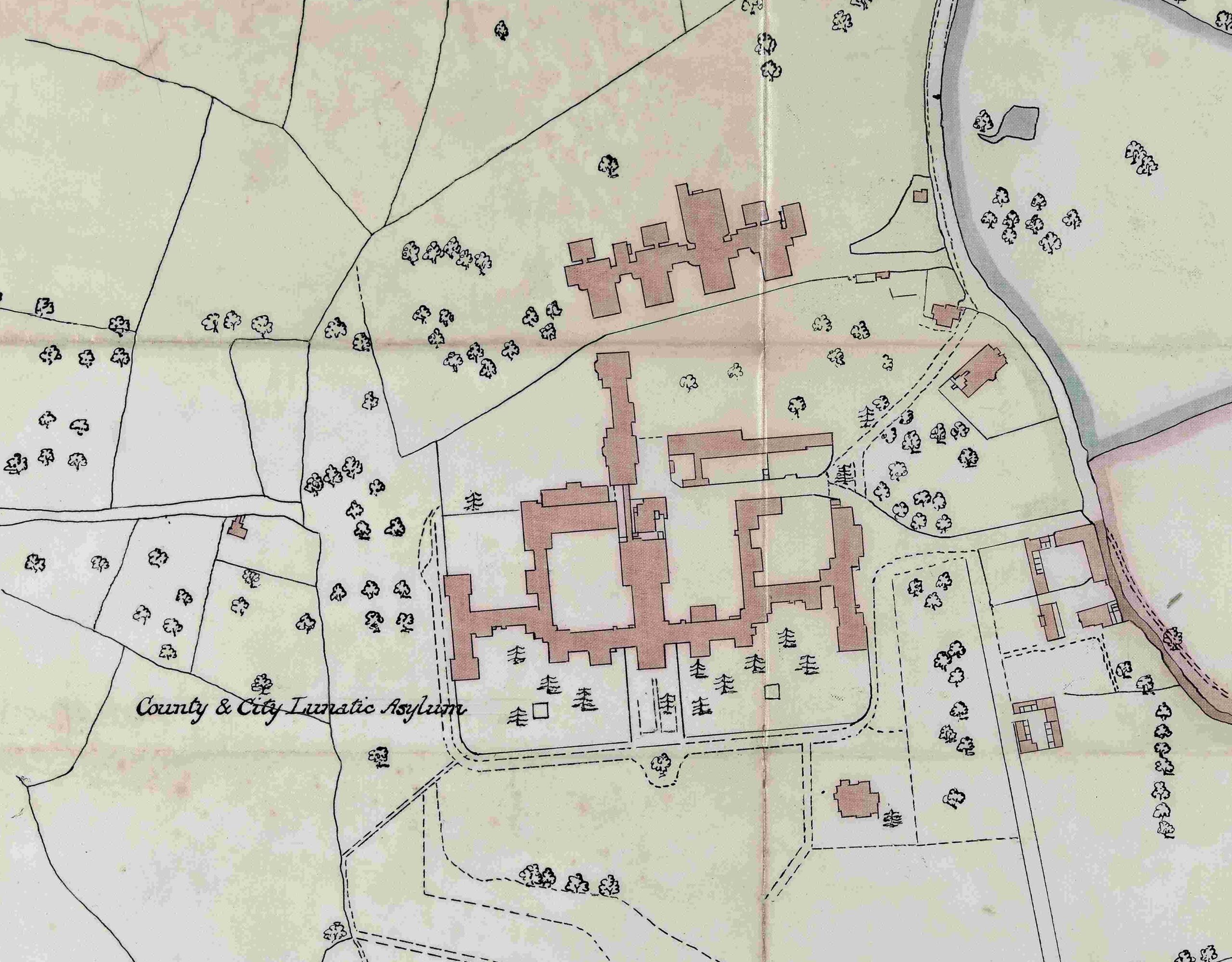
Plan of Powick asylum and grounds Finding No: BA10271 (iv) 33/9 late 19th century © Herefordshire and Worcestershire NHS Trust
Male and female patients admitted at Powick asylum and recorded in case books in the late 19th century are diagnosed with conditions which include Dementia, Mania (from Simple, Acute to Chronic), Melancholia and discrete Manias such as Puerperal Mania (which is said to have developed in a woman who was pregnant or had undergone parturition) as described by Daniel Hack Tuke in the ‘Dictionary of Psychological Medicine’ (1892). Where appropriate, when discussing a patient, a definition has been included, but for further information, please refer to Tuke’s Dictionary and/or ‘Pauper Lunatics at Powick Asylum, Worcester 1852-1918’ by Frank Crompton and Katie Leach, which describes these conditions and references individual cases. Madness or insanity in the 19th century was predominantly believed to be an affliction of the female population. As Andrew Sculll writes in ‘The Most Solitary Afflictions: Madness and Society in Britain, 1700-1900’ women stood disproportionately as exemplars of irrationality, as they were generally portrayed as biologically weaker than men, and therefore more likely to succumb to insanity (Scull, p.360, 1993). Elaine Showalter also agrees that 19th century madness was presented as a ‘female malady’, asserting that femininity was associated with irrational thinking. Historians and researchers have shown, strongly, that this, is of course, false and largely based upon the over-representation of female admissions to Victorian asylums. In fact, men admitted to asylums outnumbered women by some 30% and as reported by Dr. Farr, a pioneer in the development of medical statistics, declared that insanity was 23% more fatal to males than females, and the probability of recovery for women was considerably higher than men (William, W., 1898, p.186). Women were far more likely to be interned, treated and discharged, whereas when men were admitted to an asylum, it was unlikely that they would ever return as a ‘sane’ member of society (Busfield, Joan, 1994, p.265).
Mania
The following patient was named in the Powick asylum case book as diagnosed with Mania. According to Tuke’s ‘Dictionary of Psychological Medicine’, Mania was insanity described in its full development by mental exaltations and bodily excitement. Commonly mania was also used for the delusions of the insane. Acute mania was where the mental exaltations and excitement were more intense. In such cases, there was a total loss of self-control and in some cases absolute incoherence of speech and in other cases unconsciousness and sometimes memory loss (Crompton, F. and Leach, Katie, 2020, p.26).
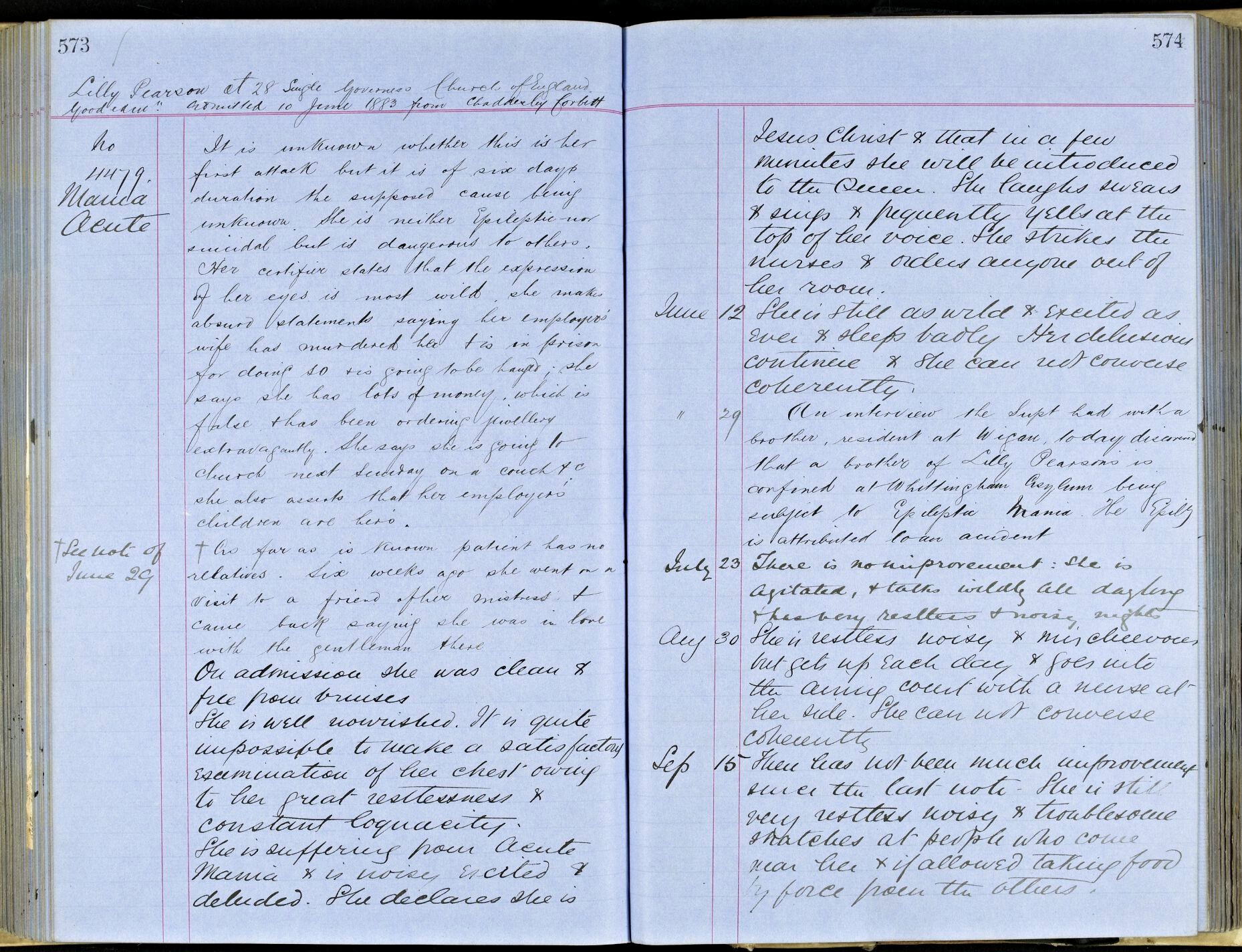
Lilly Pearson recorded in Powick asylum Case Book Vol.25 Females. No. 4510-4790 p573 at Finding No: 499:9 BA10127/22 © Herefordshire and Worcestershire NHS Trust
Who was Lilly Pearson?
Of the many cases of women described in the records of Powick asylum, the case of Lilly Pearson is a moving story but is also a window into the role of Governess – a precarious and often ambiguous profession for women in the 19th century. Case notes for Lilly Pearson available on the GMMM portal states Lilly was admitted 10th June 1883 and described as 28 Single, Governess. Church of England. Good Educ[ation] from Chaddesley Corbett. Lilly’s admission number is 4479 and Lilly’s condition was described as Mania (see drop-down section above for definition). It wasn’t known whether this was her first attack and the notes state:
“She is neither Epileptic nor suicidal but is dangerous to others. Her certifier states that her expression is most wild, she makes absurd statements saying that her employer’s wife has murdered her and is prison for doing so and is going to be hanged; she says she has lots of money, which is false and has been ordering jewellery extravagantly.”
The account also says that:
“She says she is going to church next Sunday on a coach and that she also asserts that her employer’s children are hers.”
Even more interesting is the statement that:
“Six weeks ago, she went on a visit to a friend of her mistress: and came back saying she was in love with the gentleman there.”
On admission, Lilly is reported to have no living relatives, though a note of 29th June 1883 appears to confirm that she has a brother:
“…resident at Wigan …[..]… confined at Whittingham Asylum being subject to Epileptic Mania. The Epilepsy is attributed to an accident”.
The certifier describes Lilly as “clean and free from bruises” and “she is well nourished” and that a satisfactory examination of her chest could not be made, owing to what they describe as “her great restlessness and constant coquaiety” and is suffering from “Acute Mania” and is “noisy, excited and deluded.”
Apart from the descriptions in the Case Notes describing what Lilly says, her behaviour, along with the diagnosis at the time, we are unable to comment on her mental ill-health and circumstances. However, by looking at other documentary evidence and the role of Governess in Victorian society, we can build up a picture of perhaps some of the reasons why Lilly may have ended up in Powick asylum. Were these reasons beyond Lilly’s control? Were they preventable? Were they in fact linked to the treatment she received as a result of her employer?
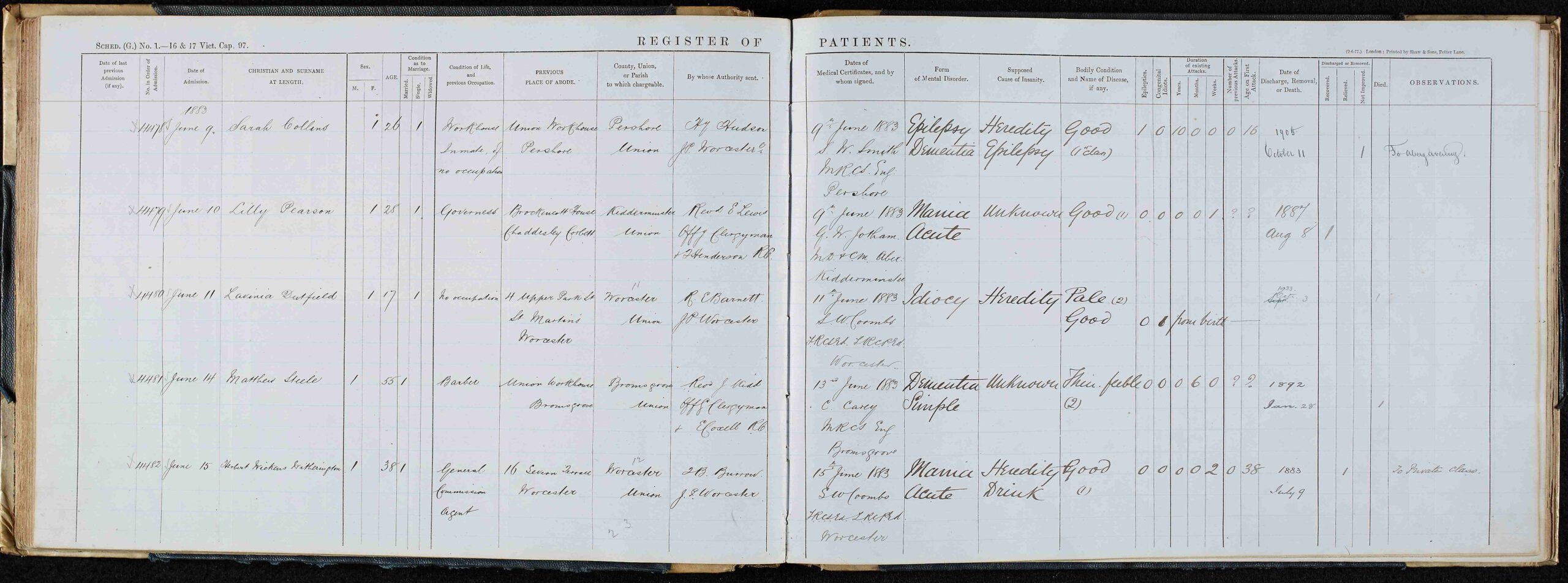
Lilly Pearson recorded in Powick asylum Register of Admissions 4158-4841 at Finding No: 48916 BA834316 c.1881-1885 © Herefordshire and Worcestershire NHS Trust
Whilst attempts to trace Lilly’s earlier life using Census records failed to return any evidence of Lilly, her admission record at Finding No: 489:16 BA8343/16 states her occupation as Governess and her previous place of abode as Brockencott House Chaddesley Corbett. After further research of Brockencott House better known as Brockencote Hall, we learn that Lilly’s employer was Henry Richard Willis, who had bought the estate in 1880 and lived there until 1897. He had already been Mayor of Kidderminster and was a successful Carpet Manufacturer according to the 1881 Census.
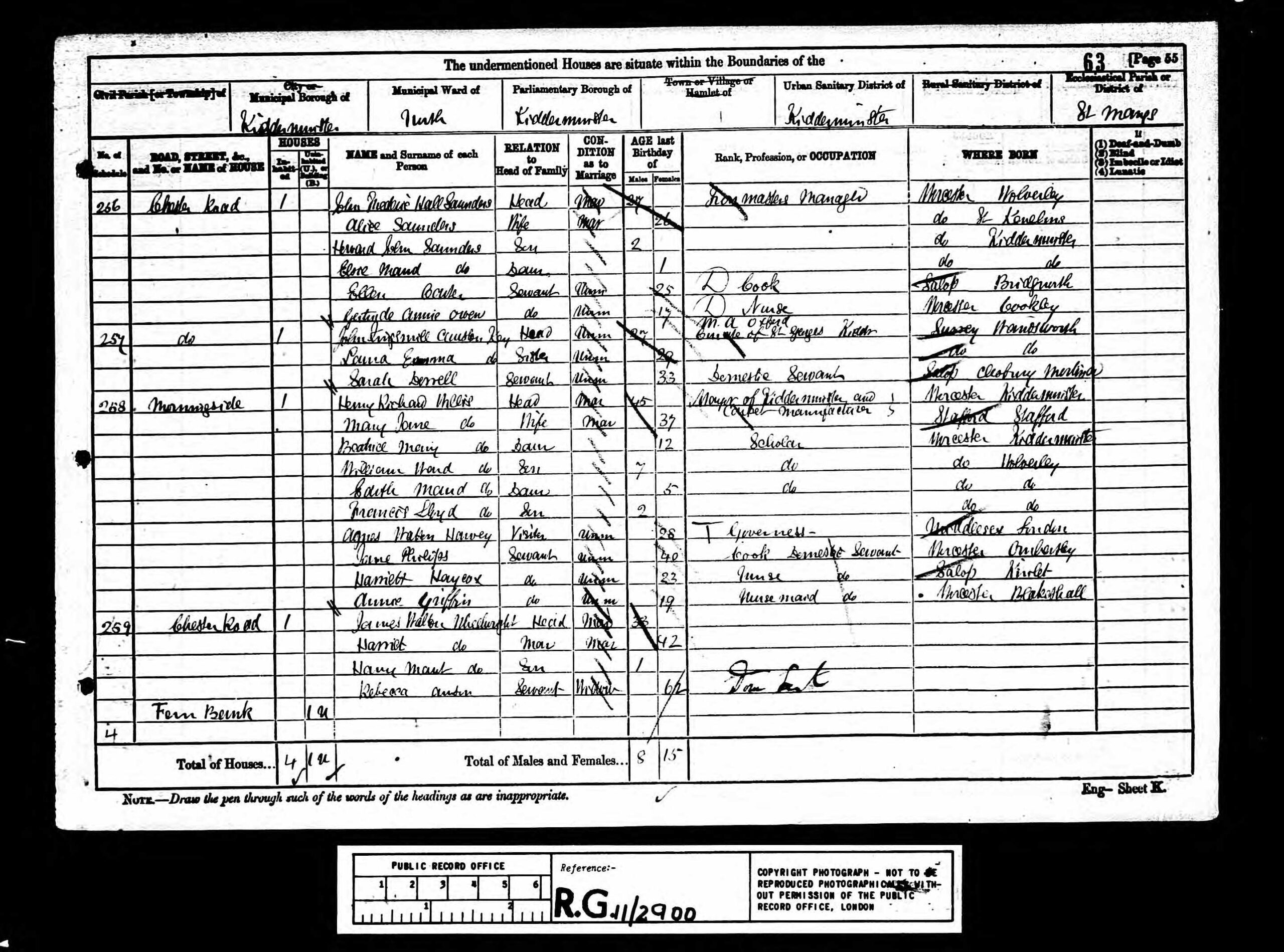
Henry and Mary Willis, family and servants shown on the 1881 Census living at Morningside, with their then Governess Agnes Hatton Harvey © Crown Copyright
By the 1891 Census, Henry Richard Willis is shown living with his young family at Brockencote Hall, having purchased the property in 1880 and rebuilt the Hall apparently ‘on the site of an ancient house’. The new hall boasted reception rooms, thirteen bedrooms and dressing rooms, billiard room, library, an eighty-foot tower with a smoking room and stabling for nine horses.
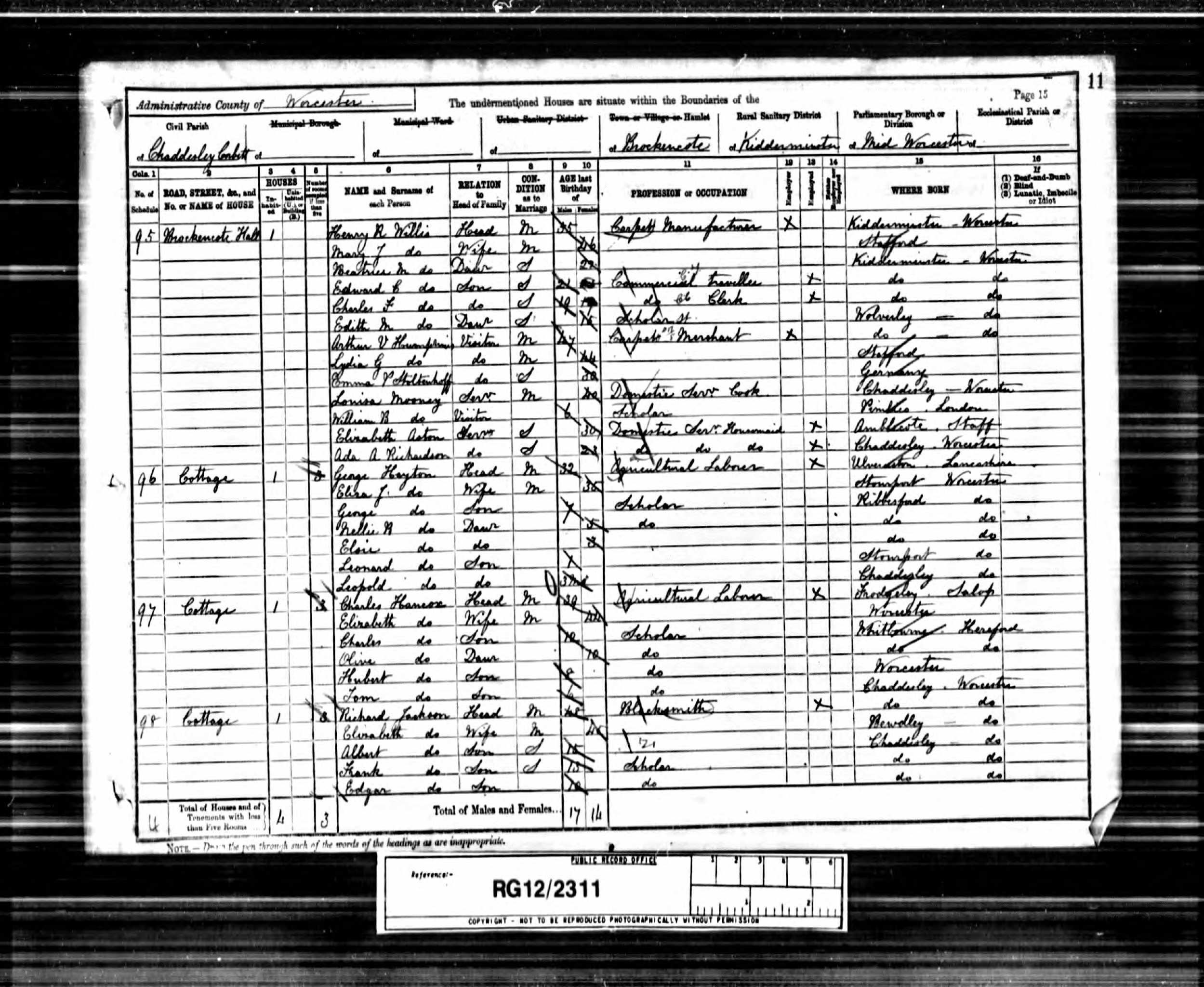
Henry and Mary Willis, family and servants shown on the 1891 Census at Brockencote Hall © Crown Copyright
The social void
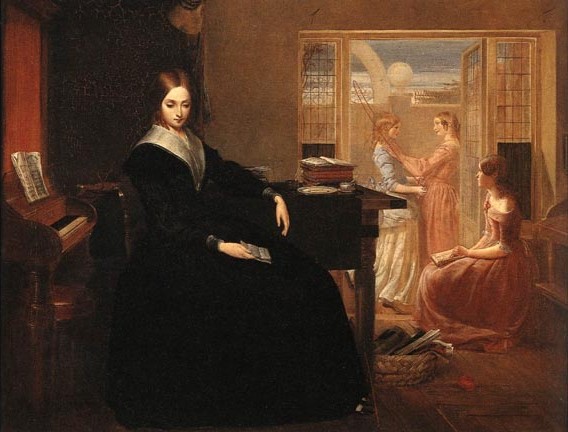
‘The Governess’ painted by Richard Redgrave. It depicts a Governess who has received a letter, possibly carrying bad news, that has stirred memories of home. c.1844 © Public Domain
Lilly was Governess to a high-profile landowning family at Brockencote Hall – a lavish country estate, but what were the realities of life as a Governess in the 1880’s? The role of paid Governess occupied an awkward social space with Victorian society. Governesses were not treated like common household servants but not like family members either. The role of Governess was one of social and emotional isolation, financial insecurity and societal inequality. Whilst their main responsibility was to teach and raise the children, they generally did not spend time with or dine with the family or alternatively any of the servants. Whilst Governesses were seen as well-educated women and treated as ladies, they were also viewed with some suspicion in wider society.
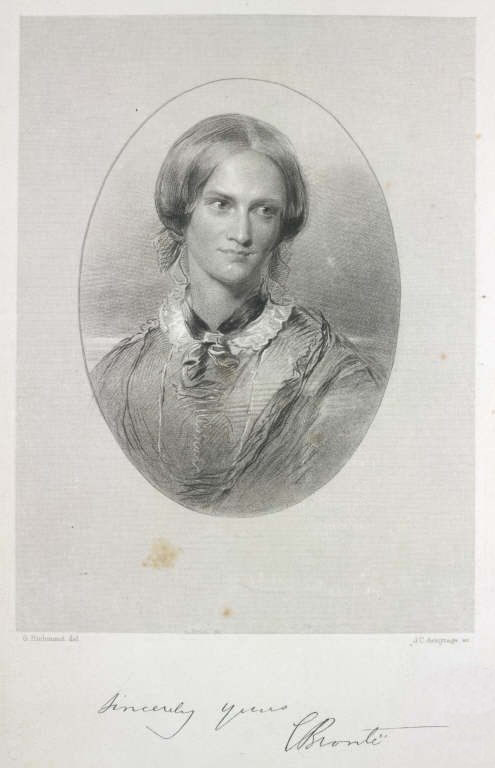
Portrait of Charlotte Brontë. Charlottë and Anne Brontë wrote about their experiences as Governess, serving as inspiration for novels Jane Eyre and Agnes Grey. c.1850 © Public Domain
We do not know the circumstances in which Lilly found herself at Brockencote Hall, but much has been said about the experience of Governesses through their own accounts, including in literature from Charlotte Bronte’s Jane Eyre (who famously ends up marrying her employer Mr. Rochester) and her sister Anne’s Agnes Grey who both worked as Governesses. Charlotte sees the role of Governess in Jane Eyre as very much a necessary path to social freedom and autonomy but detests the social degradation and isolation that comes with it. As Charlotte Brontë writes of her time with the Sidgwicks she had little opportunity to participate in the so-called glamorous goings, serving only to emphasise the distance between the governess and her employer:
‘I used to think I should like to be in the stir of grand folks’ society; but I have had enough of it – it is dreary work to look on and listen.’ (Hughes, p.91, 2001)
As historian Kathryn Hughes writes in ‘The Victorian Governess’ any woman who was unmarried at thirty-five was judged to have failed at life. She goes on to say:
“In large families, the youngest daughter was frequently expected to remain single in order that she might look after her parents in old age. The problem with this arrangement was that it left the unmarried woman at risk from a change in her family’s circumstances. When a brother married or father died, the spinster was obliged to take up her search again for a home amongst her remaining relatives. As she herself grew older, and her usefulness to her family declined the ageing single woman found herself the object of grudging charity” (Hughes, p.117-118, 2001).
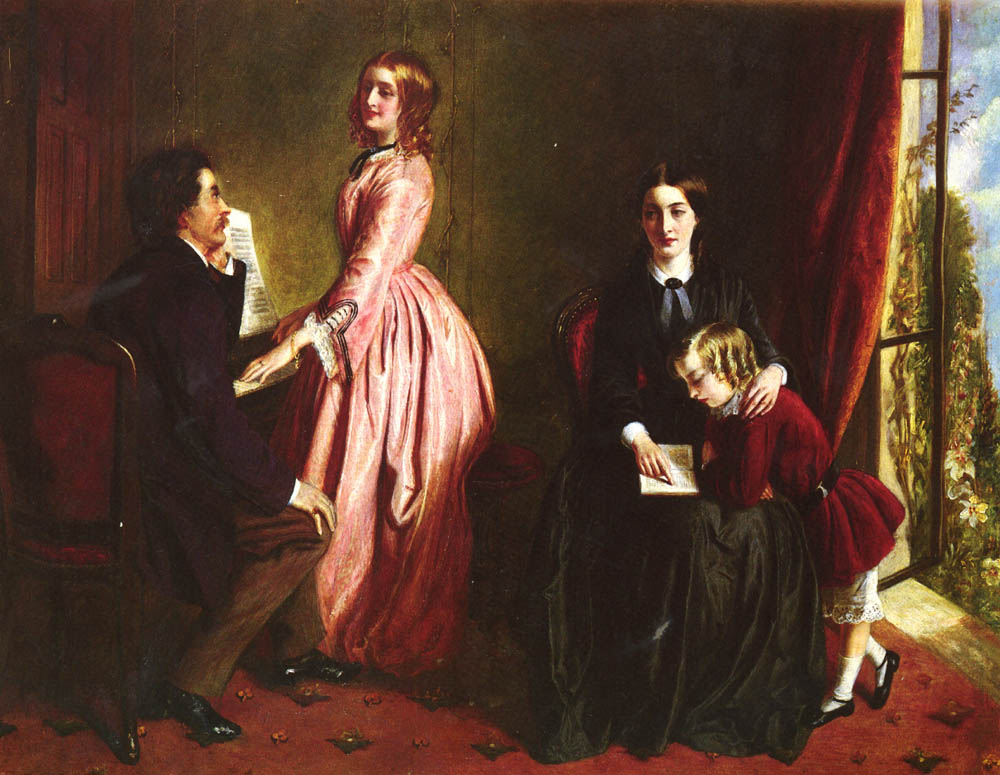
‘The Governess’ painted by Rebecca Solomon. It depicts a Governess dressed modestly and with the deportment appropriate to her quasi-invisible role in the household c.1851 © Public Domain
Subsequently, any middle-class women without independent means or whose families were not able to offer them a home, were left with no alternative but to earn their living in the schoolroom. Some women did not take up Governessing until it was apparent into their late twenties they were unlikely to marry. It was this association with the spinster of Victorian society that laid the basis for the popular image of the Victorian Governess as dry, old and ugly, an embodiment of frustrated emotional and sexual desire. Yet, the evidence says otherwise and whilst a proportion of Governesses were married, those women who lived with their employers were expected, along with domestic servants, to remain single. Furthermore, in 1861, as is the case with Lilly Pearson, two thirds of all governesses were under thirty, some were as young as eighteen (Hughes, p.118, 2001).
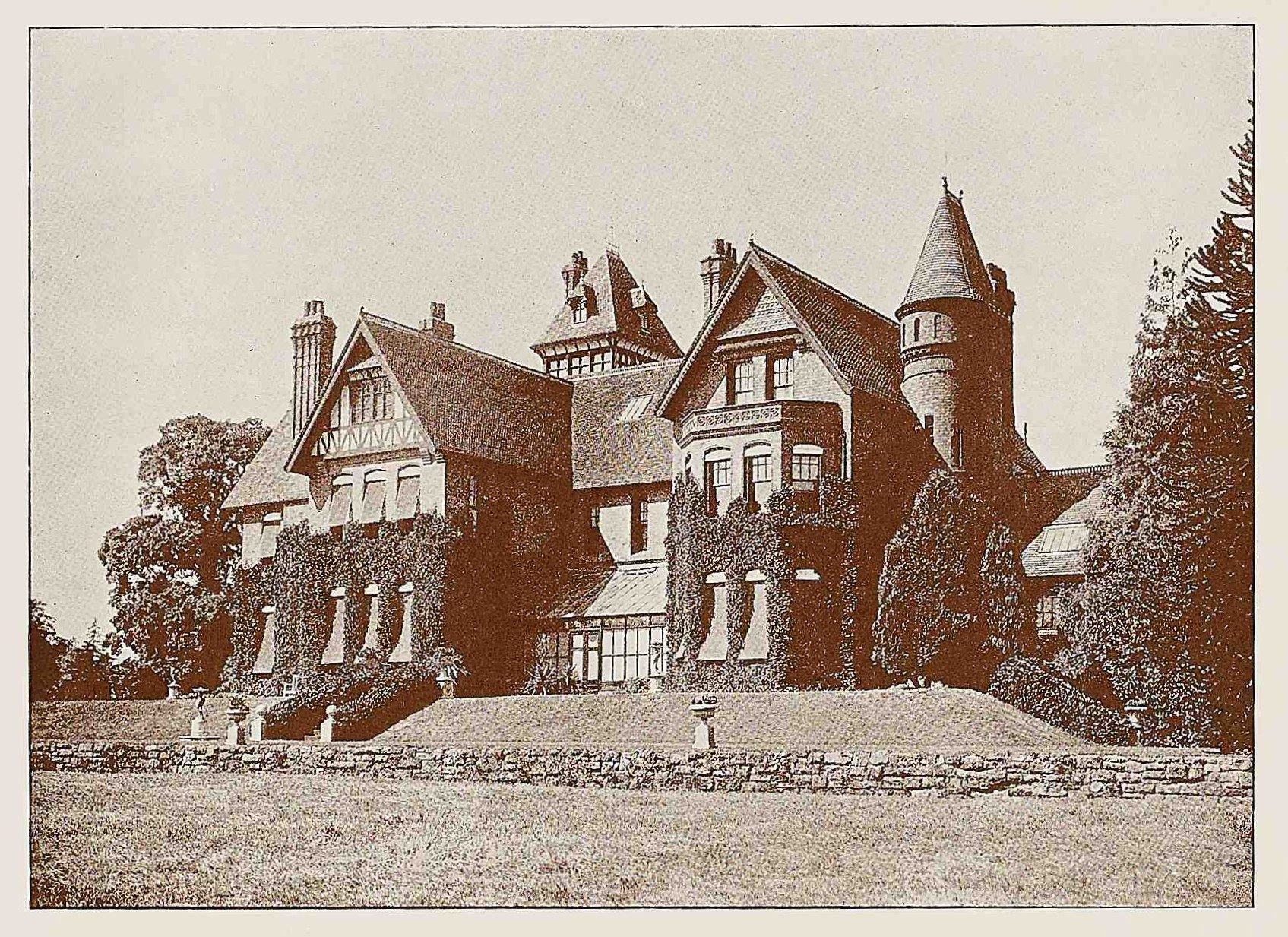
Photograph of Brockencote Hall taken from Sale Particulars at Finding No: b899.31 BA3762/155 c.1914 © WAAS
Employment at Brockencote Hall
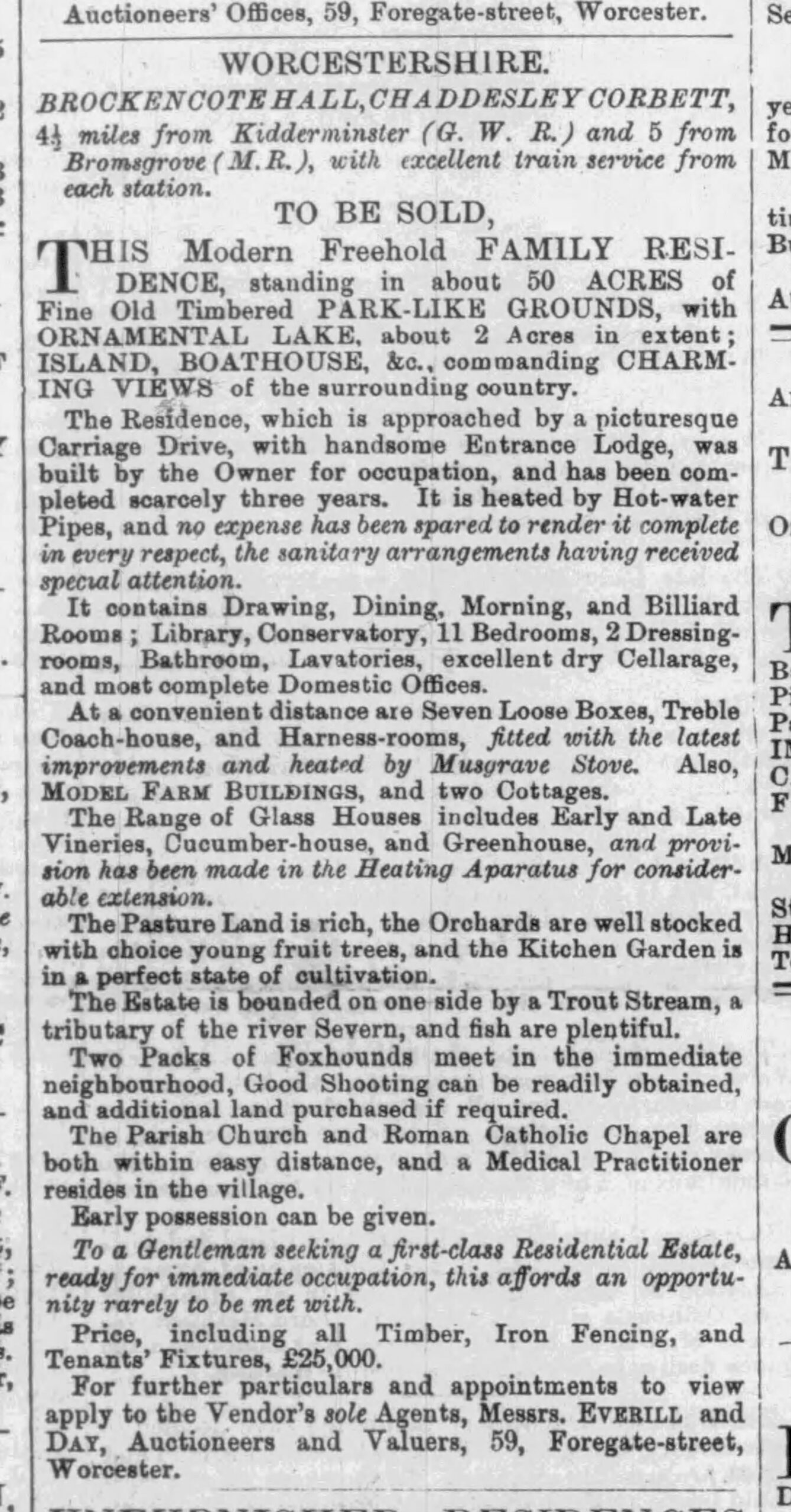
Advert for Sale of Brockencote Hall, The Worcester Herald c.1885 © Newsquest
Whilst Lilly may have seemed lucky to have landed a job as Governess at Brockencote Hall, which is handsomely described in a Worcester Herald advert of 1885 and Sale Particulars held in our archive, based upon the Powick asylum case notes there is the suggestion of impropriety on Lilly’s part, having been engaged with and interested in, a male companion of her mistress. Lilly further states that she believes the children to be hers. Is there any truth to these statements? We simply do not know. As Hughes states, the Governess took up her position at the very heart, bringing the explosive threat of unregulated sexuality. Unprotected by her own family network, Governesses were vulnerable to sexual approaches in a way that marked her out from the majority of single middle-class women who were chaperoned in the presence of men to whom to whom they were not connected by blood (Hughes, p.119, 2001).
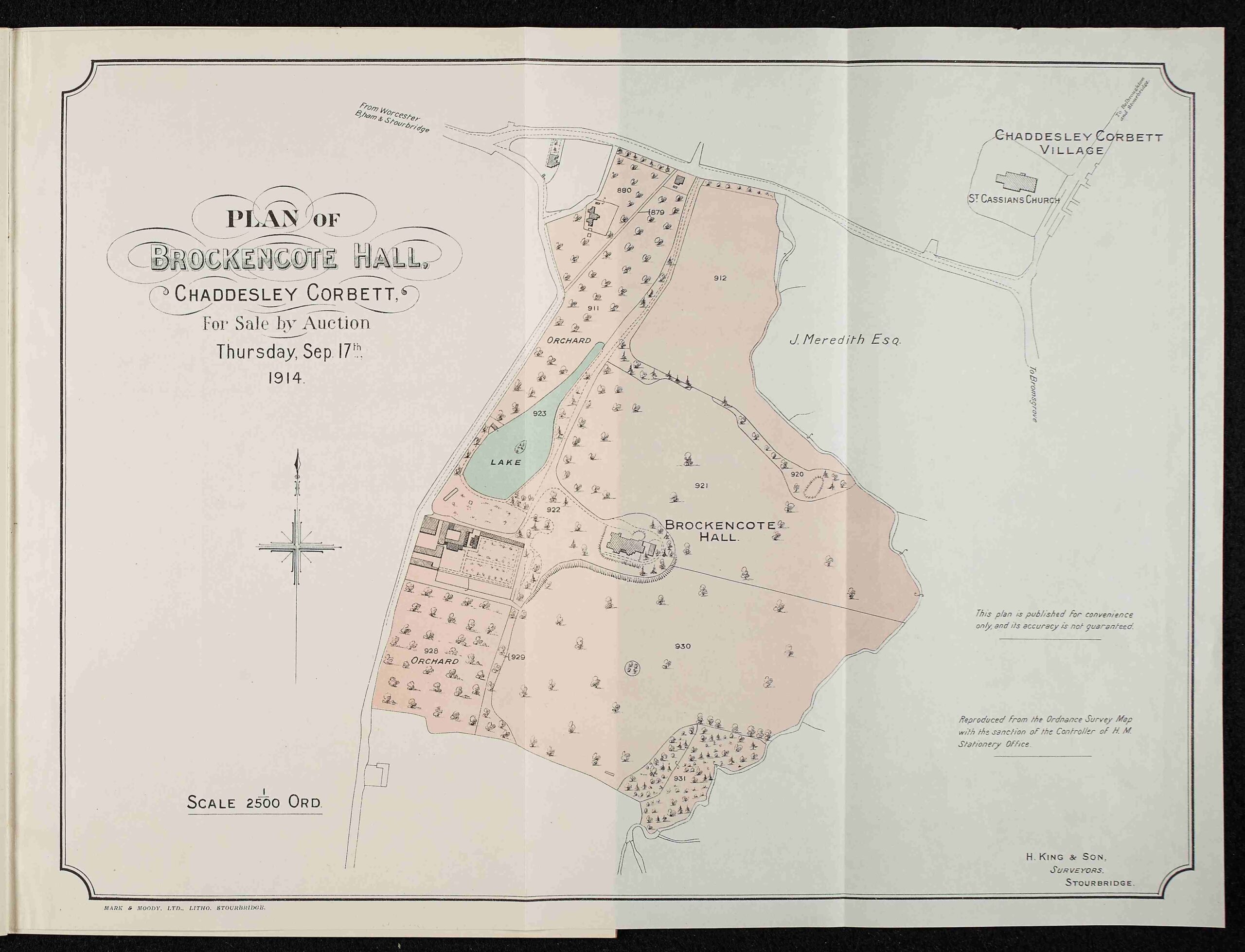
Plan of Brockencote Hall taken from Sale Particulars at Finding No: b899.31 BA3762155 c.1914 © WAAS
Furthermore, whilst there is little evidence of the sorts of men that governesses eventually did marry (if indeed, they were interested romantically in men), it was those men who they would likely come across through the course of their work, such as clergyman, tutors and masters who had regular, unaccompanied access to the Governess and a similar perceived social standing (Hughes, p.122, p.141, 2001). However, the fact that remained that so much was thought, said and written about the possibility of a Governesses being engaged with a member of the household, suggested that a highly sensitive nerve had been touched (Hughes, p.123, 2001).

Advert placed by a Governess describing her skills and experience in The Times, 8th January 1845 © The Times Digital Archive
In terms of the education that Lilly may have had prior to being employed as a Governess, we can only speculate. No formal training existed for Governesses. Educated for the most part by her mother, at a small boarding school or at one of the institutions designed specifically to prepare girls for a life spent teaching, the Governess was frequently required to provide a type of education, for which she herself had no direct experience (Hughes, K., p.43, 2001).
The 1881 Census shows Henry and Mary Willis had two daughters and two sons, three of whom were school aged named Beatrice, William and Edith. Dependent on the age of her pupils, Lilly would likely have taught ‘the three R’s’ of reading, writing and arithmetic (Maths) to the youngest, whilst coaching the older girls in French conversation, history and Geography. For older teens, she would instruct them in ‘key accomplishments’ such as drawing, playing piano, dancing and deportment (how to conduct oneself), all designed to attract an eligible suitor in a crowded marriage market.
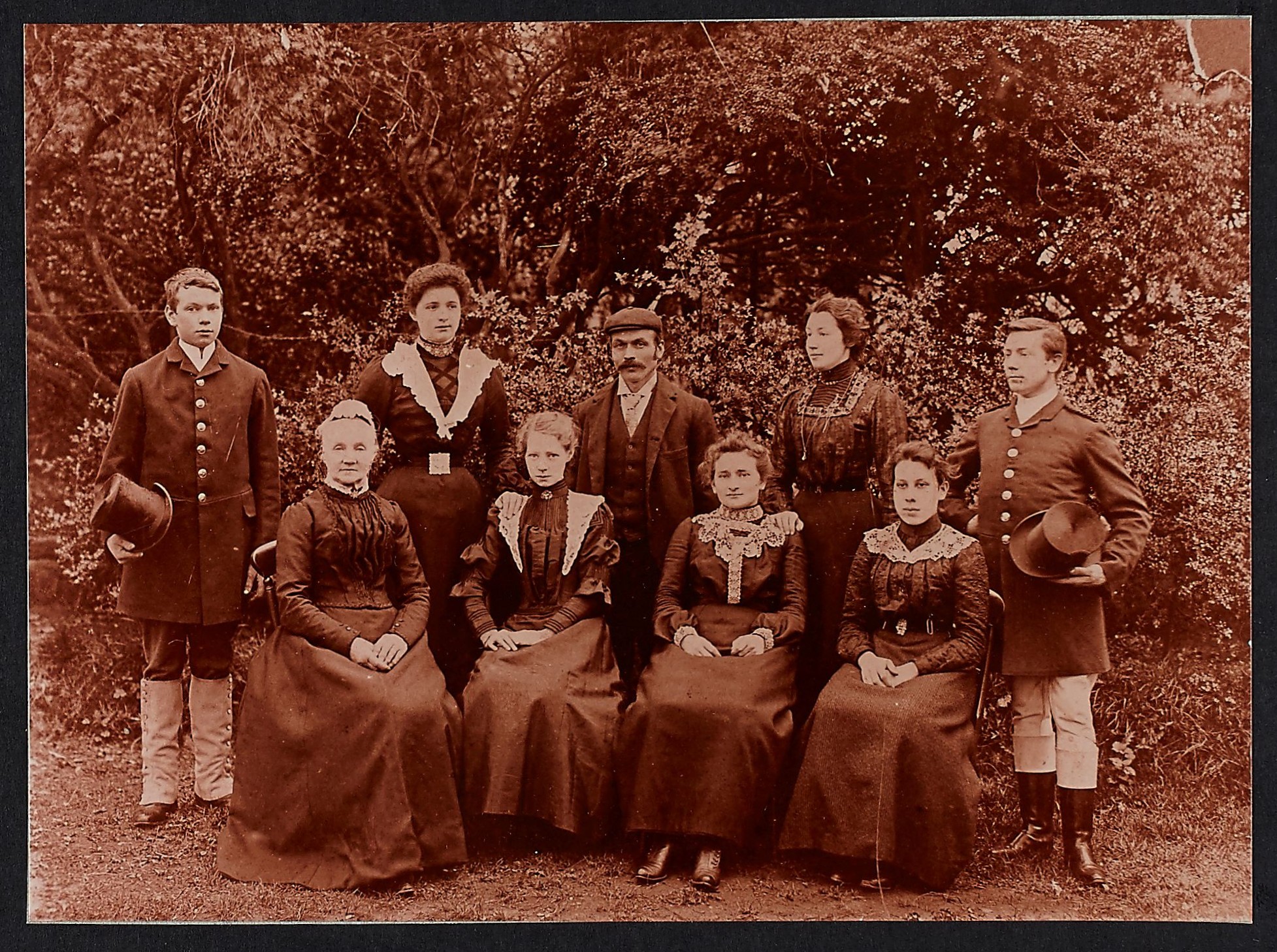
Servants shown at Brockencote Hall (unnamed). c.1880’s at Finding No: 899:156 BA1332 WPS 62187
Lilly herself would have no doubt experienced social and emotional isolation in her role as Governess, but we can only guess at the relationship she held with the household servants. Thanks to an incredible chance find from our Worcestershire Photographic Survey we do have a photograph showing the servants, including probably the footmen, lady’s maid, cook and housekeeper dated to the 1880’s. Could Lilly Pearson be pictured amongst them? Whilst Governess manual writers maintained that it was in three or four person households that the Governess encountered most difficulties, there is plenty of evidence that specialist upper servants of wealthier households resented the Governess’ claim to service (Hughes, p.95, 2001).
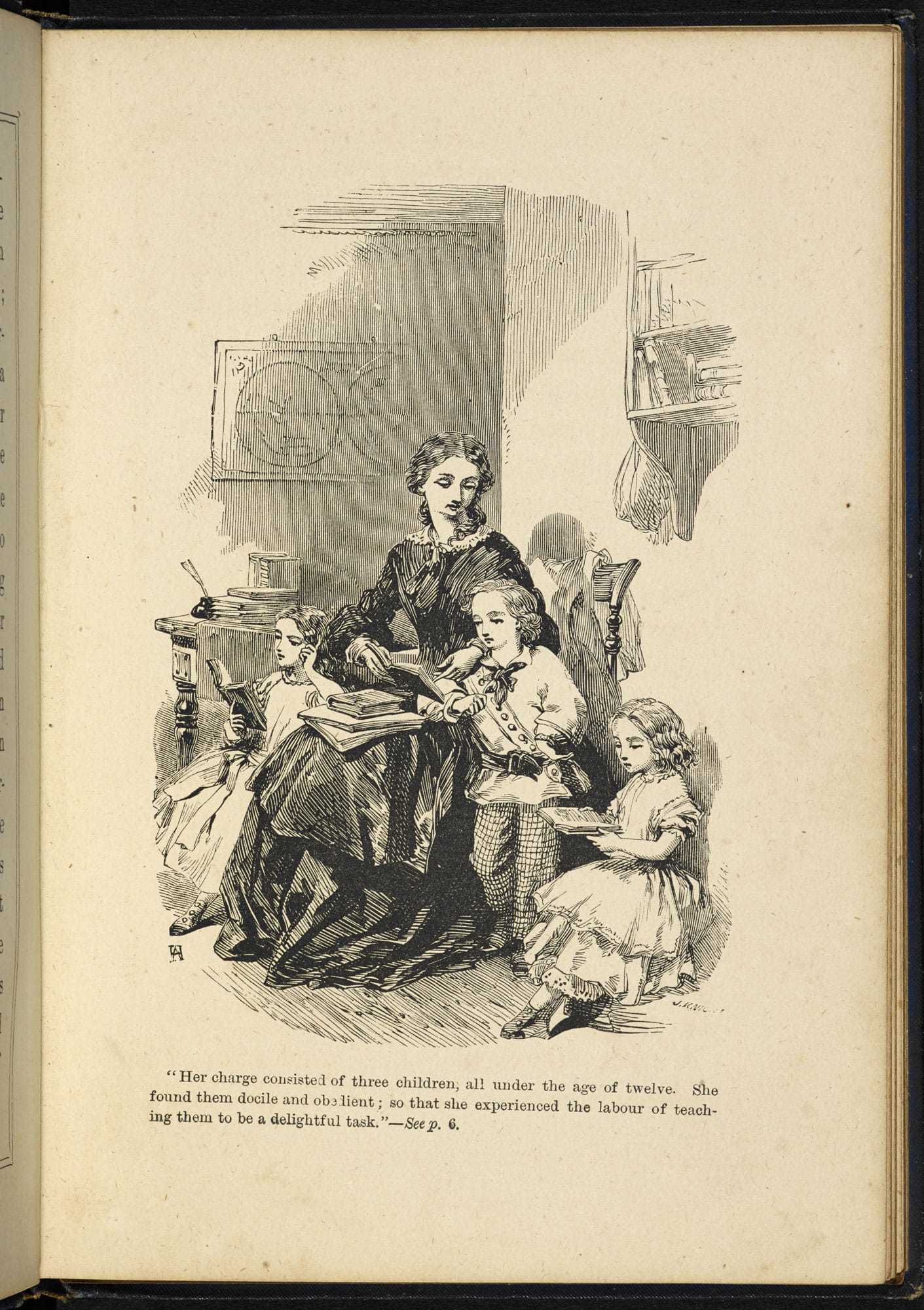
Idealised depiction of a Governess teaching her three pupils, including a young boy, from the fictional story The Governess, or the Missing Pencil-Case c.1875 © Public Domain
Governesses at work
Governesses were poorly paid, given they were expected to dress and conduct themselves as ladies in Victorian society. A governess depended entirely on the family for food, shelter, and a small yearly wage.
As Hughes writes, a male tutor could earn up to £84.00 a year, tutoring only 1 hour a day in the comfort of his own rooms, whilst a Governess earned less than half of this for a life permanently spent on duty. By 1861 the suggestion is that according to Mrs Beeton’s Household Management around £50.00 a year compared with footman earning £15-£25, housekeepers between £18 and £40 and lady’s maids between £10 and £20. However, out of the £50 she was expected to supply the accoutrements essential to the appearance and habits of a lady:
‘she must dress like a lady; travel like a lady, and in all her petty expenditure, pay like a lady: add to this, she requires an occasional replenishing of her library, her portfolio, or her music desk, beyond the needs of most ladies’ (Hughes, p.158-159, 2001).
A Governess’s life was frequently short: jobs became hard to find with most women facing retirement at the age of forty or even thirty-five (Hughes, p.169, 2001). If retirement due to ill-health did not occur, Governesses’ salaries were expected to fall into middle age. As the Governesses Benevolent Institution (GBI) pointed out in 1843, it was virtually impossible to save for the future, working for 25 years at the utmost, with a salary of £25.00, seldom exceeding £80 per annum, following domestic ties taking part of her savings, and the need for compulsory rest due to ill health, her future was bleak (Hughes, p.160, 2001).
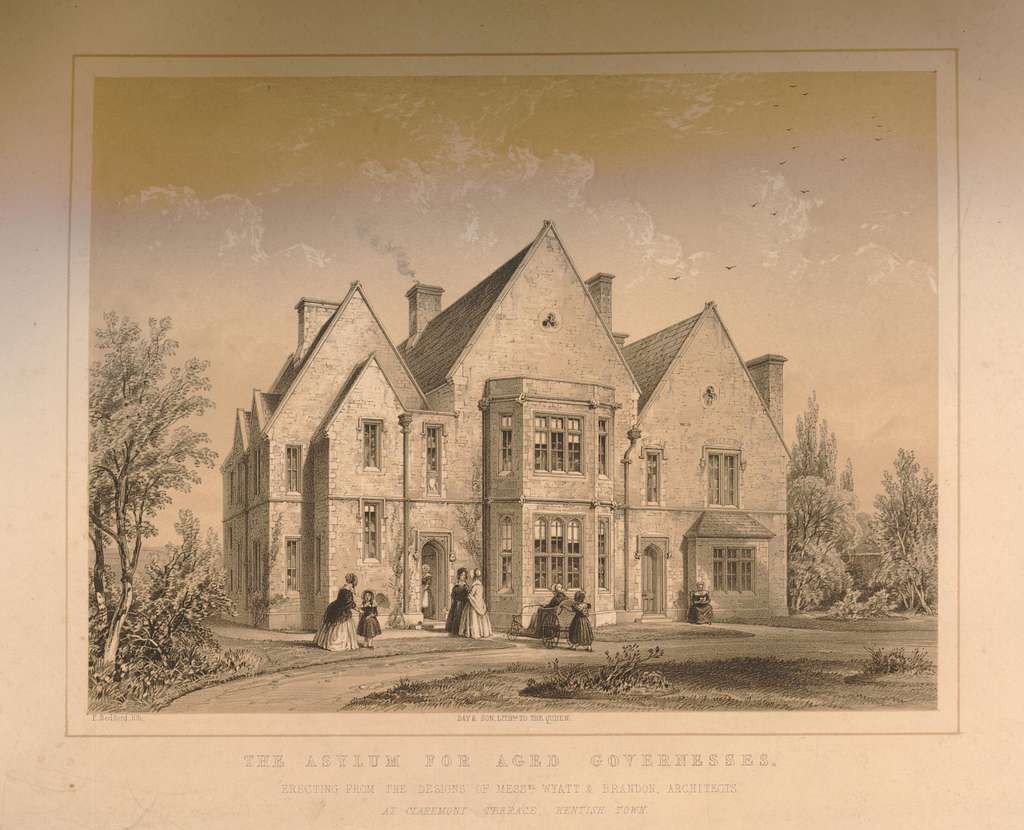
The Asylum for Aged Governesses, Kentish Town, north London which opened on the 12th June 1849 and provided safe and cheap housing for elderly and destitute former governesses who could no longer work (BM 1927,1126.1.23.3) © Public Domain
Governesses and the asylum
It is true that some Governesses did have very good experiences with their employer, and wider household. Elizabeth Ham, for instance, a governess to a Mr. Elton and his family, describes how she sat regularly with Mr. Elton after supper in the drawing room discussing Poetry, Art and Life, much to the consternation of his wife as she says ‘…Mr E often sat so long as to bring Mrs E. down to see what was become of him..’ (Hughes, p.122, 2001).
Many, however, did not and lived in fear of how they should conduct themselves daily around their employer and family, especially when entertaining visitors and led a quasi-invisible life.
Kathryn Hughes states that ‘In real life governesses did not marry Mr. Rochester and not because there was something nasty in the attic. On the whole they chose their male equivalents, marginal men whose occupation as curate or teacher could offer them no fairy-tale ending. Life continued to be financially precarious and socially ambiguous: according to the summary reports of the GBI many who left the profession to marry were forced to return to their former way of life following the death of their husbands.’ (Hughes, p.141, 2001).
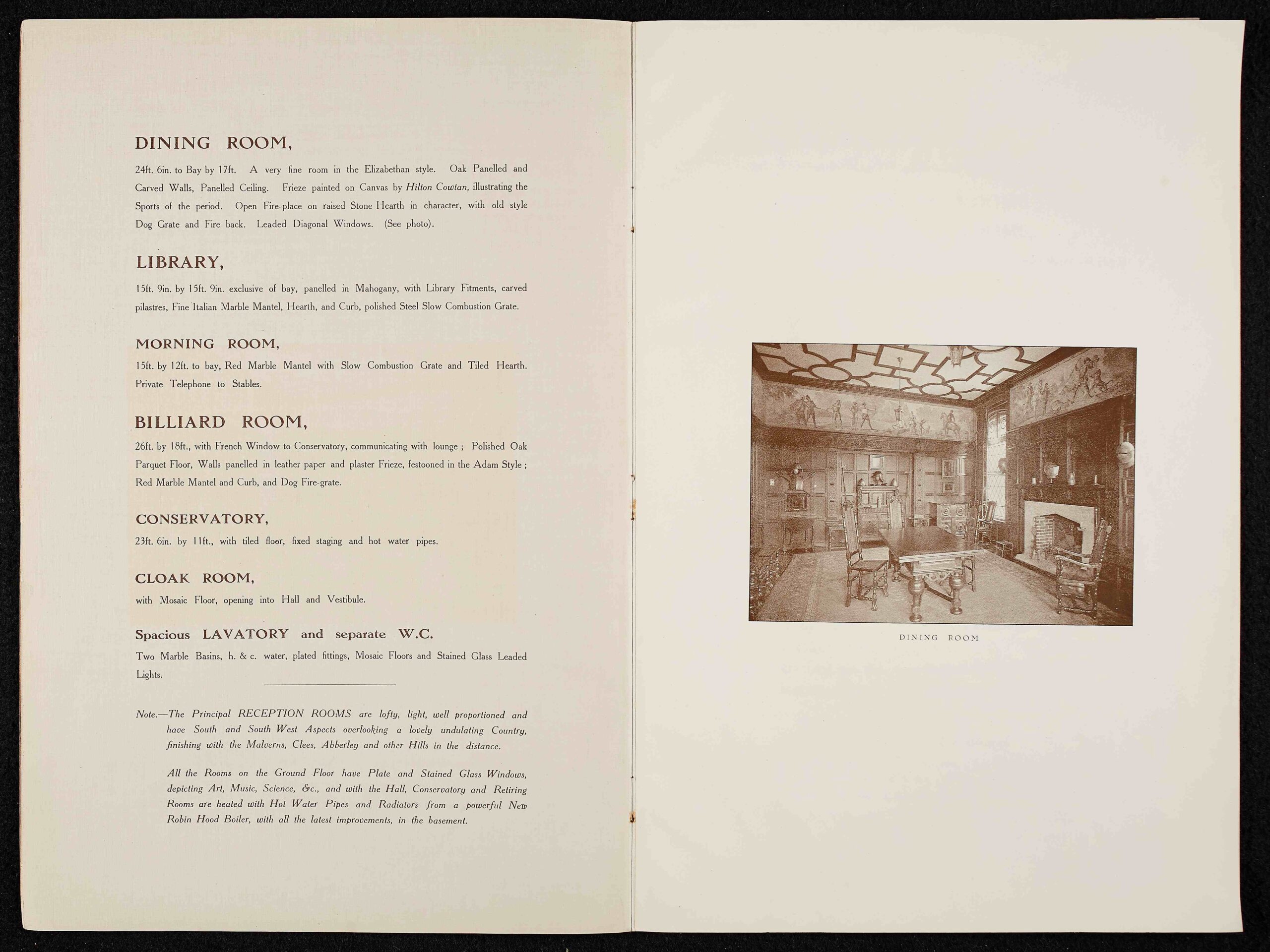
Photograph and description of Dining Room and adjacent rooms, Brockencote Hall taken from Sale Particulars at Finding No b899.31 BA3762155 c.1914 © WAAS
Reasons that Governesses may have retired or left their profession, apart from negative experiences with their employer or the household, included loss of appetite (due to apparently the nervousness that came with dining with their employer) and becoming too weak to work (a tactic perhaps to leave an unbearable situation), injured sight and a loss of understanding. GBI reports highlight ‘shaken nerves’ alluding to a mental condition such as hysteria or breakdown of the nervous system – a stroke for instance (Hughes, p.162, 2001).
Charlotte Bronte’s experience with her employer was commonplace who states in 1839:
‘I soon found the constant demand on my stock of animal spirits reduced them to the lowest state of exhaustion; at times I felt and I suppose, seemed depressed. To my astonishment I was taken to task on the subject by Mrs Sidgwick with a stress of manner and harshness of language scarcely credible.’ (Hughes, p.162, 2001).
Given the indifference of employers to the emotional well-being of Governesses, Lady Elizabeth Eastlake, author, art critic and historian wrote that ‘the lunatic asylums of this country are supplied with a larger proportion of inmates from the ranks of young governesses than from any other class of life’ and in 1861, the proportion of Governess asylum inmates (136) to total Governess population (24770) at 0.55 per cent, was higher than that of any other occupational group (Hughes, p.163, 2001).
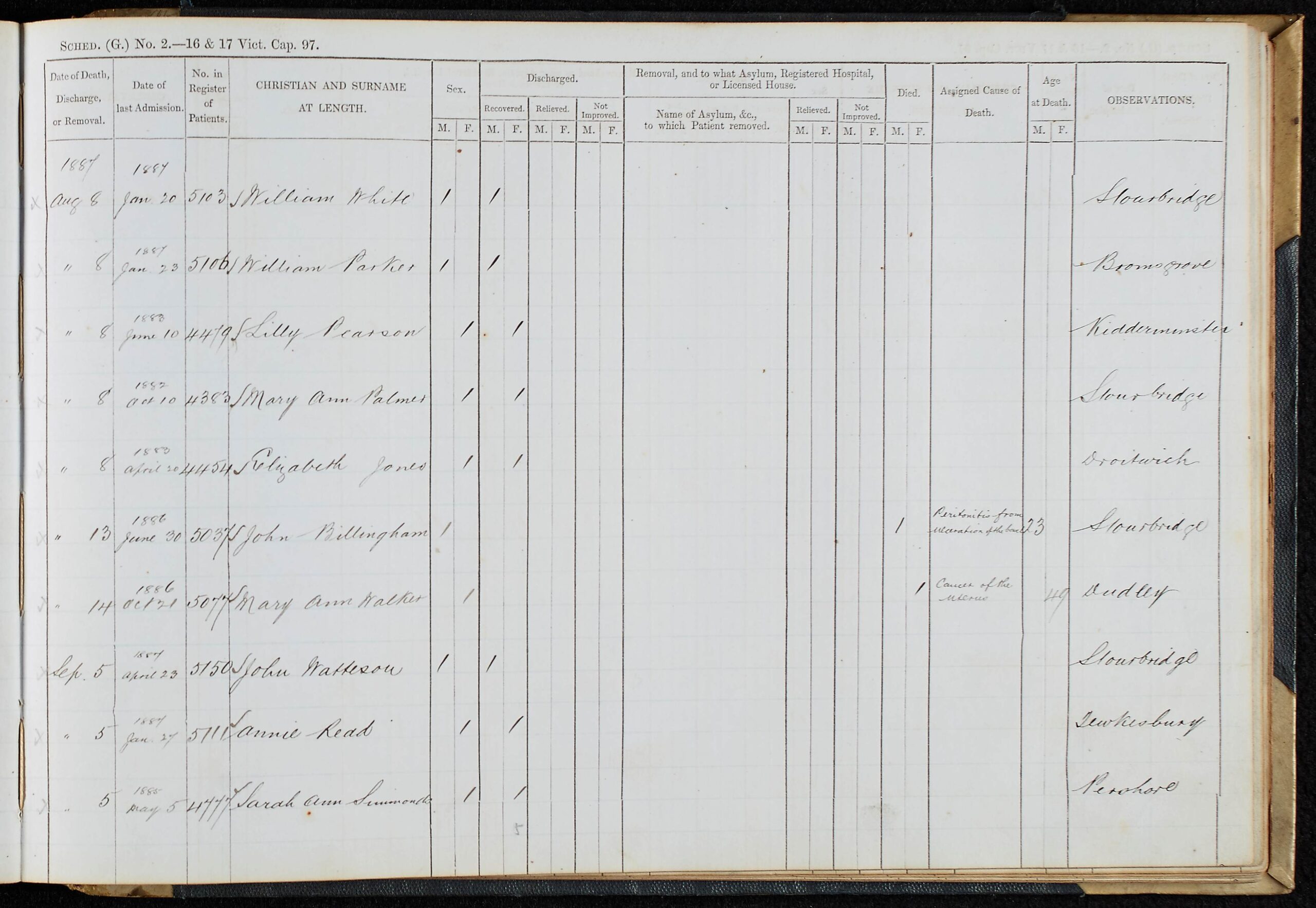
Lilly Pearson listed as discharged from Powick asylum on 8th August 1887 in Powick Hospital’s Register of discharges, deaths and removals. Pauper patients. at Finding No: 489.16 BA8343/33 © Herefordshire and Worcestershire NHS Trust
Lilly’s later years
Lilly is just one of hundreds of Governesses and thousands of women who ended up in asylums and as Kathryn Hughes reports these women were not so much mad as senile, consumptive or simply homeless. This appears to be the case for Lilly following the breakdown of her relationship with her employer (Hughes, p.164, 2001). Further case notes for Lilly Pearson state that after nearly 3 years of treatment at Powick, Lilly was released on trial in July 1866 but later returned to Powick after she was ‘unmanageable’, ‘still excited’ and ‘behaved violently to several patients’. Lilly is eventually discharged in August 1887 having apparently recovered.
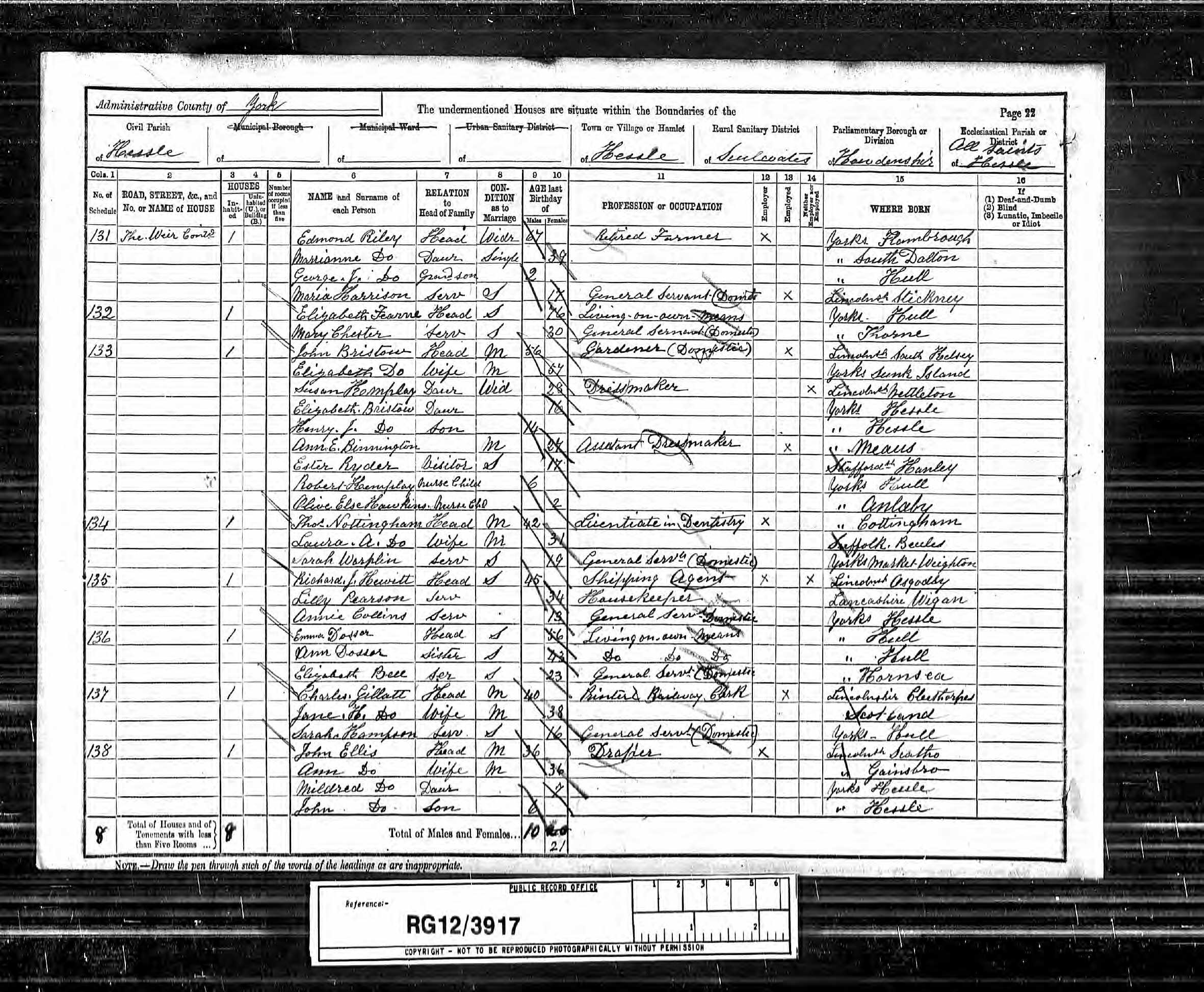
Lilly Pearson listed on the 1891 Census at The Weir, Hessle, York © Crown Copyright
Having left Powick asylum Lilly appears on the 1891 Census at The Weir, Hessle, York working as a Housekeeper. Sadly, by the 1901 Census, Lilly is listed as once again a patient at Rainhill asylum, St. Helen’s, Lancashire, not far from Wigan, where she was born. Without any family and unable to support herself, she likely had nowhere else to go.
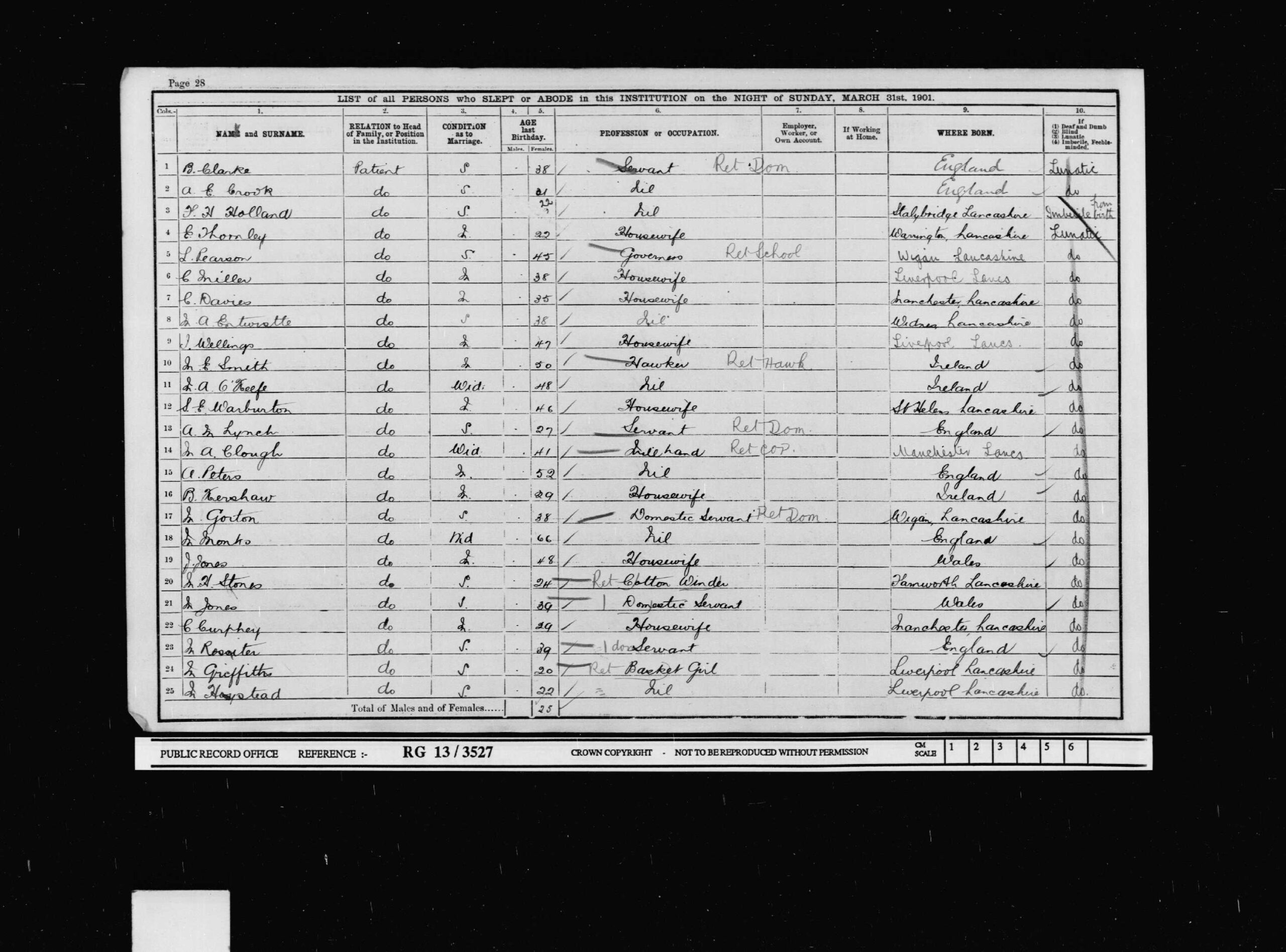
Lilly Pearson listed on the 1901 Census at Rainhill asylum, St. Helen’s, Lancashire © Crown Copyright
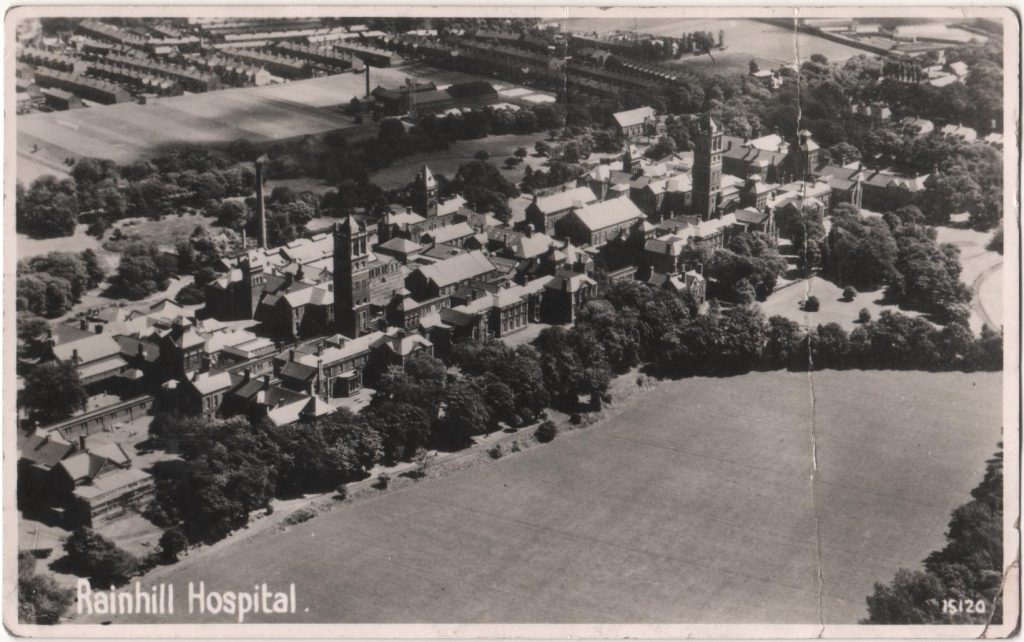
Photograph of Rainhill Asylum, later Rainhill Hospital early 20th century © Public Domain
Other Sources used:
Compton, Frank and Leach, Katie Pauper Lunatics at Powick Asylum, Worcester 1852-1918: An Exploratory Monograph Available at L362.21094244, Local Studies Collection
Hughes, Kathryn The Victorian Governess Available at L370.941, Local Studies Collection
George Marshall Medical Museum


Post a Comment