Milestone Ground Broadway – Dig Diary 4
- 24th May 2025
Welcome back to our dig diary! This time, we are learning about the Saxon occupation at Milestone Ground.
Our archaeological works have been revealing insights into many time periods, stretching back into early prehistory. One period that is especially exciting to find evidence from is the Saxon or Early Medieval era, spanning from AD 410 (end of Roman Britain) to 1066 (Norman Conquest).
Saxon period archaeology in the West Midlands is scarce, and even rarer in Worcestershire, making each discovery a significant find. Even small pieces of Saxon pottery are a thrill to find, as such finds are so rare. However, in recent years, interesting discoveries have been made in and around Broadway.
A notable discovery occurred during the flood alleviation excavation at Broadway in 2016-17, when archaeologists uncovered the remains of four buildings. Dating from the mid-Saxon period (around AD 600 – 800), these buildings were in a row and are believed to be the remains of a small settlement by the Basey Brook.
At our current site, we have already identified a number of Saxon buildings including postholes defining 3 or 4 rectangular timber structures and 4 sunken-featured buildings (SFBs); a common architectural type for this period. SFBs were typically small, simple structures with a distinctive sunken floor and a single large posthole at each end. They first appear in the early Saxon period and were used for a range of domestic or industrial/craft purposes.
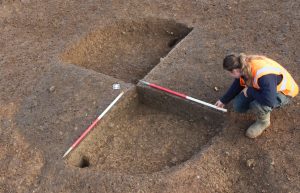
Archaeologist preparing to photograph a Saxon SFB
SFBs are not only valuable for their rarity, but also because they offer a direct glimpse into everyday life. Once out of use, they sometimes became rubbish dumps and can therefore contain interesting artefacts. Among the most exciting finds at Milestone Ground are several loomweights – ceramic, doughnut shaped objects that were crucial in textile production.
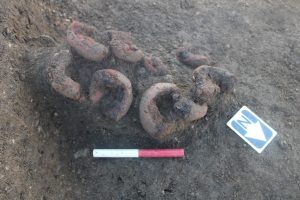
Ceramic loomweights found in an SFB
These loomweights suggest that the SFBs may have been textile workshops housing warp-weighted looms. This common type of loom consisted of two upright poles supporting a horizontal bar, with threads hanging down. The weights were tied at the bottom of the threads to keep them taut, allowing the maker to weave horizontal threads in and out of the vertical ones, creating cloth. These simple but effective looms were essential for daily life, and the presence of loomweights provides evidence of the area’s role in textile production.
In another SFBs, we recovered a spindle whorl, adding to the evidence for textile production at Milestone Ground. A spindle whorl is a perforated disc, typically made of ceramic, stone, or bone, that fits onto a spindle shaft. It’s used to provide the necessary weight to keep the spindle spinning steadily during the process of hand-spinning wool into yarn. The whorl’s mass and balance help maintain consistent rotational momentum, which is crucial for producing even, high-quality thread.
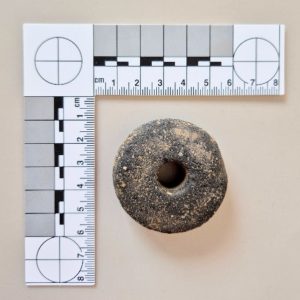
Spindle whorl found in a SFB
A number of delicate bone combs have also been found, which required careful excavation to lift. This style of comb is believed to have been used for keeping hair neat and tidy as well as removing nits.
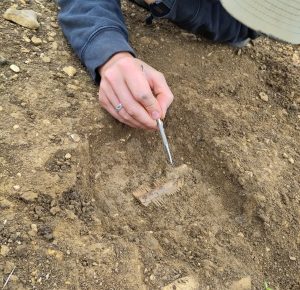
Archaeologist carefully excavating a comb
Broadway is beginning to become a hotspot of Saxon archaeology, as further Saxon archaeology has been uncovered in and around the village. Each new find illuminates a little more of life during this era, from domestic activities to craftsmanship and burial practices. Further possible buildings are yet to be excavated on site – what else will they reveal?
Worcestershire Archaeology are undertaking the excavation on behalf of Wychavon District Council and information is shared with their kind permission.


I have emailed the Digging for Britain team, and told them about the dig and a general outline of finds. They were asking about digs for filming a new series with Alice Roberts.