Milestone Ground Broadway- Dig Diary 5
- 22nd July 2025
Welcome back to the dig diary!
As the archaeological excavations at Milestone Ground are drawing to a close, the archaeology team continues to uncover fascinating traces of the site’s prehistoric past. In the northern part of the site, close to the area where the cemetery was uncovered, excavations have revealed a series of Neolithic (4000 BCE–2351 BCE) pits containing some lovely finds.
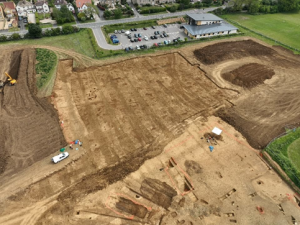
Newly opened area of excavation
Among the finds are several beautiful pieces of impressed ware pottery. One standout piece, shown here, features decoration created using impressions from a small bird bone—a delicate detail that highlights the craftsmanship of Neolithic communities.
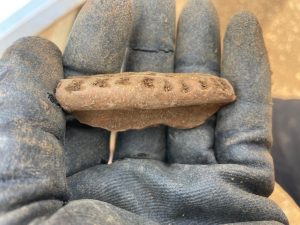
Impressed Ware decorated using bird bone
The pits also contained a broken polished stone axe, a particularly exciting discovery.
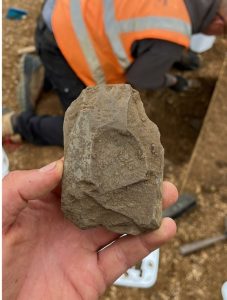
Polished stone axe
Elsewhere on the site, another notable feature has emerged: a series of aligned pits curving around the edge of the large D-shaped enclosure. Though their purpose is not yet clear, the regularity and positioning of these features suggest they may have been laid out with care—possibly as part of a ceremonial or structural boundary. This is something the team will explore further during post-excavation analysis.
Later activity at the site continues to offer surprises. Within a sequence of ditches, archaeologists have uncovered another Roman corn dryer, this one preserving a substantial deposit of burnt grain. It appears to have been constructed into the backfill of an earlier ditch, likely chosen for its softer ground, which would have made construction easier.
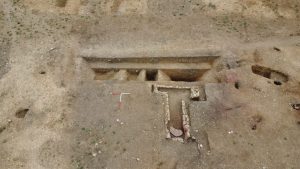
Roman corn dryer
At the heart of the site, evidence for a Roman building has also come to light. Reuse of materials was common in the past, and some stones here show signs of heat damage, suggesting they may have originally formed part of an earlier structure, perhaps another corn dryer. Nearby, a pit was filled with metal objects, including an iron knife and a copper alloy Roman brooch. Scorched patches of ground and deposits of charcoal point to metalworking activity—whether for repair, recycling, or small-scale manufacture remains to be seen.
One of the final tasks for the team was to identify the edge of the former quarry, previously excavated by archaeologist Nancy Smith. (Learn more about Nancy in Dig Diary 2.
The quarry was later used by local residents as a dumping ground during the 1950s and 60s, which means we’ve also uncovered a range of more modern finds—offering a glimpse into the recent past as well as the ancient one. Click through the gallery to see some of the modern gems uncovered.
What Happens Next…
Fieldwork may be the most visible part of archaeology, but post-excavation is where the real interpretation happens. All artefacts will be carefully cleaned, catalogued, and analysed by specialists. Conservation work will be undertaken where necessary to preserve fragile finds.
Environmental archaeologists will study soil samples for pollen, seeds, charcoal, and insects, providing clues about the ancient landscape and climate. Meanwhile, a human bone specialist will help unlock further details about the cemetery burials. The team will also select key samples for radiocarbon dating, including some of the human remains and prehistoric artefacts, to better understand the timeline of activity at Milestone Ground.
Because of this detailed work, it will take some time before the full results can be shared, but these discoveries promise to significantly deepen our understanding of the site’s history
Keep an eye on our social media for further updates about the exciting finds and more!
Worcestershire Archaeology are undertaking the excavation on behalf of Wychavon District Council and information is shared with their kind permission.


Post a Comment