Royals and Rebels – What Have We Learnt?
- 8th October 2025
This is the last of three posts highlighting the discoveries made during archaeological investigations undertaken by Worcestershire Archaeology on part of the site of the Battle of Worcester. Over the mini-series we explore how the 17th century battlefield surface was located, the artefacts found there, and what this can tell us about the Battle.
On most battlefields, artefacts relating to conflict are usually found in the topsoil, often as a result of ploughing or other redevelopment churning up the ground. This in turn means that the physical remnants of battle often become damaged and are also vulnerable to piecemeal discovery by metal detecting as they are close to the surface.
What makes the finds from this Worcestershire Archaeology project so exciting is many of them are surprisingly intact, recovered from where they fell to the ground in the heat of battle. Whilst they are generally typical Civil War battlefield finds and comparable to others, such as Edgehill (1642), they are the first to be systematically recorded as (largely) in situ from a sealed horizon – in this case within an alluvial layer – and, therefore, retrieved directly from an intact 17th century battlefield landscape. The location of this part of the battle within the alluvial landscape of the River Severn and River Teme floodplain is key to protecting the archaeological evidence of that momentous day and the finds themselves give us a direct connection to the battle for the first time.
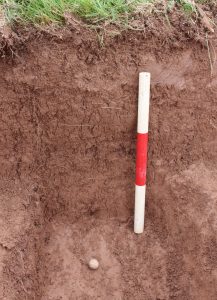
Musket ball as excavated showing its burial in the upper flood silts
This is all the more powerful in bringing the heat of battle to life. The social aspects are brought into sharper focus, the fear those fighting must have felt and the desperation when they felt their defensive positions were under threat. We can now take a step closer to imagining what battle may have been like, and so feel an increased connection to it.
Furthermore, the distribution of the finds supports our existing knowledge of the battle through documentary sources. These tell us that the approach route between Powick village and the bridge over the River Teme was heavily contested, and that it became a major frustration for the Parliamentarians. Here the hedged lanes, ditches and small strip fields are thought to have slowed the movement of troops, particularly cavalry. Finds from the western side of the old lane leading to Powick Bridge included a low-density grouping of pistol and buck shot, as well as a lead token, a horseshoe and clay pipes. This could suggest that cavalry had tried to stay off the roadway in this area – it was in any case too narrow to be a useful means of advance.
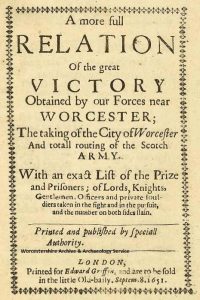
Pamphlet published on 8 September giving details of the Battle. Worcestershire Archive & Archaeology Service. BA3669/2(vi)
To the east of the road, a high-density concentration of artefacts was directly associated with a former field boundary. Here, the numerous lead shot was all from muskets (appearing mostly to have been used with smaller, lighter “bastard” muskets), demonstrating an infantry confrontation. Other finds from this area included a powder charge cap, a priming flask nozzle, rolled lead, worn (illegible) copper-alloy coins, pewter plate, a horseshoe and fragments of iron. In combination with the musket shot, these finds probably indicate that this was part of a defensive position.
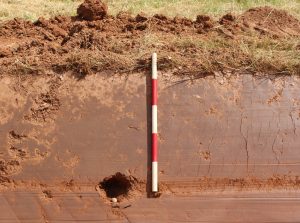
Musket ball discovered where it fell at the height of battle
The occupation of a boundary, likely comprising a ditch and a hedgerow, correlates well with descriptions from the time of “hedge to hedge” fighting that required close engagement. A Parliamentary Pamphlet of 1651 recorded that “all… advanced towards the Enemy, who had lined their hedges thick with men”, while a contemporary letter says that “the dispute was from hedge to hedge, and very hot; sometimes more with foot than with horse and foot”.
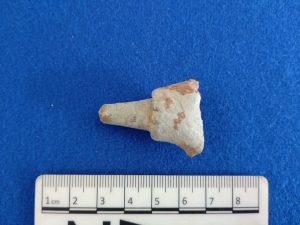
A lead priming flask nozzle
The numbers of finds may seem quite small for such an engagement, however, we were limited in the areas that we were able to investigate through the development. Given the vast size of the battlefield, the potential for similar finds across its full extent is considerable. Significantly for the continued survival of this material, the productive level of the 17th century battlefield is beyond the reach of metal detectors used at the surface today, thereby preserving it for future detailed recording. Who knows what lies waiting to be discovered?
We hope you have enjoyed this mini-blog series. Want to know more? Why not come along to our Royals and Rebels talk on Friday 24th October 7-8pm at The Hive in Worcester.
This blog is based on an article by Derek Hurst and Richard Bradley, first published in the January/ February 2023 issue of British Archaeology magazine. And Bradley, R. and Hurst, D. (2023). Worcester Southern Link Road (Phase 4): Archaeological investigations 2018–2023. Worcestershire Archaeology unpublished report.
The project was undertaken by Worcestershire Archaeology for TACP (UK) Ltd, working on behalf of Alun Griffiths and Worcestershire County Council. Abbie Horton (Worcestershire Archaeology) created the reconstruction solider drawings. Photos and figures are copyright of Worcestershire Archaeology, unless otherwise stated.


Post a Comment