Wonderful Worcestershire architecture
- 17th July 2026
This month, the Explore Your Archive campaign is #EYAarchitecture, so we thought that it was a great time to focus on some of our marvellous collections. Whether its timber framed buildings, New Towns, churches, public buildings or stories of the architects themselves, we have something to interest you.
Conserving timber framed buildings
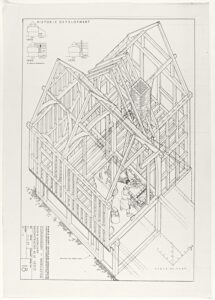
The Commandery, Worcester. Historic reconstruction of shop and workshop as it would have looked c.1450 ©WCC
Freddie Charles (1912-2002) was an architect and nationally recognised expert on the conservation and repair of timber-framed buildings. His wife, architect Mary Charles (nee Logan, 1924-2005), worked alongside him. When Mary chose to pursue a career in architecture fewer than 4% of UK architects were women. Their archive includes the plans and images of over 250 buildings in Worcestershire, as well as documents relating to the firm. The archive is digitally available along with about 1000 images, on the Historic Environment Rrecord and on the Archaeology Data Service (ADS) website
The buildings conserved by Freddie and Mary Charles include The Commandery Worcester, now part of the city’s museums. Freddie’s technique was to take the building back to its main building phase, and to reconstruct the building as it stood in its busiest period. His plans and specifications are beautiful and incredibly detailed
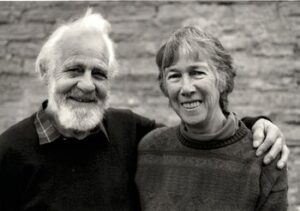
Chartered architects F.W.B ‘Freddie’ and Mary Charles © Malcolm Kirk.
The archive is also available to view in the searchroom under the references numbers BA12857, BA13218, BA14485, and BA14644 and there are plenty of blogs to read more about the Charles archive https://www.explorethepast.co.uk/blog/
Planning a whole new town
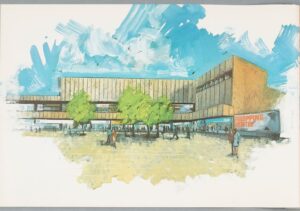
Kingfisher Shopping Centre Brochure BA10300/123(3)
Planned in 1966, Redditch was built as a New Town although it has much older origins. The New Jerusalems project The New Jerusalems: post-war New Town archives in Britain and Ireland – Worcestershire Archive & Archaeology Service , funded by the Wellcome Institute, helped to collate and catalogue the many plans and c9500 photographs of the proposed development. By 1979 10, 000 houses had been built in Redditch, with the necessary roads and sewage systems, as well as new facilities such as the shopping centres, the Palace Theatre, Arrow Valley Lake, golf courses, playing fields and parks, community centres, health facilities and schools.
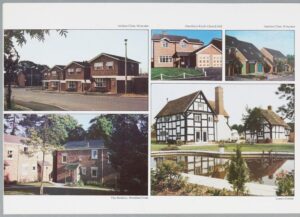
Celebrating 10,000th House in Redditch taken from a Publicity Brochure c.1979. BA10300/123(3)
Public buildings
Recently, our archaeology department have added a new layer of 20th century heritage to the Worcestershire’s Historic Environment Record, which was funded by Historic England. This includes a list of plans created by Henry Rowe and Son, a prominent local architectural practice (BA1685). H. Rowe and Sons designed many buildings owned by the County Council, and even some diocesan buildings. In the 19th century their designs had included the Corn Exchange in Angel Street and the market hall in the Shambles, Worcester. They also designed Barnsley Hall Asylum, Bromsgrove, and Workhouses in Kidderminster and Bromsgrove.
When A. V. Rowe was at the helm the firm added a new concert hall extension in 1951 to the Winter Gardens in Priory Park, Malvern, and built the building formerly used as the County Buildings in St Mary’s Street, Worcester in 1929-30 in a Neo-Georgian in style.
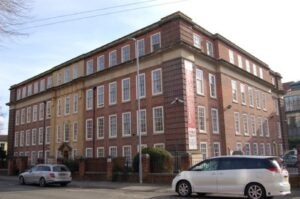
6 Rowe St Mary
Diocesan buildings and other things
While H. Rowe and Son designed and renovated many buildings for the Worcester Diocese, it was the architect A. E. Perkins who was responsible for many churches, in the county. He built the churches of St Philip and St James in Whittington, 1844, Holy Trinity at Far Forest, 1844 [BA7796/8] and St Mary’s in Doddenham, 1855. He worked on the Worcester Cathedral restoration for nearly 20 years (1854-1873).
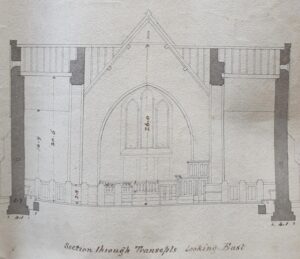
Holy Trinity church at Far Forest 1844
From 1843 he renovated many churches around the county, as well as designing and building several rectories and national schools including those at St Johns (1870) and St Peters (1843), Worcester, Badsey (1847), Broadwas (1863) and West Malvern (1873). He also rebuilt the Worcester Dispensary in 1850 [BA6018]
If we have wetted your appetite for the architecture of Worcestershire, there are blogs available from Explorethepast for further detail of each topic.


Post a Comment