‘Dunkirk Joe’ – The Remarkable life of Admiral William Tennant
- 14th August 2026
Worcestershire Archives and Archaeology Service are privileged to have a deposit in their collections connected to one of Worcestershire’s most distinguished naval heroes, Admiral Sir William George Tennant.
In this article, we will take a look into the life of Admiral Tennant.
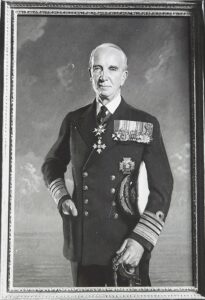
WPS25988 Portrait of Adm. Tennant at County Hall © Newsquest
Born at Quatford, Shropshire in January 1890 to Edmund and Mary Tennant, William would spend most of his life as a resident of Upton upon Severn at the family home of The Eades. William Tennant was also briefly educated at Hanley Castle Grammar school before joining the navy in 1905 as a 15-year-old naval officer cadet.
During the First World War, the now Lieutenant Tennant served on the destroyers HMS Lizard and Ferret and aboard the cruisers HMS Chatham and Nottingham. He saw action during the Battle of Jutland, the largest naval battle in history up to that point and would survive the sinking of HMS Nottingham during the ‘Action of 19th August 1916’.
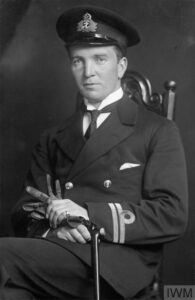
Lt. W. G. Tennant c.1918 (HU 118957) © Imperial War Museum.
By 1939, Commander William Tennant was appointed Chief of Staff to the First Sea Lord, Sir Dudley Pound. With the retreat of the British Expeditionary Force in France, Tennant was sent on 26th May 1940 as Senior Naval Officer ashore (Beachmaster) to Dunkirk. Between 26th May and 2nd June 1940, Tennant worked tirelessly to organise the evacuation of British and French troops from the beaches of Dunkirk. Many soldiers remembered Tennant, loud hailer in hand, pacing the beach, calling for troops to embark. It was in no small part that many troops were rescued due to Tennant’s effective leadership. Soldiers and sailors who saw him called him ‘Dunkirk Joe’ and he was known for his jovial manner, being called ‘Happy Willy’ by people who knew him.
Upon his return to Britain, Tennant was given command of the battlecruiser, HMS Repulse. As Captain of the Repulse, Tennant was involved in the hunt for the German warships Scharnhorst and Gneisenau and also the search for the German battleship, Bismarck.
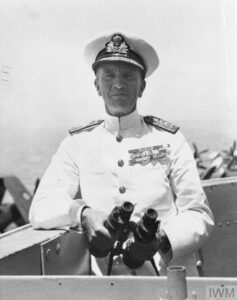
Adm. Tennant, May 1945, Indian Ocean (A 29072) © Imperial War Musuem.
Towards the end of 1941 and the threat of war with Japan, Tennant and Repulse, alongside the brand-new battleship HMS Prince of Wales, was sent to reinforce Britain’s Far East fleet as part of Force Z. On 10th December 1941, Japanese bombers attacked this force with the resultant loss of Prince of Wales and Repulse. Under the skilled command of Tennant, Repulse avoided 19 torpedoes and numerous bombs before being overwhelmed by Japanese bombers. Tennant ordered the evacuation of the ship and was rescued from the water by HMS Vampire. Over 500 men would lose their life out of a compliment of 1300.
In 1944, Rear Admiral Tennant was given the responsibility of laying large artificial harbours called Mulberry harbours, used to support the Normandy landings of June 1944. He was also tasked with organising the laying of the Pluto oil pipelines used to fuel Allied armies in France.
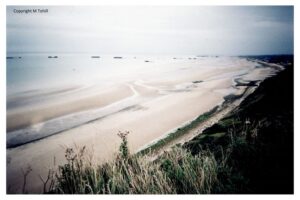
Mulberry Harbours © Maggie Tohill
By the wars end, Tennant was promoted to Vice-Admiral and knighted. He would be made a full Admiral in 1948 and would retire from the navy in 1949.
Upon his retirement, he would return to his family home of Upton and in 1950, was made Lord Lieutenant of Worcestershire, a position he would retain until his death in 1963.
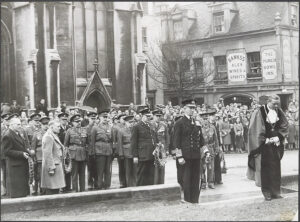
WPS2251 Adm. Tennant as Lord Lieutenant c. 1952 © Newsquest
During the 1950s, Admiral Tennant deposited a number of records associated with his time as Lord Lieutenant, including letters patent issued by King George VI. If you are interested in viewing these collections at Worcestershire Archives, they are found under the reference 970.5:155 BA1859, 970.5:155 BA2546 and 705:153 BA1011.


Post a Comment