Find of the Month – July 2018
- 2nd August 2018
Ever dropped a plate or mug? Almost everyone has broken crockery at some point, but what did you do then – repair it, or throw it away? This month we found evidence of Roman thriftiness near Evesham: a pot repaired with lead.
Yes, you read that correctly. Before the invention of superglue and epoxy adhesives, people repaired broken pottery with metal ties to hold the fragments together. Being easily malleable, lead was most often used, although copper alloy and iron examples have been found too. The curious thing about this Roman jar is that it was a common, easily available and affordable type of pottery called Severn Valley ware.
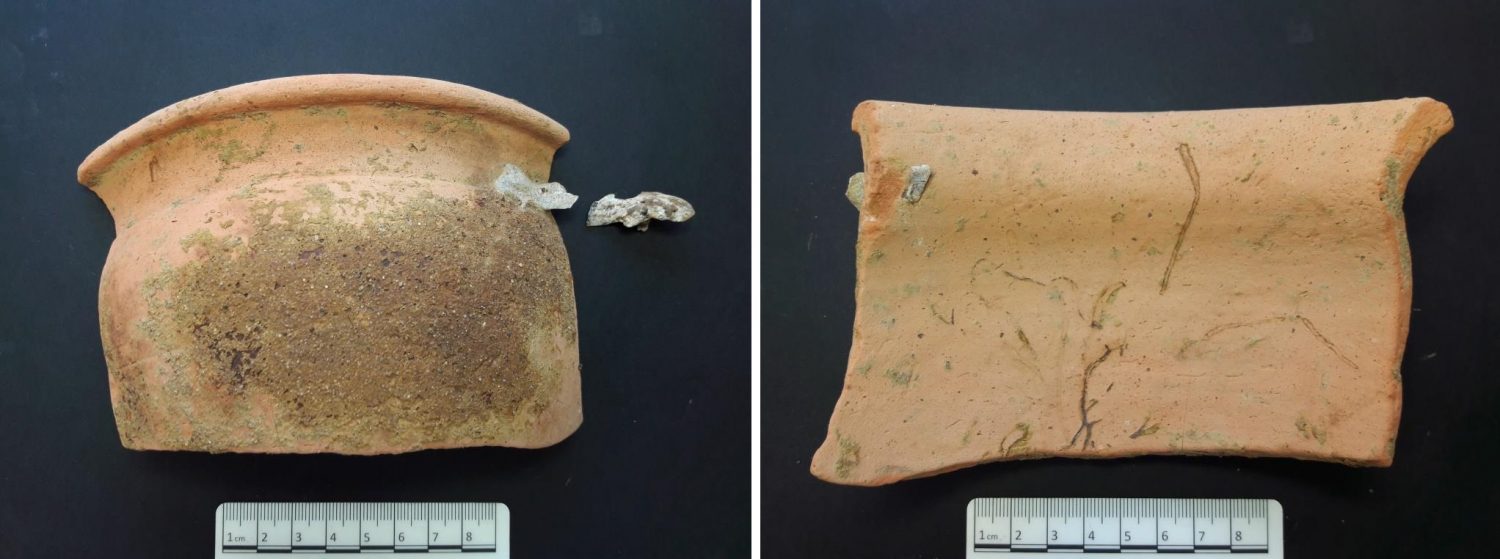
Outside (left) and inside (right) of Roman jar repaired with lead rivet – the discolouration on the outside surface is soil that has welded itself to the pot (8cm scale).
A hole has been drilled through the pot to hold a lead rivet, which was connected via a narrow strip to a second rivet in the other pot fragment. It’s not very neat or pretty, but it would have done the job. Done well, metal rivets can make vessels fairly watertight again; as long as you don’t break the pot further by drilling into it. Riveting is not an easy option as you have to know what you’re doing, so why bother?
Repairs are most frequently found on Samian ware – imported pottery used to make fine and often decorated tableware with a glossy surface. Archaeologists have also found neater X shaped rivets in Roman Samian ware, where two dovetail grooves are cut in each fragment and a lead tie (sometimes poured in molten) used to fill the X shaped gap. It’s not as strong as our rivet above, but it’s much neater. The practice of mending ceramics with metal continued until the creation of suitable adhesives during World War II. Over time techniques developed from crude Roman rivets to neat staples or metal ‘stiches’ in porcelain, which were often disguised with paint. Repairing these items makes sense, as both Samian ware and porcelain were expensive. By contrast, Severn Valley ware was comparatively cheap, so why repair it?
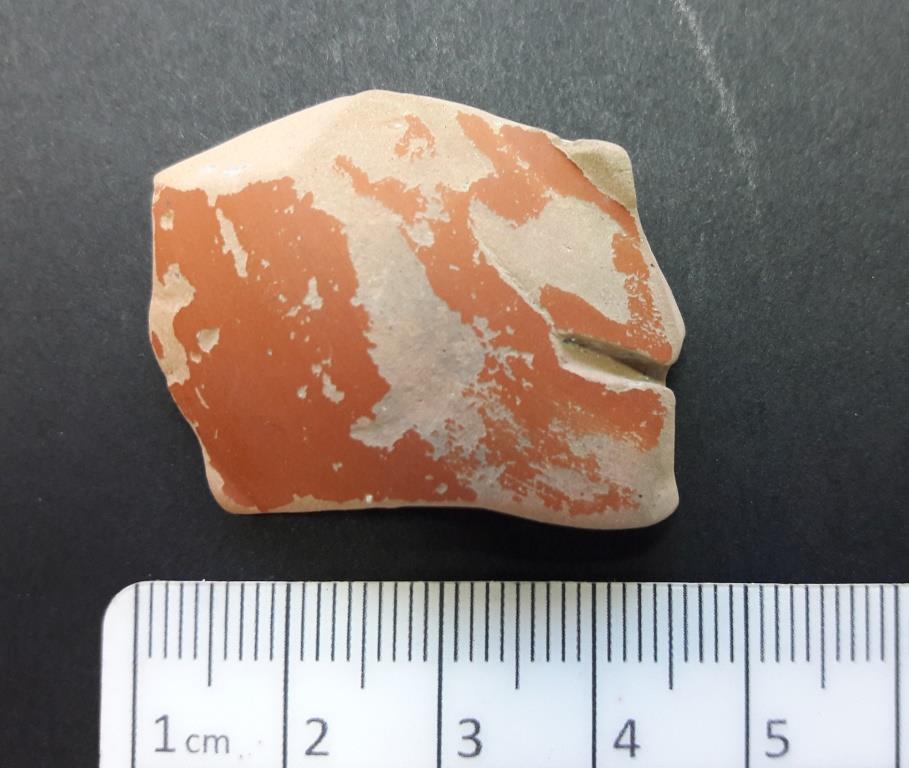
Fragment of Roman Samian ware with groove on right side from an X shaped metal rivet.
The answer is probably the distance to market as much as cost, as repaired Roman pots turn up more frequently on rural sites than urban areas. Distances that seem short to us suddenly become significantly greater when you consider travelling by foot or horse – from the site to Evesham is only 3 miles, but it’s 19 miles to Worcester. Severn Valley ware was made around Malvern and Gloucester, although it’s hard to know where and how reliably stocked the nearest market was.
The Roman site this repaired jar comes from seems relatively high status, so money is less likely to have been an issue. It was found dumped in a watering hole with lots of other broken pottery, as part of a backfill deposit when the watering hole fell out of use. The vessel is a wide-mouthed jar of a slightly unusual shape, with some features more typical of the early Roman era and others that are common later on. Due to these later characteristics, our pottery specialists have dated the jar to the 3rd or 4th century AD – towards the end of the Roman era. This repaired jar doesn’t come from the site’s final days of decline though, as later Roman features cut through the watering hole after it had been filled in and the repaired jar buried.
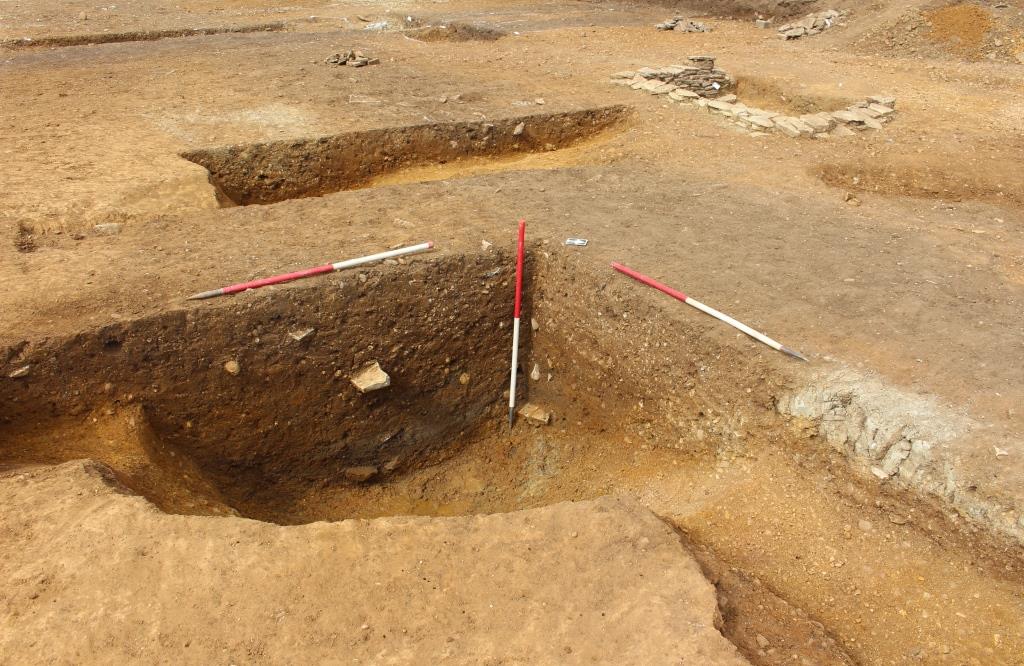
Excavated slot through watering hole with dark filled ditch on right side, cutting watering hole, and stone lined water cistern in top right-hand corner, which probably replaced the watering hole. Repaired pot was found just below largest stone in slot section (1m scales).
Was it a favourite, particularly useful jar? A practice piece for someone learning the skill of pot repair? Or an easier option than travelling to market? It’s hard to know. Today we have less incentive to repair items as replacements are easy to come by for all but the most sentimental of possessions. At least we no longer have to rivet pots together though – glue is far easier to apply.
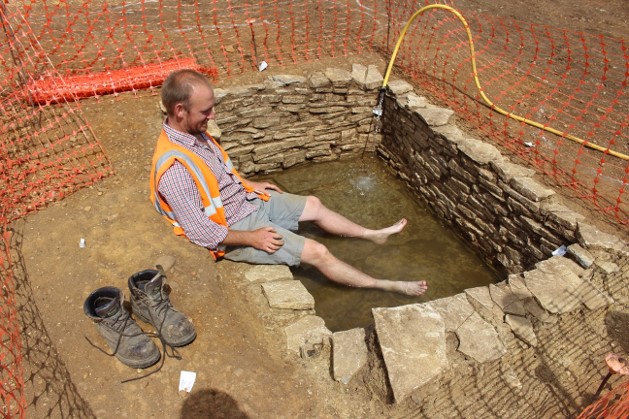
Testing the cistern found on the same site to see if it still held water!


Did they find the tool used to drill the metal ties? It’s a skill to drill a pot without breaking it.
That would have been a lovely find, but sadly no such tools were found. It is a real skill – not everyone could repair a pot in this way!