The Charles Archive: Dowles Manor House
- 20th August 2018
This is the ninth in a series of blog posts celebrating the life and work of timber frame building specialists FWB ‘Freddie’ and Mary Charles. Funded by Historic England, the ‘Charles Archive’ project aims to digitise and make more accessible the Charles Archive collection.
This post centres on the wall murals at the Manor House of Dowles Manor, Upper Arley. The material found in the Charles Archive makes it all the more regrettable how this building was ultimately destroyed.
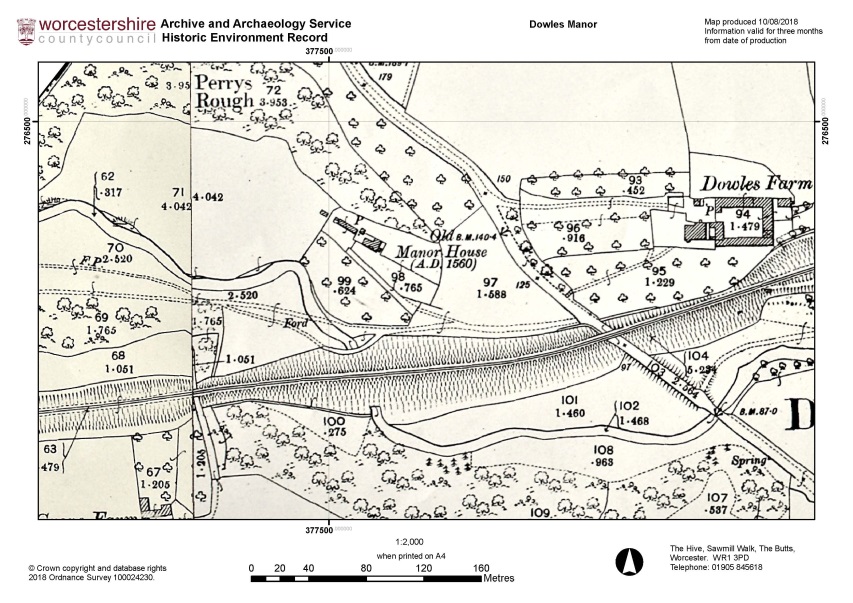
The manor house dates from c.1600 (despite a date stone of 1560, these cannot always be a trusted guide to a building’s construction date) and is thought to stand on the same spot as a 12th century stone building that was partly demolished and rebuilt to form a half-timbered house. The walls were constructed of wattle and daub and many parts of the interior framing were reused timber, however, the main timber frame construction was all new in the 16th century. The house was laid out in a typical 16th century plan with a hall occupying the central ground floor leading to a kitchen wing on the left and a solar to the right, with later, modern additions to the rear (Elliott, 1917), (Pevsner, 2007), (http://www.british-history.ac.uk/vch/worcs/vol4/pp262-265).
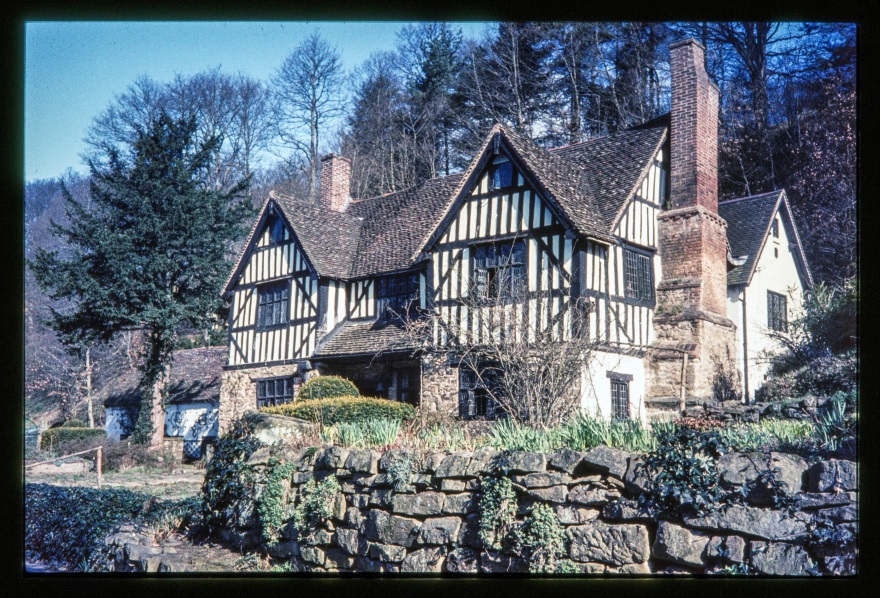
Digitised slide of Dowles Manor House © Worcestershire Archive and Archaeology Service: Charles Archive Collection.
The mural paintings are found in the hall, dining room, the bedroom above and the middle bedroom. These were painted in layers directly onto the interior surface of the wattle and daub. It’s due to this process of layering and the more porous surface that these murals stood any chance of surviving. It is also due to the ever changing fashions of household interior design, as some time in the late 18th century all the walls were battened and covered with lath and plaster and then papered to keep up with the prevailing fashions in London at the time. It was during renovation work in 1908 that some of this lath and plaster was accidently chipped off to reveal the first glimpses of the murals that lay underneath (Elliott, 1917).
In the hall the paintings show a vase motif with a floral design on each panel. There is also a female bust in Elizabethan costume, which is thought to be Queen Elizabeth I. A continuous frieze at the top of each panel depicts scrolls, mythical beasts, female figures, flowers and shields bearing fleur-de-lys (Elliott, 1917), (Lines, 1982).
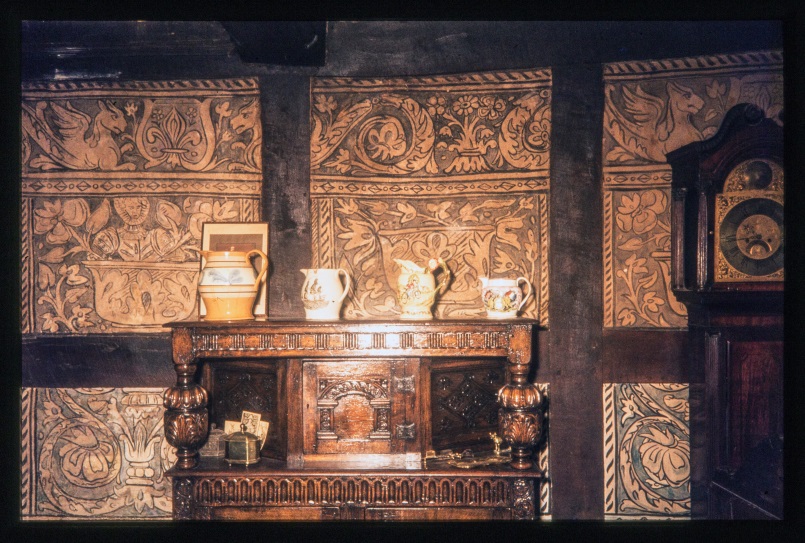
Digitised slide from the Hall of Dowles Manor House © Worcestershire Archive and Archaeology Service: Charles Archive Collection.
In the dining room the murals depict the same vase and floral motif but the frieze at the top of each panel is a continuous interlocking design thought to represent the holy thorn. One major difference, however, is that the whole of this room was originally decorated, including the massive beam that sits over the fireplace. In these places the paintings were so delicate the decision was made to cover them up in an attempt to preserve them (Elliott, 1917).
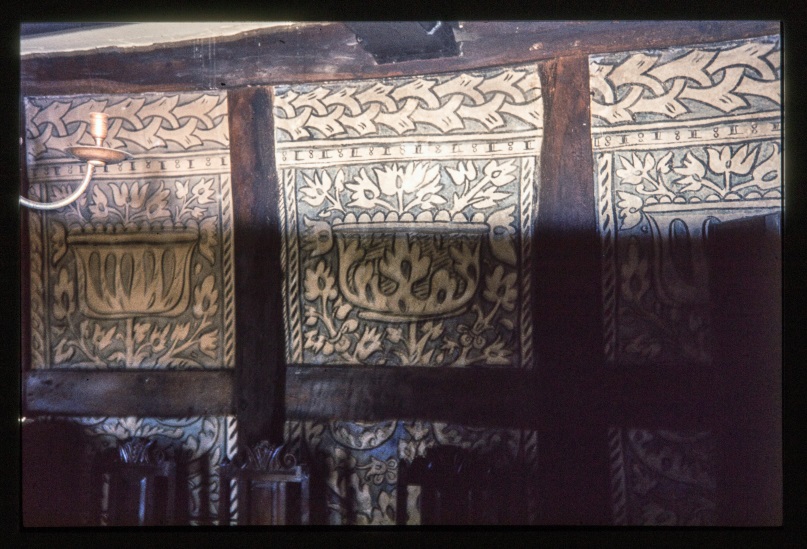
Digitised slide from the Dining Room of Dowles Manor House © Worcestershire Archive and Archaeology Service: Charles Archive Collection.
The bedroom above the dining room has murals on all four walls depicting alternating panels of mythical beasts and human figures with scrolls that support a vase motif. The continuous frieze that goes around the top of the room depicts half human, half animal figures with further vase and floral motifs in between. The continuous frieze at the bottom of each panel was a Grecian honeysuckle motif (Lines, 1968).
The middle bedroom, above the hall, has murals that show the master and mistress of the household depicted in Elizabethan dress and a passion flower above them. On the opposite side of the room are the words ‘Godes peace be here amen’ with the dates 1622 and 1636 added underneath the text with some initials that were added, presumably later, in red chalk (Elliott, 1917).
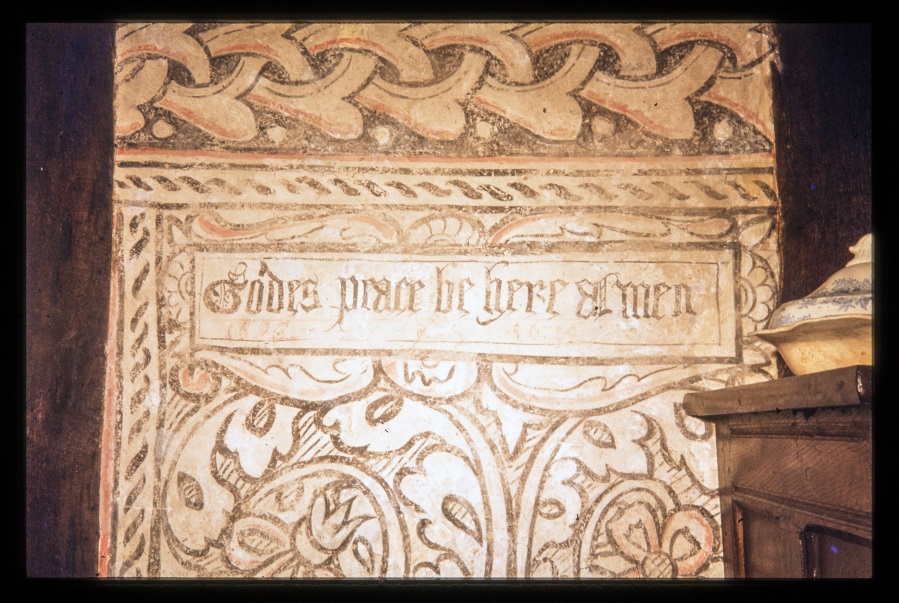
Digitised slide from the Middle Bedroom of Dowles Manor House © Worcestershire Archive and Archaeology Service: Charles Archive Collection.
The house was looked after by one occupier from 1942 until 1982 when the house caught fire and was badly damaged. What was left was then sold to the final owner who, in 1993, was found to have illegally demolished part of the manor house and had rebuilt a new house in its stead. The owner was fined and ordered to demolish this new house, leaving virtually nothing of the original manor house (Worcester News, 2005). For this reason the building was delisted in 1994 and the whole site was sold at auction in 2017 (Learoyd, 2017).
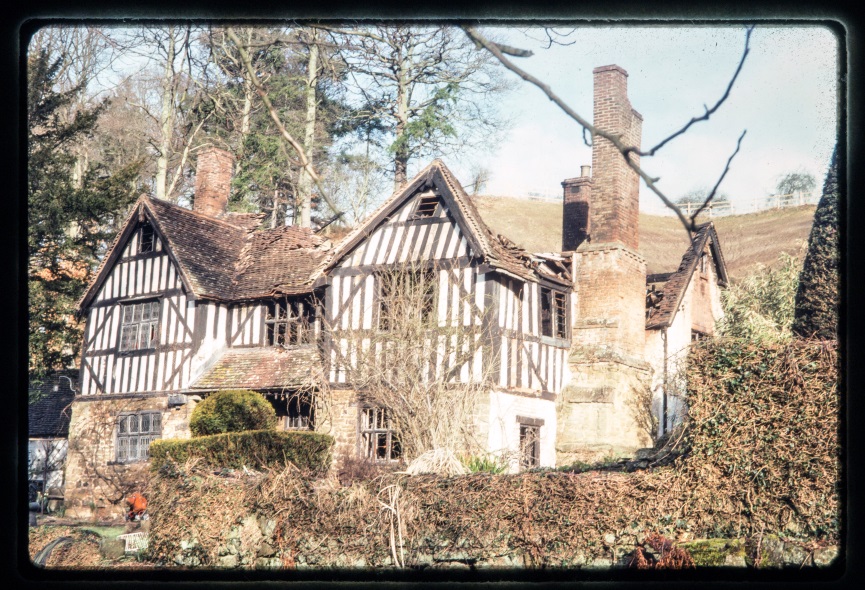
Digitised slide of Dowles Manor House after the fire in 1982 © Worcestershire Archive and Archaeology Service: Charles Archive Collection.
References:
Elliott, J. (1918). Concerning the Manor House, Dowles and its Demense with Illustrations, plans and maps. Herald Press: Dudley
Learoyd, A. (2017). Rare chance to buy and restore ‘totally irreplaceable’ Dowles Manor. [online] birminghammail. Available at: https://www.birminghammail.co.uk/news/property/rare-chance-buy-restore-totally-13037881 [Accessed 15 Aug. 2018].
Lines, C. 1968. Fairy Tale home in the Woods. Warwickshire and Worcestershire Life.
Victoria county history: ‘Parishes: Dowles’, in A History of the County of Worcester: Volume 4, ed. William Page and J W Willis-Bund (London, 1924), pp. 262-265. British History Online http://www.british-history.ac.uk/vch/worcs/vol4/pp262-265 [accessed 10 August 2018].
Worcester News. (2005). Video charts house demise. [online] Available at: http://www.worcesternews.co.uk/news/7448840.Video_charts_house_demise/ [Accessed 15 Aug. 2018].


I was part of the crew on the first pump to get to dowles manor fire