Printing on Ice: Worcester’s ‘frost fair’
- 30th December 2021
Frost fairs are more commonly known to have been held on the River Thames, the most recent example being in London in 1814. Examples of provincial frost fairs include one held in Shrewsbury in 1739. A printed souvenir held within the archives from 1855 has led us to investigate whether there is any evidence of frost fairs held at Worcester.
In the past we’ve shared about times the River Severn was frozen in the mid/late 19th century and a medieval ice skate our archaeologists uncovered, but this time we are looking at the 18th & mid/early 19th Centuries.
Printed documents can tell us a lot about the history of our county, and are often overlooked. One such example printed on the frozen River Severn in 1855 has led us to investigate some of the activities and festivities that were held on the river when this was taking place.
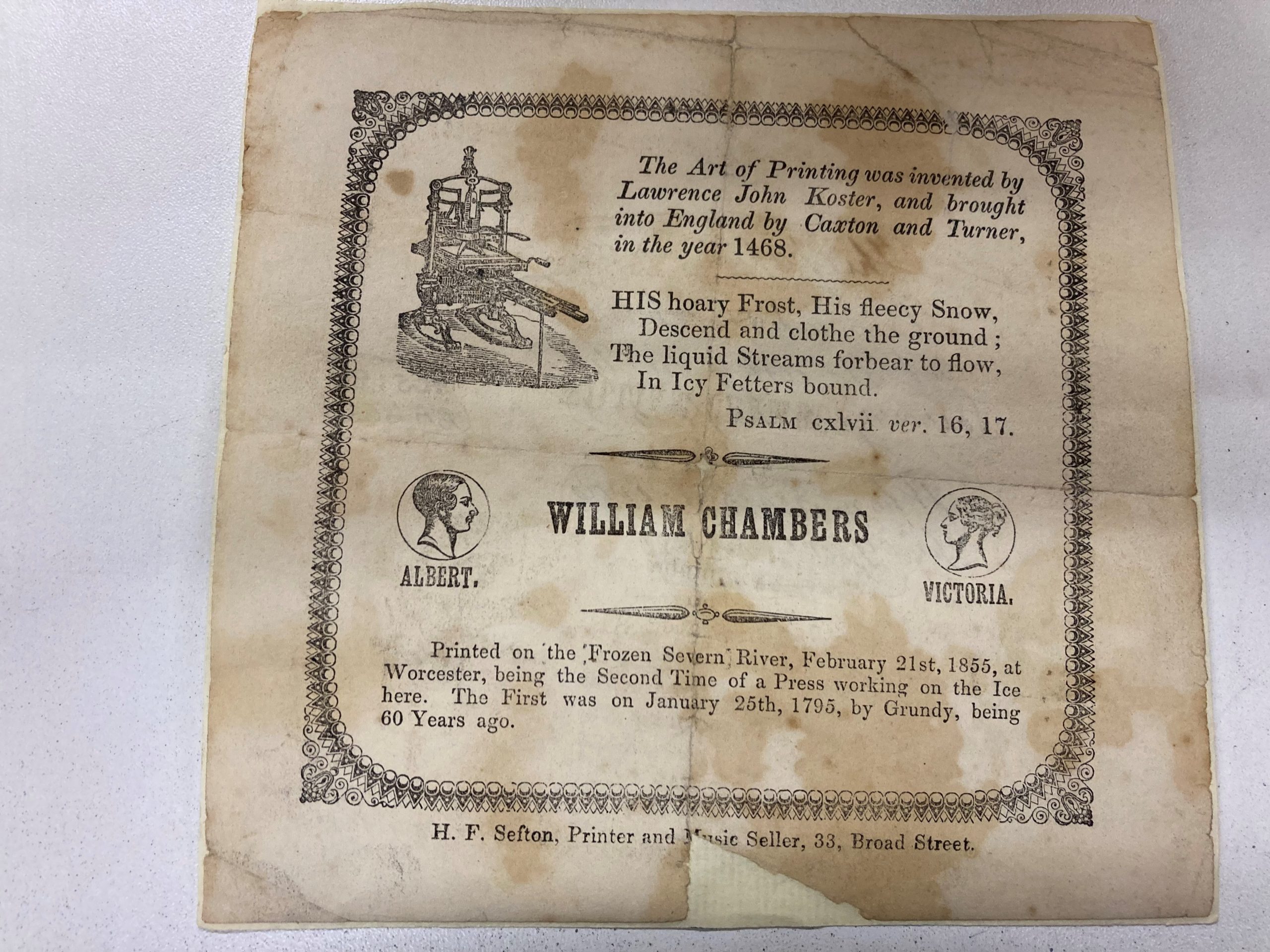 Sheet of paper printed on ice : Ref:705:86/6030 This example is one of several similar sheets held in our archives. They all contain the same information, with the only difference being the name inserted on the printed page, in this case William Chambers. This was a souvenir item, where you could have your own name printed on a sheet of paper. As a number have survived, it must have been highly thought of by the purchaser. The fact that this occurred live on the ice, on the named day, was very popular and is given special mention in the local newspapers of the time. Berrow’s Worcester Journal of 24/02/1855 reports that it was Mr Sefton ‘who erected a printing press on the ice, by the side of The Quay, which has been kept in constant operation.’ This corresponds to the name listed on the document, H.F. Sefton, printer and music seller of 33 Broad Street Worcester.
The frozen river attracted thousands onto the ice, including, according to the local press, the local militia in their red jackets. Crowds of pedestrians were said to have lined the riverbanks. There were many sports and amusements to partake in, including sliding, skating, sledge driving, hockey, and bowling. A booth was also erected where the ‘noble art of self-defence’ was taught, and a sheep was roasted, which was again very popular.
There were also reports that the distance between both Worcester and Stourport, and Tewkesbury and Worcester were traversed by skaters. On the canal, newspaper reports show that R. R. Tuthill Esq, CE, left Worcester, eventually for York, via the Worcester and Birmingham Canal on his long Dutch skates.
The festivities did not pass without incident, with several people being rescued from being immersed in the frozen river. This included a young girl who was rescued by Reverend Walter Thursby, Curate of St John’s. Of course after the freeze came the great thaw, resulting in severe flooding.
The printed material from 1855 states that the first use of a printing press on the ice was on 25/01/1795 by Grundy. In fact, in the newspaper of 24/02/1855 that celebrates Sefton’s use of the press, this is offered for sale, with particulars available from the newspaper office. The frost fair would have acted as a good example of marketing!
There were two people with the name of Grundy operating in the city in 1795. John Grundy, who was based in Friar Street and James Grundy who was based in Silver street at around the time. John Grundy in Friar Street published a directory in the city, including those for 1790,1792 and 1794 which can be viewed in our self-service area.
|
The newspaper of 29/01/1795 has no mention of activities on the Severn in the city, or the use of a printing press. There is a mention the previous week of the river being frozen and subsequent newspapers discuss the severe flood following the thaw and its repercussions.
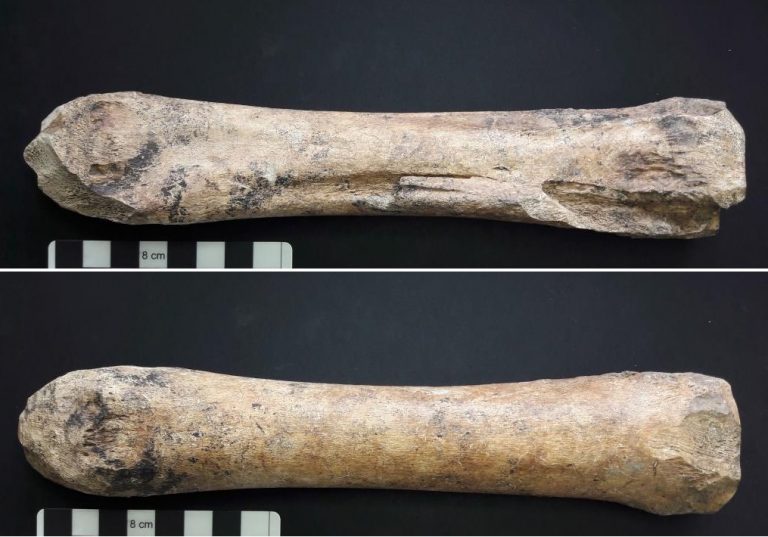
Medieval ice skate. Unfinished, so maybe the ice melted before it could be completed!
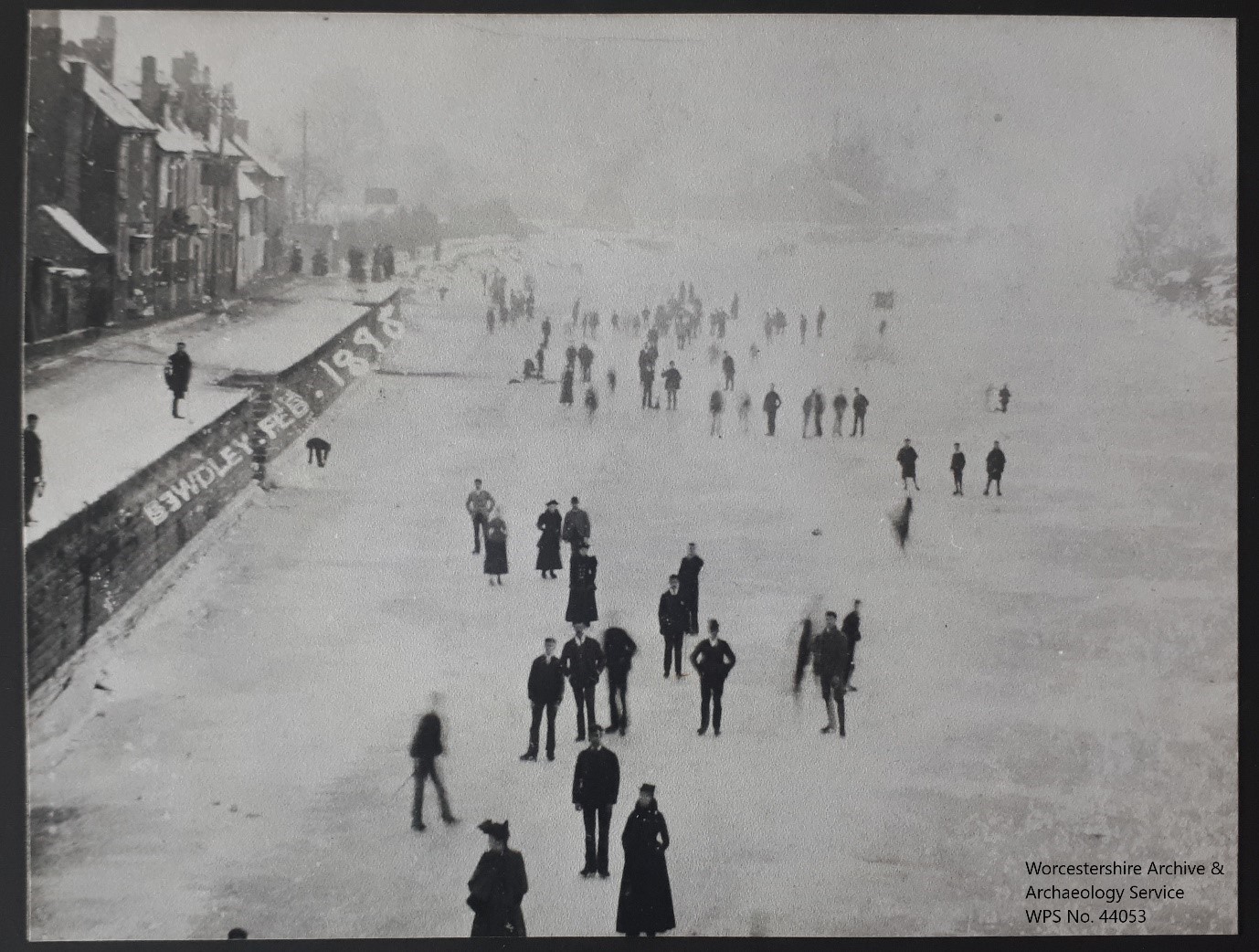
River Severn frozen at Bewdley 1895, taken from the Worcestershire Photographic Survey


Post a Comment