The Granville Bantock Diaries: 1911 – 1919
- 11th April 2023
A recently catalogued collection of 37 handwritten diaries belonging to the composer Sir Granville Ransome Bantock, shed insight into his life and music. Those written between 1911 and 1919 are the focus of this blog. Future posts will cover the years 1920 – 1927 and 1928 – 1946, respectively.
Though they might at first appear mundane or insignificant, diaries are historical documents that can tell us many things about a person’s life or period in the past. Often honest, first-person accounts, they bring us closer to life as it was back then. The condition of the cover and the pages within it can also offer clues as to how regularly a diary was used by the author or thumbed through by its subsequent owners.
Sir Granville Ransome Bantock (1868 – 1946) was a local composer of classical music who lived and worked during the English Musical Renaissance. He was of vital importance to British classical music – writing over 800 works across multiple genres – yet despite much historical research into composers associated with this time, Bantock remains largely overlooked.
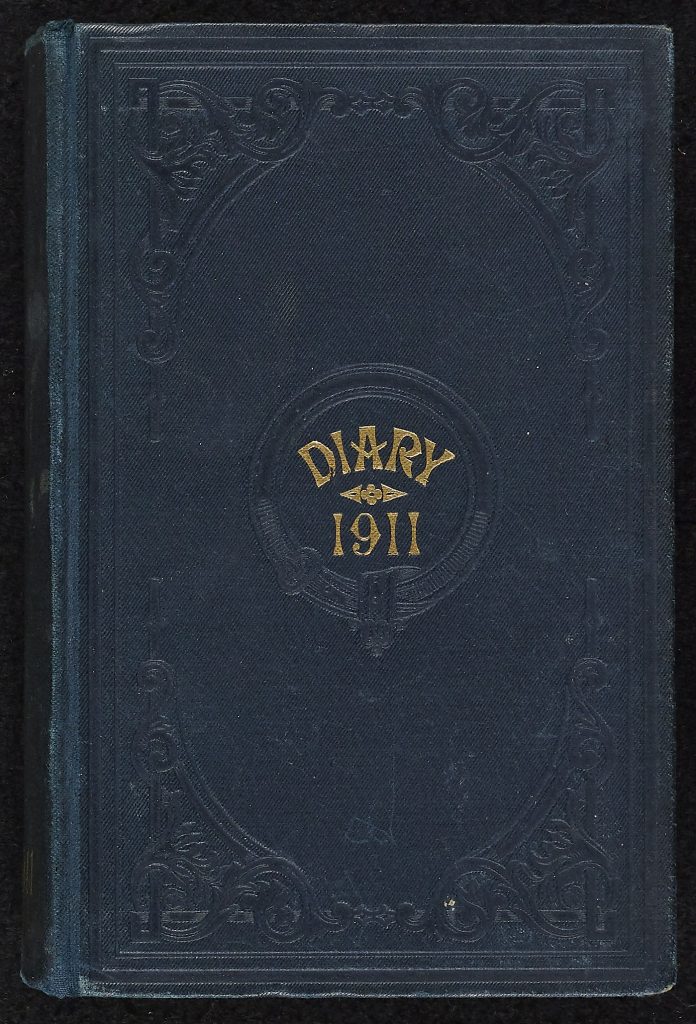
Diary of Granville Bantock, 1911: 705:462 BA16022/1
The Diaries
When Bantock passed, his diaries became the property of his son, Hamilton. They were subsequently passed from him to his daughter Fiona, and in 2016, they were deposited in the Bantock Archive held here at Worcestershire Archive and Archaeology Service. Spanning the years 1911 to 1946, they
range in size from substantial desk-diaries to small leather-bound pocket-diaries which Bantock likely carried on his person. His entries detail his daily life as a chronological record of his activities and offer a resourceful tool to researchers interested in Bantock’s life and music. While some give a complete account of the year in question, others are written with varying degrees of consistency. They rarely record his reaction to events, thoughts or emotions, but they do provide great insight into his compositional output and the progress of his work. They highlight his love of literature, art and culture, and life as a family man, as well as his notable relationships and friendships with his contemporaries, including Worcestershire born Sir Edward William Elgar. His friendship with the poet Alfred Hayes is well documented, as are his meetings with the poet and playwright John Drinkwater, novelist Francis Brett Young and musicologist Donald Tovey.
Career Development and Political Philosophy
Bantock’s diaries also help trace the development of his career as an educator, conductor, examiner and adjudicator. In 1900, Bantock became Principle of the Birmingham and Midland Institute School of Music (now the Royal Birmingham Conservatoire). In 1908 he also succeeded Elgar as Peyton Professor at the University of Birmingham – a position he remained in until 1934. These appointments afforded Bantock professional stability that gave him the freedom to compose the music he was passionate about. The years 1911 to 1919 saw him write some of his most famous works. Hebridean Symphony – the most renowned of his Hebrides-inspired pieces – is referenced often in his diaries. His magnum opus the choral epic Omar Khayyám – though composed prior to 1911 – is also mentioned. In 1912, Bantock wrote a short choral work, They that go down to the sea in ships ‘in memoriam’ of the Titanic disaster.
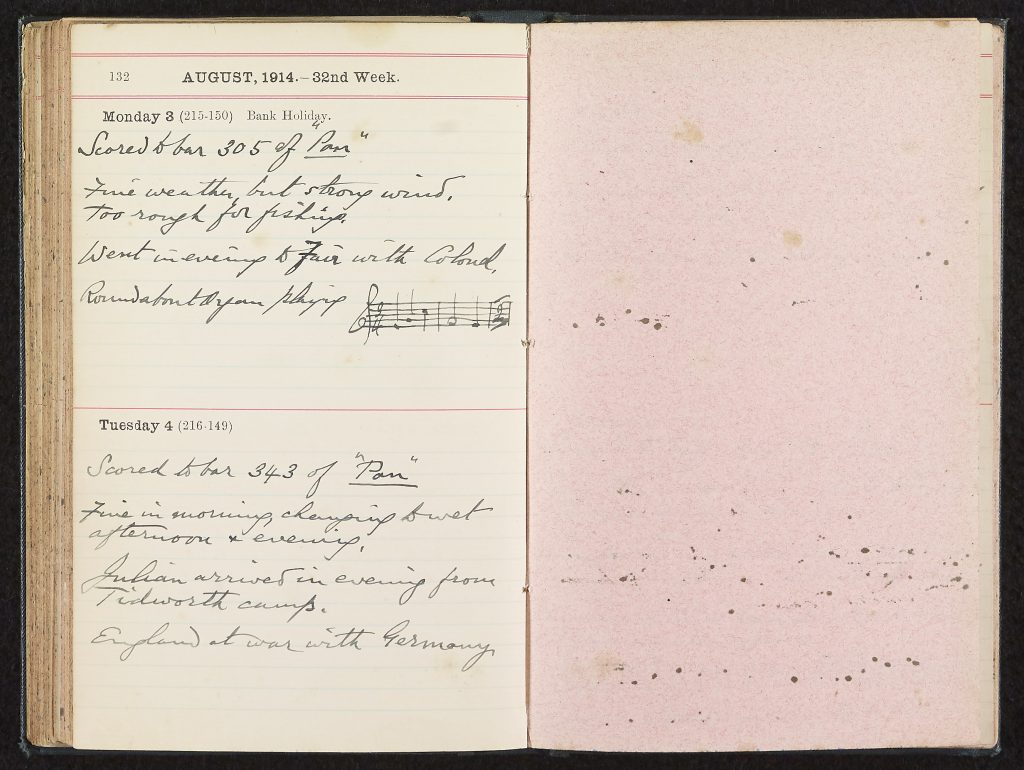
Sketches of music bars for ‘Pan’, Diary of Granville Bantock, 1914: 705:462 BA16022/4
Also, during this period, Bantock became a public supporter of Socialism. In a 1913 entry he records being asked by Labour Party founder James Keir Hardy to ‘write a Labour March and Song for the Labour Coming of Age Conference. ‘Will see what I can do’, he muses. On Saturday 11th April 1914, Bantock conducted the performance of his Festival March and Song of Liberty at the 21st Independent Labour Party Conference in Bradford. Four months later, and three days before his 46th birthday, he notes the start of the First World War. ‘England at war with Germany’.
The War Years
The war years (1914 – 1918) saw Bantock focus his attention on Celtic and Eastern influenced songs and other works. We can see from his 1914 diary, this was a year he was primarily concerned with writing his Choral Ballet, The Great God Pan (1920). Within his August entries are sketches of music score for Pan. It appears Bantock thought little about the war, and life carried on as normal as far as his diaries are concerned. Despite mention of his son Angus’ involvement in active service, the war isn’t mentioned again until a series of entries detailing its end in 1918 when he notes ‘news of the Kaiser’s abdication’ and the firing of maroons ‘announcing the signing of armistice and peace’.
Next week, the diaries of the 1920s shed light on Bantock’s most productive period of songwriting. As his diaries progress, they begin to provide fuller accounts of his world-wide travels and busy work schedules as a conductor, accompanist and examiner; and give further insights into his impressive friendships and political alliances. Stay tuned!
The diaries of Granville Bantock are available to research. Please submit an enquiry at ArchiveEnquiry (worcestershire.gov.uk) or speak to someone on the desk if you would like to enquire about viewing these records. Transcriptions of many but not all are also accessible on CD in our Self-Service Area.


Post a Comment