A brief history of Worcestershire Bankruptcy records
- 11th June 2025
Amongst the County Court records held with us there are Bankruptcy papers dating from the late 19th to early 20th century. They provide a fascinating insight into the lives of those involved, their circumstances, personal effects, relationships and the challenges that they faced. In the first of two blogs, we outline the history of Bankruptcy, with some examples from our archives.
As early as 1542 the Bankruptcy process was formalised. In the Croome archive, belonging to the Coventry family, there are examples of Commissions of Bankruptcy, signed by the Lord Keeper, Thomas Coventry. The one dates from the early 17th century.
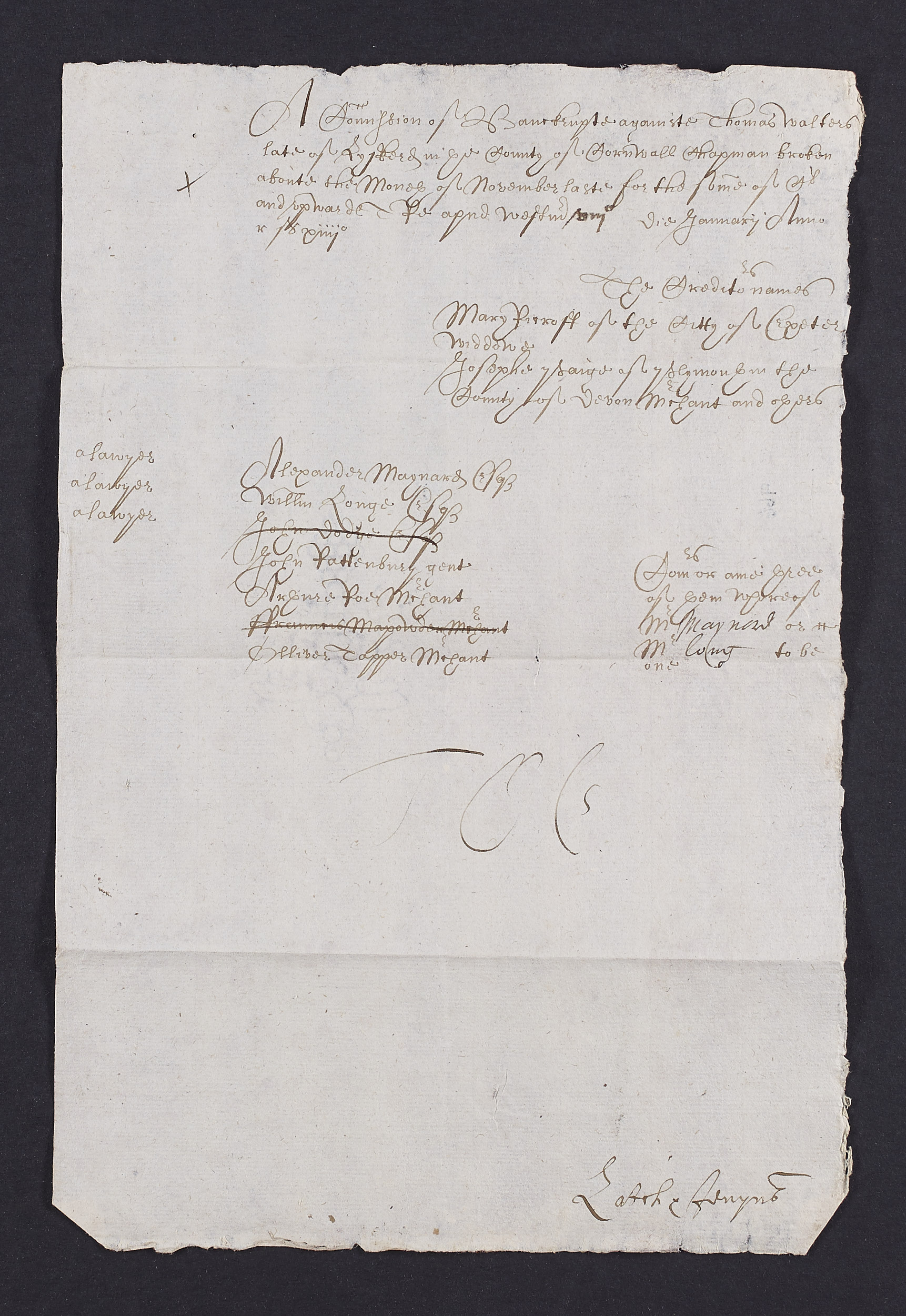
A Commission of Bankrupt for a Thomas Walters of Liskeard, Cornwall. C1638/9 Finding No: 705:73 BA14450/376 which reads:
‘A Commission of Bankrupte against Thomas Walters late of Lyskerd in the County of Cornwall, Chapman [Trader] broken aboute the Money of November laste for the sume of 4s [shillings] and upwardes P[e]r ap[e]nd Westm[inster]’.
Dated the 8th day of January 1638/9 [Regnal Year: 14 Chas I].
The document lists the creditors to whom Thomas owed money:
‘Mary Rycroft of the Citty of Exeter Widdowe and Josephe paige of Plymouth in the County of Devon M[e]r[c]hant and o[th]e[r]s’. It is signed by ‘Alexander Maynard Esq., William Longe Esq., John Rattenbury gent., Anguse Roe M[e]r[c]hant, Olliver Tapper M[e]r[c]hant’ who were presumably commissioners and it is initialled by Thomas Coventry.
Bankrupts were defined as insolvent persons engaged in trade or business. Until the Bankruptcy Act 1861, a distinction was maintained between Insolvent debtors and bankrupts.
To qualify for bankruptcy, you had to be a trader or skilled craftsmen. People sometimes gave misleading descriptions of their occupations so they could qualify as a trader. On documents the term ‘dealer or chapman’ appear. The 18th century example below, lists John Tilley (formerly of the Parish of Bloomsbury, London, but now of Stourbridge) as a glass seller, dealer and chapman.
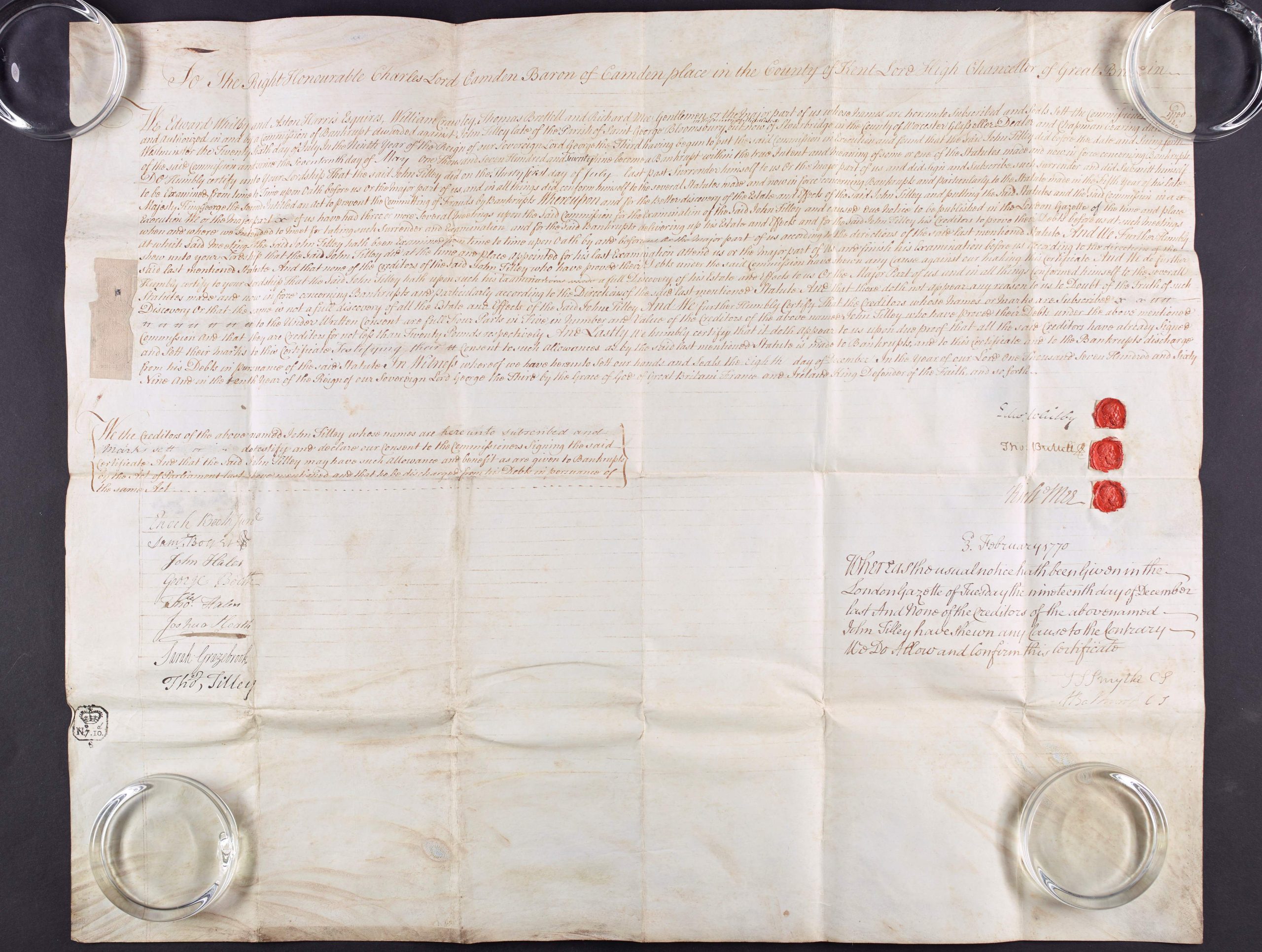
Certificate of Commissioners of Bankruptcy awarded against John Tilley late of the parish of St. George, Bloomsbury [London], Middlesex, but now of Stourbridge [West Midlands], glass seller, dealer and chapman. Finding No: 899.749 BA8782/59/26
In the Archives we have petitions, oaths and schedules for Insolvent Debtors. Johanna Adams, Widow, was imprisoned for debt and petitioned the Mayor of Worcester for release under the Acts for the Relief of Insolvent Debtors. It details her personal possessions and estates, including lands owned that passed to her from her late husband. Johanna stated that she is unable to qualify their value at the time.
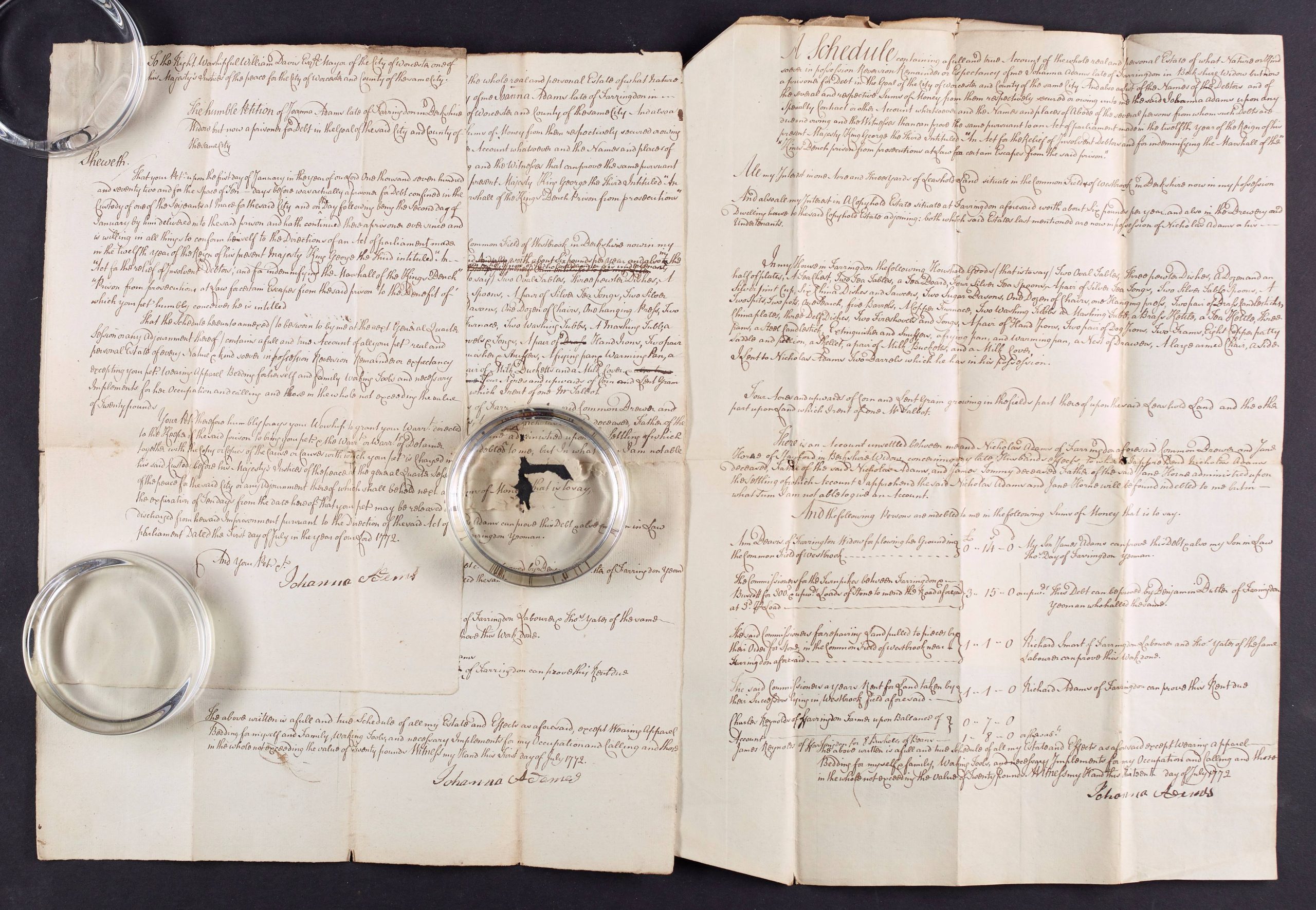
Petition, oath and schedule of goods for Insolvent Debtor Johanna Adams. Insolvent Debtors could be imprisoned for debt, and their schedule listed their lands and property (excluding wearing apparel, bedding and working tools and include debts owed to the debtor). They could, as in the case of Adams to the Mayor of Worcester, petition for their release under the Acts for the Relief of Insolvent Debtors. c1769 Finding No: 496.5 BA9360/A8/Box 2a/12/1-2
Creditors could petition for a bankruptcy order to be made against an individual debtor. All creditors would have a claim to any assets left, and the court would order how these were to be distributed.
Partnerships of individuals could declare themselves bankrupt, but companies were not covered until after 1844.
From 1861 Insolvent debtors could apply for bankruptcy even if they were not traders. Imprisonment for debt ended in 1869.
To avoid misinformation and slander Bankruptcy cases were reported in the London Gazette. The Gazette website can be searched by name of bankrupt or insolvent debtor.
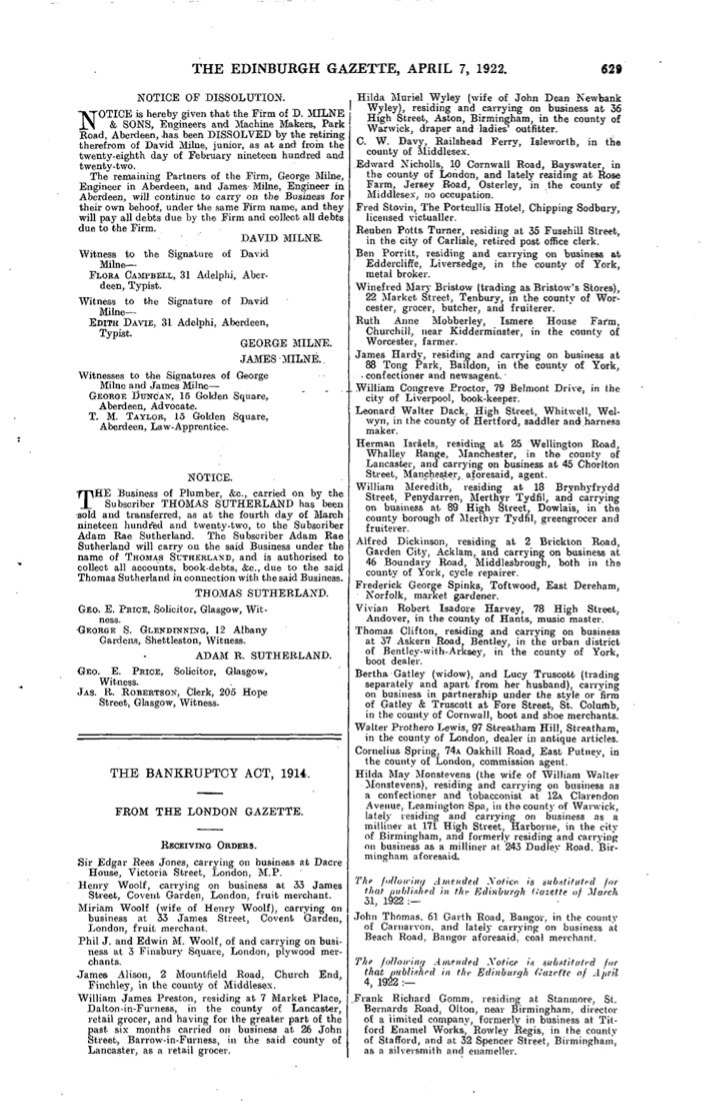
A list of receiving orders for Bankruptcy, in the London Gazette, reported in the Edinburgh Gazette for 7th April 1922
From 1842 district bankruptcy courts were established. Worcestershire Archives holds bankruptcy registers for Worcester (1870-1952), Stourbridge (1844-1956) and Great Malvern (1885-1915) and individual case files for Kidderminster (1919-1928) and Stourbridge (1920-1926).
In our next blog, we will explore some individual case files to demonstrate the difficulties families and businesses faced following the terrible upheaval of the First World War.
Please note that some Bankruptcy records under 100 years old are closed to the general public under the Data Protection Act (2018).


Post a Comment